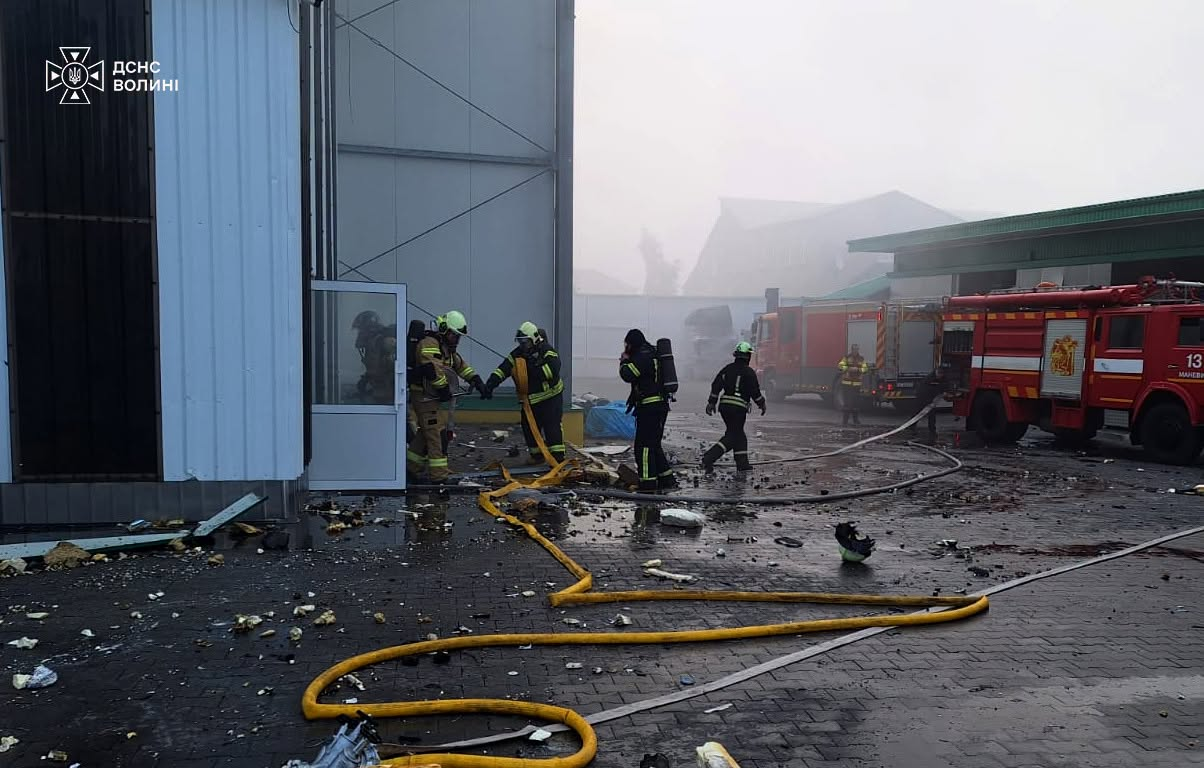
Russian drones struck a Polish-owned food-processing factory in western Ukraine on Friday, 16 October, killing one person and injuring eight others. The attack hit a facility belonging to Ahrofrukt LTD, part of Poland’s Polko Group, in the Volyn region bordering Poland, forcing the company to suspend operations and raising fresh concerns about the security of Polish businesses operating in Ukraine.
The attack occurred in the town of Manevychi during a large-scale Russian drone assault on western Ukraine that also damaged energy infrastructure, disrupted electricity supplies and struck other commercial facilities.
The Volyn Regional Military Administration confirmed that one person died and eight were injured at the Ahrofrukt facility. Its initial statement said a fire had broken out and emergency crews were working at the scene.
- Find more news from Poland on our Homepage .
Later on Friday, regional authorities confirmed that firefighters had extinguished the blaze and that an earlier concern about a possible ammonia leak had been resolved. Officials said there was no danger to nearby residents from the chemical.
Sławomir Polkowski, co-owner of Polko Group, confirmed the attack in comments to the Polish Press Agency (PAP), saying the extent of the damage remained unclear and that production had been temporarily halted.
The company is providing assistance to the deceased person’s family and those injured.
There is no evidence that Russian forces specifically selected the facility because of its Polish ownership. The attack occurred on Ukrainian territory as part of a broader Russian assault on civilian and critical infrastructure.
Polish group suspends production and assists victims
Ahrofrukt is part of Polko Group, a Polish-owned business with interests in the production, processing and export of fruit.
The Ukrainian operation has been active since 2001 and specialises in organic berries, working with local farmers in the Volyn region and supplying markets that include Poland.
Its products form part of a cross-border agricultural supply chain involving Ukrainian growers, processing facilities and international customers.
According to PAP’s interview with Sławomir Polkowski, the strike occurred in the morning when only part of the factory’s workforce was present.
Polkowski said firefighters and emergency personnel initially prevented access to the damaged buildings because of the fire.
As a result, the company could not immediately establish the full extent of the destruction or calculate its financial losses.
Operations were suspended while emergency services responded to the incident and the company began assisting the people affected.
Polkowski also noted that attacks on industrial and refrigerated-storage facilities have occurred elsewhere in Ukraine, including locations far from the front line.
The latest incident demonstrates the vulnerability of civilian businesses operating in a country subjected to continuing Russian aerial attacks.
The nationality of the person killed and those injured has not been publicly established. No verified information indicates that Polish citizens were among the casualties.
Fire extinguished after emergency crews tackle ammonia leak
The strike caused a fire at a warehouse building on the factory premises.
Emergency crews initially reported that the blaze had been contained but not completely extinguished, with firefighting continuing while the possibility of further Russian drone attacks complicated their work.
There was also concern about ammonia used at the facility, prompting local authorities to issue precautionary advice to residents.


Volyn’s acting regional governor, Roman Romaniuk, subsequently said the main ammonia storage tank had not been damaged and that there was no threat to the surrounding community.
A later account from the Ukrainian State Emergency Service, reported by Ukrinform, provided a more specific assessment: specialists identified a small ammonia leak and took immediate action to contain it.
The emergency service said no concentrations above permitted limits had been detected outside the facility.
Firefighters also confirmed that they had extinguished the warehouse-roof fire, although further work was needed to clear and cool damaged structures.
The two official accounts differ over whether a leak occurred, but both indicate that there was no continuing hazardous ammonia exposure beyond the site.
The final extent of the factory’s structural damage has not been publicly quantified.
Russian drones strike infrastructure across Volyn
The attack on Ahrofrukt formed part of a much larger assault on the Volyn region, which shares a border with Poland.
The regional military administration reported that approximately 20 Russian jet-powered attack drones had been directed towards Volyn during the initial overnight and morning attacks.
Civilian businesses and critical infrastructure were damaged.
At 08:00 local time, approximately 370,000 electricity customers were without power. By late morning, that figure had fallen to around 270,000 as repair crews restored some connections.
The disruption also affected Lutsk, Volyn’s regional capital, where authorities warned that electricity supplies might take considerable time to restore.
Emergency support points were brought back into operation to assist residents without electricity.
Russian attacks continued later on Friday.
In Kovel, a customs terminal was struck, and approximately ten lorries with semi-trailers caught fire. Regional officials reported one additional person injured in the later attacks.
A foreign-invested business in Lutsk was also struck again, according to later statements from the Volyn regional administration.
These were separate incidents from the attack on Ahrofrukt in Manevychi. The additional injury reported in Kovel should not be added to the eight people injured at the Polish-owned facility.
The wider strikes illustrate the scale of Russia’s ongoing attacks on transport, energy and commercial infrastructure in western Ukraine.
Attack highlights risks to Polish commercial interests in Ukraine
Poland has been one of Ukraine’s most important political, military and economic partners since Russia launched its full-scale invasion in February 2022.
The two countries share extensive commercial links, including agricultural trade, food processing, transport and logistics.
Polish companies have continued operating in Ukraine despite the security risks, while Ukrainian businesses depend on connections through Poland to reach European markets.
For businesses such as Ahrofrukt, Russian attacks can have consequences extending beyond damaged buildings.
Suspended production can disrupt employment, reduce purchases from local farmers and interrupt deliveries to customers abroad.
However, the immediate financial consequences for Polko Group cannot yet be established because the company has not completed its damage assessment.
The attack also demonstrates that Ukraine’s western regions, despite their distance from the principal land front lines, remain vulnerable to long-range Russian weapons.
Manevychi lies in Ukrainian territory roughly 100 kilometres from the Polish border, according to PAP.
There is no indication that the drones crossed into Poland during this particular strike, and the attack should not be described as an assault on Polish territory or NATO.
Nor has evidence emerged that the factory’s ownership was a factor in Russia’s choice of targets.
What happens next?
The immediate priority remains support for the casualties and their families, followed by an assessment of the factory’s condition.
Polko Group has not announced when production might resume.
It remains unclear whether the damaged premises can be repaired quickly or whether the company will face a more prolonged interruption to its operations.
The identities and nationalities of those killed or injured have not been made public, and no specific Polish government assistance arrangement had been independently confirmed at the time of this report.
For Poland, the attack illustrates a direct economic connection to the human and material consequences of Russia’s continuing war.
A business owned by Polish investors, operating within Ukraine’s civilian food industry, has suffered a fatal attack. Its employees, suppliers and customers now face the consequences.