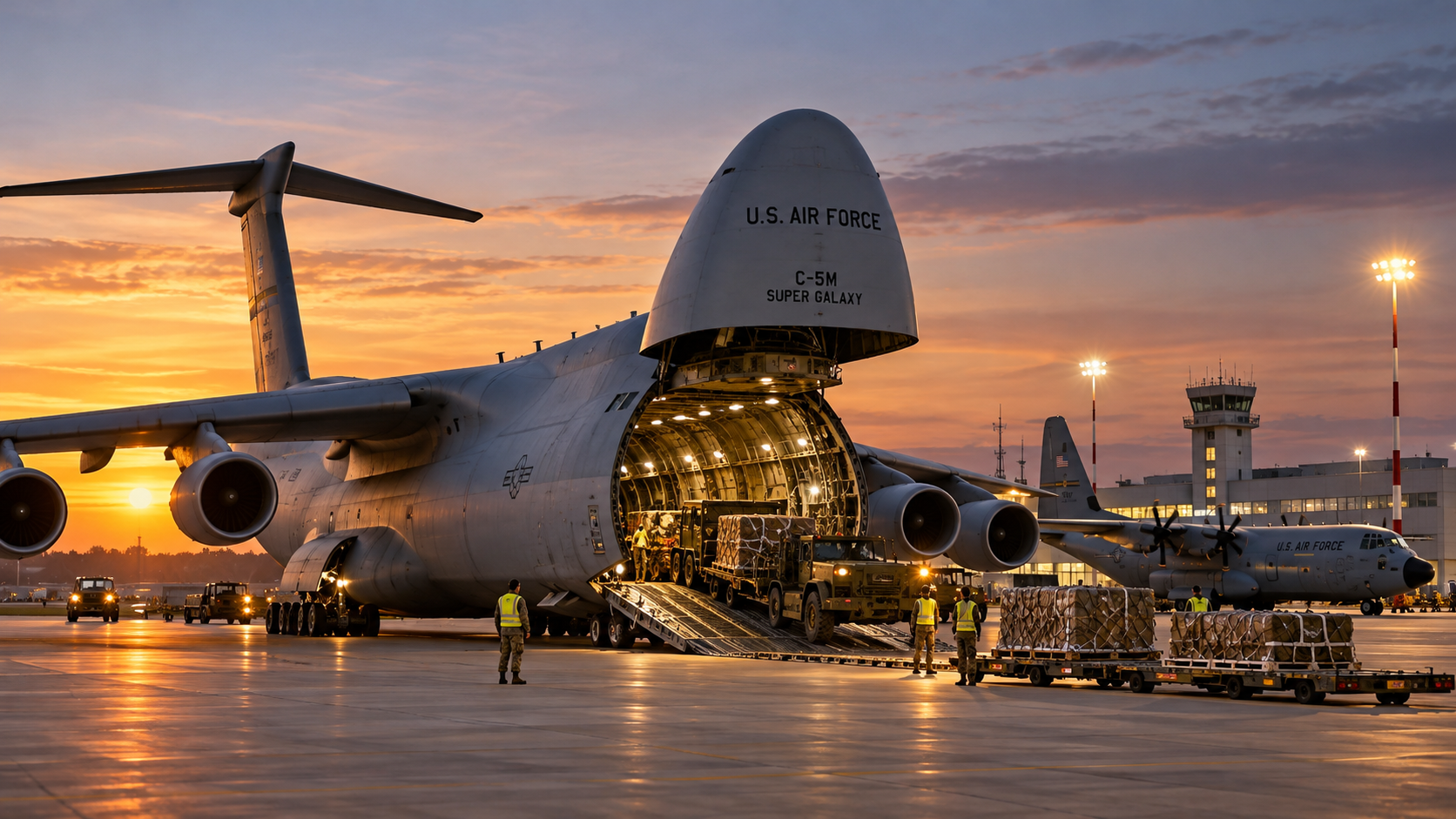
Poland has signed a construction contract worth approximately PLN 539 million (€125 million) to expand military infrastructure at Wrocław Airport, creating a logistics hub capable of handling some of the largest transport aircraft operated by the United States Air Force. The project will include seven dedicated aircraft parking positions, new taxiways and support facilities, strengthening Poland’s capacity to receive American military personnel and equipment.
The agreement was signed on 14 October by the Regional Infrastructure Authority (RZI) in Wrocław, a Polish military infrastructure agency, and construction company PORR. Details were made public through military and municipal reporting on 14–15 October.
The contract covers the first five of 20 planned infrastructure tasks forming part of the Wrocław-Strachowice Air Port of Debarkation (APOD), a facility intended to receive, unload and support US military air transports.
- Find more news from Poland on our Homepage .
According to Wrocław’s official municipal news service, the contracted works are scheduled to begin following the handover of the construction site, expected during the week beginning 19 October.
The project is intended to achieve the necessary certification and operational capability by 2029.
The investment forms part of the 2020 Polish-American Enhanced Defense Cooperation Agreement (EDCA), under which Poland undertook to provide infrastructure supporting the long-term presence and activities of US forces.
Seven parking positions for America’s largest military transport aircraft
The centrepiece of the investment will be two new military aircraft parking areas designed to accommodate different classes of American transport aircraft.
One will provide four positions for the Lockheed C-5 Galaxy, while the other will accommodate three C-130 Hercules aircraft.
The C-5M Super Galaxy is the largest aircraft in the US Air Force’s inventory and is designed to carry oversized military cargo across intercontinental distances.
According to the US Air Force’s official specifications, the aircraft can carry approximately 127 tonnes of cargo, including military vehicles and equipment that would be difficult to transport using smaller aircraft.
Its distinctive design allows cargo to be loaded and unloaded through both the nose and rear of the aircraft, making it particularly useful for moving large quantities of military equipment.
The C-130 Hercules serves a different purpose. It is a smaller tactical transport aircraft capable of moving troops, supplies and equipment to airfields closer to operational areas, including those with relatively limited infrastructure.
Together, the two aircraft types provide complementary capabilities for moving military equipment over long distances and distributing it within a theatre of operations.
In addition to the seven parking positions, the contract covers taxiways connecting the military aircraft areas to the wider airport infrastructure.
PORR will also construct a military fire station and a building for the airport’s duty technical officer.
The local reporting on the contract identifies the PLN 539 million figure as the gross contract value, including VAT.
The amount relates to the five tasks included in the newly signed agreement, rather than the complete 20-task military infrastructure programme.
Military construction expected to begin shortly
The agreement was signed on behalf of the military infrastructure authority by Colonel Robert Wójcik, its director in Wrocław, and on behalf of PORR by company president Piotr Kledzik.
Wójcik told Wrocław’s municipal news service that the construction site would be handed over to the contractor the following week, allowing the contracted works to begin.
The broader project will require not only building the facilities but also certifying them for use within an international airport.


In an official statement published by PORR Polska, the contractor confirmed that completion, certification and the capability to receive military aircraft are scheduled for 2029.
The company also highlighted the difficulty of carrying out construction next to an operational civilian airport.
Some work will take place in close proximity to areas used by passenger flights, requiring coordination with the airport operator and air traffic management authorities.
The military facilities are intended to operate within Wrocław-Strachowice’s existing dual-use airport rather than as a wholly separate civilian airport development.
Although the new logistics hub is being prepared for American forces, the contract does not establish that C-5 Galaxy aircraft will be permanently stationed in Wrocław.
Its principal purpose is to provide the infrastructure necessary to receive and support military transport operations when required.
Part of a wider Polish-American defence agreement
The development is one of the infrastructure commitments arising from the Enhanced Defense Cooperation Agreement signed by Poland and the United States in August 2020.
The agreement established arrangements for increasing the American military presence in Poland, supporting US deployments and developing the facilities needed for long-term defence cooperation.
Wrocław-Strachowice was specifically designated as an air port of debarkation for American military forces.
The Polish Ministry of Defence’s original explanation of the agreement identifies infrastructure and logistical support as important elements of the bilateral arrangement.
An air port of debarkation acts as an arrival and reception point for aircraft bringing personnel, equipment and supplies into a country.
For US and NATO forces operating in Central and Eastern Europe, facilities of this kind can improve the ability to receive additional units during military exercises, deployments or emergencies.
The Wrocław project is particularly relevant because the ability to land a large transport aircraft is only one requirement for an effective military airlift operation.
Aircraft also need sufficient parking space, suitably constructed taxiways, firefighting coverage, cargo-handling facilities and onward transport connections.
Poland is developing these supporting systems to make Wrocław a more capable reception point for allied military movements.
The investment does not itself announce the arrival of additional American troops or a newly assigned permanent US military aviation unit.
Wider programme includes rail links and logistics facilities
The five newly contracted tasks represent only part of the wider military development planned for Wrocław.
According to the Wrocław municipal report quoting the military infrastructure authority, the broader programme envisages cargo-handling installations, facilities for dangerous goods, accommodation and support buildings, and additional security infrastructure.
Other planned elements include logistics buildings, temporary accommodation, administrative facilities, medical support and telecommunications infrastructure.
A rail connection has already been constructed towards the military section of the airport, linking the site with the Wrocław Zachodni railway station.
However, Colonel Wójcik confirmed that the railway infrastructure inside the airport site had not yet been completed and trains were not yet using the new connection.
The rail link is intended to improve the movement of freight between air transport and the wider Polish railway network once the necessary infrastructure becomes operational.
Earlier municipal reporting placed the estimated Polish-funded military investment at approximately PLN 750 million.
That figure is a previous estimate for the wider military development, not the newly signed contract’s value. A final, updated total budget for all 20 tasks has not been independently confirmed.
Separate civilian airport expansion already completed
The military investment is taking place alongside major improvements to Wrocław’s civilian airport infrastructure.
In September, Wrocław Airport announced the completion of a separate expansion and modernisation of its operational area.
The municipal announcement published on 24 September reported that the civilian development had been completed more than two months ahead of schedule, at a cost exceeding PLN 464 million including VAT.
That project expanded the airport’s operational infrastructure and included work intended to benefit both civilian and military aviation.
The civilian investment received support from the European Union’s Connecting Europe Facility, under a programme designed partly to improve military mobility.
The Polish Centre for EU Transport Projects confirmed the EU funding arrangement for Wrocław’s dual-use airport improvements.
The civilian and military developments are separate projects with different financing arrangements and must not be treated as a single PLN 539 million investment.
Once the planned military infrastructure is completed and certified, Wrocław Airport is expected to have greater capacity to accommodate large transport aircraft and support their operations.
That would make it a more capable entry point for US military equipment and personnel moving into Poland and potentially onwards to other locations on NATO’s eastern flank.
For now, the confirmed development is the signing of the first major construction contract. The facilities are not yet operational, and the 2029 readiness target remains subject to successful construction and certification.