


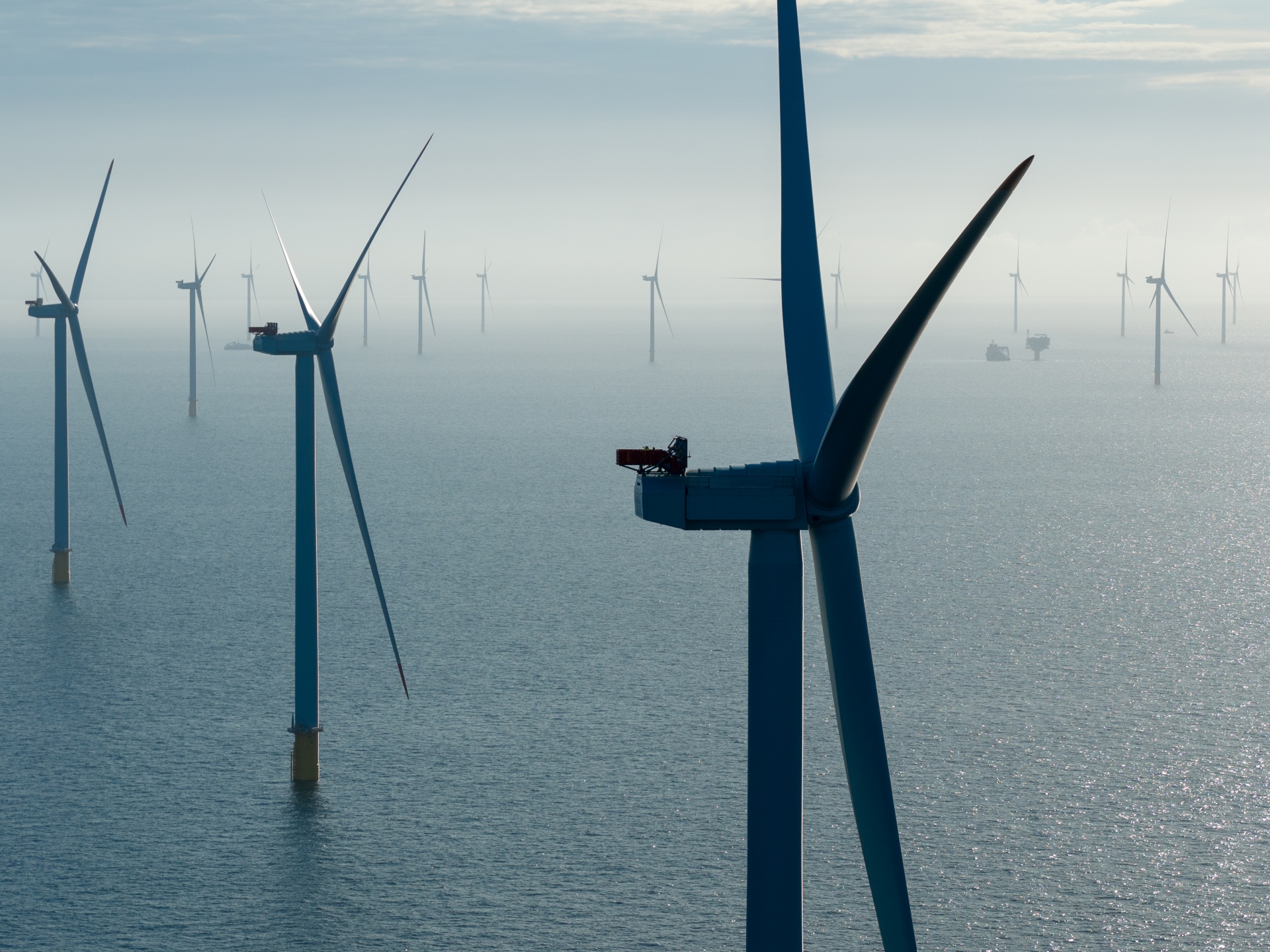
Installation of all 76 wind turbines at Baltic Power, Poland’s first offshore wind farm, has been completed, marking the end of the project’s main offshore installation campaign. The wind farm is now moving through commissioning and reliability testing, with more than one-third of its turbines already generating electricity for Poland’s national grid and commercial operation still expected later in 2026.
The project, developed by Polish energy group ORLEN and Canada’s Northland Power, is being built in the Baltic Sea off the coast near Łeba and Choczewo. Its 76 Vestas V236 turbines each have a rated capacity of 15 MW, giving the completed array an installed capacity of 1,140 MW, or 1.14 GW. ORLEN commonly describes the project as having capacity of “up to 1.2 GW”.
That distinction is worth making because the completion announced on 7 October covers turbine installation, not the completion of the entire wind farm. The turbines still have to pass commissioning tests before being formally handed to the operations team.
- Find more news from Poland on our Homepage .
According to ORLEN’s project update, each turbine undergoes a series of checks including a 240-hour reliability test. Turbines are being connected to the power system sequentially rather than waiting for the whole wind farm to finish testing.
Electricity is already reaching the Polish grid
Baltic Power generated its first electricity in July, when the first commissioned turbines began feeding power into the national system. Project operator Baltic Power said at the time that Polskie Sieci Elektroenergetyczne, Poland’s transmission-system operator, had confirmed receipt of the electricity at the onshore substation near Choczewo.
Northland said on Wednesday that more than one-third of the 76 turbines are now generating power, even though the project has not yet reached commercial operation.
Polish regulations allow generation during commissioning before the final operating licence has been granted, provided the installation has obtained the appropriate interim operational notification and complied with the applicable pre-licensing requirements.
Northland’s most recent timetable says Baltic Power remains on track for commercial operation in 2026. Its August financial update was more specific, saying commercial operations were expected in the second half of 2026. Neither project partner has announced a precise commercial-operation date.
Poland’s first offshore wind project at industrial scale
The scale of the installation campaign is unprecedented in Polish waters. ORLEN says around 7,000 people and 110 vessels participated in the offshore construction work.
The turbines themselves are among the largest commercially deployed offshore machines. Each has blades approximately 115 metres long and rises more than 250 metres above sea level at its highest point. The area swept by the blades is around 43,000 square metres.
The project also represents the beginning of a domestic offshore-wind supply chain rather than simply an imported generation asset.
More than one-third of Baltic Power’s nacelles — the structures at the top of the turbine towers containing the main generating equipment — were manufactured at Vestas’ new factory in Szczecin. ORLEN says approximately 21% of expenditure over the wind farm’s full lifecycle is expected to go to Polish companies.
Polish suppliers have been involved in areas ranging from steel structures, cables and turbine components to foundations, substations, surveying, logistics and construction. Companies named by ORLEN include Grupa Przemysłowa Baltic–Stocznia Gdańska, Smulders Polska, Protea, Enprom, Erbud and MEWO.
The permanent economic footprint will be smaller than during construction but still significant locally. Baltic Power’s operations and maintenance base in Łeba is expected to support around 100 permanent jobs, alongside demand for maintenance, transport and other local services during the wind farm’s roughly three decades of operation.
A multibillion-euro investment
Baltic Power is owned 51% by ORLEN and 49% by Northland Power. ORLEN’s financing disclosures put the project’s total financing plan at approximately €4.73 billion, including roughly €4.05 billion of capital expenditure and contingency as well as financing costs and reserves.
The project secured €3.6 billion of long-term investment loans from a consortium of 25 Polish and international financial institutions, with additional facilities also available. Project financing was designed to cover around 80% of expected capital costs, with the two shareholders providing the remaining equity.
Northland said in its latest announcement that project costs remain aligned with its original expectations.
The wind farm is supported by a 25-year contract-for-difference mechanism, providing long-term revenue support once the project is operating commercially.
Enough electricity for more than 1.5 million households
Once fully commissioned, Baltic Power is expected to generate around 4 TWh of electricity annually. The developers say that corresponds to approximately 3% of Poland’s current electricity demand and enough power for more than 1.5 million households.
That makes the project significant beyond its status as Poland’s first offshore wind farm. It introduces more than 1 GW of large-scale generation into a power system still undergoing a shift away from its historic dependence on coal.


Baltic Power also establishes infrastructure and industrial expertise that can be reused as Poland develops a wider offshore-wind sector in the Baltic Sea. ORLEN is already preparing additional offshore projects, while other developers are progressing separate Polish concessions.
For now, however, Baltic Power remains a project under commissioning rather than a fully completed operating wind farm. The installation of the final turbine closes one of the most technically demanding stages of construction, but the next milestone will be the completion of testing and the declaration of full commercial operation later in 2026.