

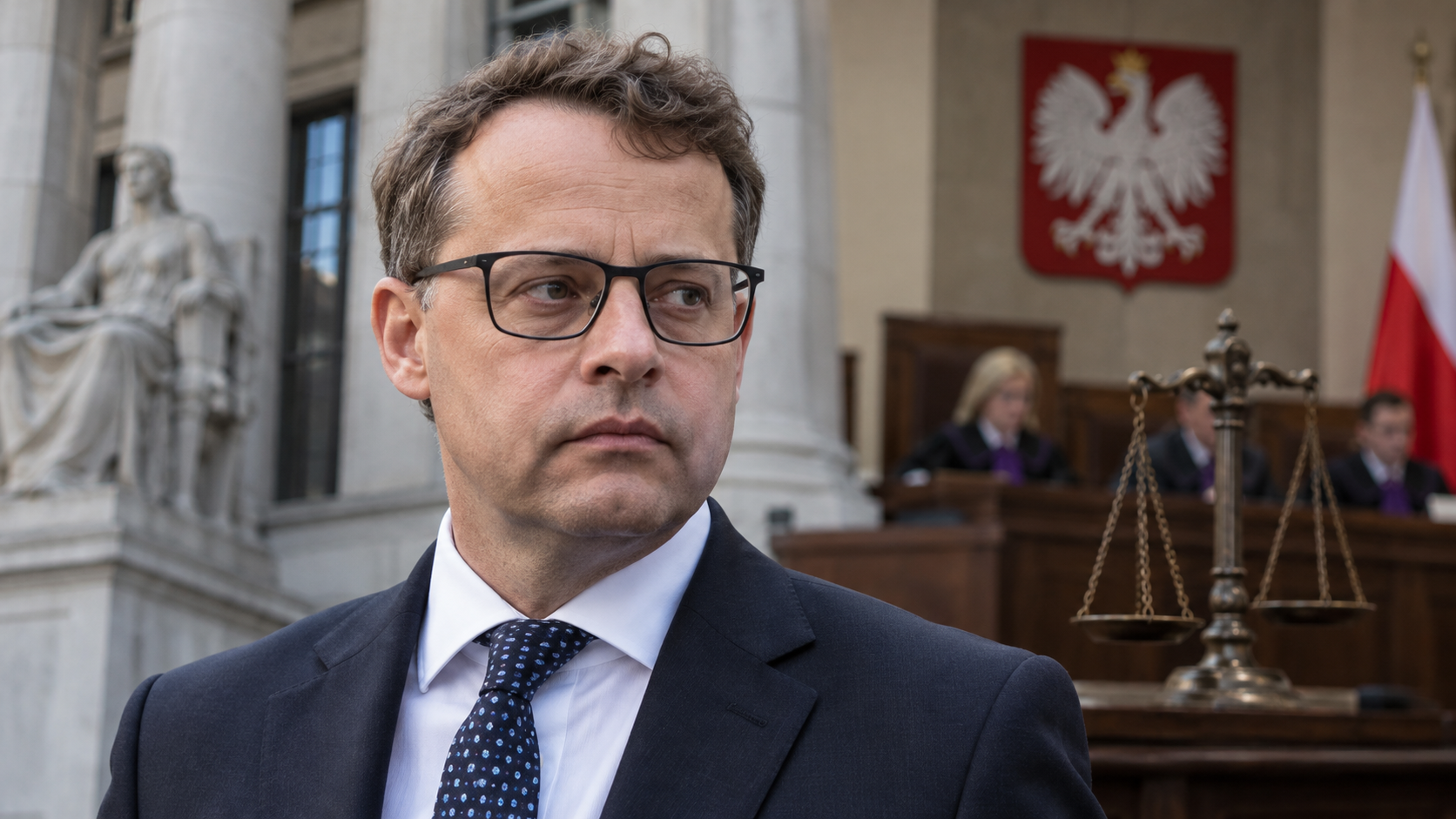
A Warsaw court has granted former deputy justice minister Marcin Romanowski safe conduct that could eventually allow him to return to Poland and take part in the Justice Fund investigation while remaining at liberty. The decision, issued on 30 September, is not final and does not currently protect Romanowski from detention: prosecutors opposed the application and immediately announced that they would appeal.
The Warsaw Regional Court issued the ruling during a hearing on Wednesday afternoon. According to a Radio Lublin report following the hearing, Romanowski’s lawyer Bartosz Lewandowski said the court also ordered that the existing pre-trial detention measure be lifted once the safe-conduct decision becomes final.
That timing is significant. Under Poland’s Code of Criminal Procedure, when a court issues safe conduct — known in Polish as a list żelazny — it lifts any pre-trial detention order, but that part of the ruling becomes enforceable only once the safe-conduct decision is final.
- Find more news from Poland on our Homepage .
Romanowski therefore cannot yet rely on Wednesday’s ruling to return to Poland without risk of detention.
Prosecutor Piotr Woźniak, who heads the Justice Fund investigation, said after the hearing that prosecutors would challenge the decision. He argued that investigators could not trust Romanowski to comply with its terms.
If the ruling survives the appeal, the safe conduct would allow Romanowski to remain free while participating in the proceedings, provided he complies with statutory conditions. These include appearing whenever summoned by a court or prosecutor, remaining at his declared place of residence unless permitted to leave and not unlawfully obstructing the investigation.
The court’s reasoning, as relayed by its spokesperson and participants in the hearing, was that securing Romanowski’s participation in the proceedings could now better serve the administration of justice than continuing methods that had so far failed to bring him before investigators.
The ruling also raises a notable legal issue because prosecutors expressly opposed granting the safe conduct.
The current wording of Article 281 of the Criminal Procedure Code says that during a pre-trial investigation safe conduct may be issued at a prosecutor’s request or in the absence of prosecutorial opposition.
Polish courts have not interpreted that provision uniformly, however. Some appellate rulings have treated a prosecutor’s objection as binding, while other courts have concluded that the judiciary retains the final power to decide. That disagreement is likely to form part of the legal dispute when Wednesday’s decision is reviewed on appeal.
Romanowski’s lawyer has also said that if the ruling becomes final, the European Arrest Warrant currently in force against his client would cease to operate because the domestic detention measure underpinning it would have been lifted.
That is the defence’s interpretation. No separate decision cancelling the European Arrest Warrant has yet been announced, so Romanowski remains wanted under the existing measures while the safe-conduct ruling is under appeal.
Romanowski served as deputy justice minister during the Law and Justice-led government and is a suspect in the long-running investigation into alleged irregularities in the Justice Fund, a state fund intended primarily to assist crime victims and support post-penitentiary assistance.
The National Prosecutor’s Office has said that investigators originally presented Romanowski with 11 charges, including alleged participation in an organised criminal group and alleged abuse of public office connected with the allocation of Justice Fund money.
Five of the original allegations involved alleged financial damage to the state totalling more than PLN 111 million. Romanowski has denied wrongdoing and has characterised the proceedings against him as politically motivated.
After Polish authorities sought his detention, Romanowski left Poland and was subsequently granted international protection in Hungary. His precise current location has since become unclear.
The application for safe conduct received by the Warsaw court in August was mailed from Tiraspol, the capital of Transnistria, the Russian-backed separatist region of Moldova.
That does not establish that Romanowski was actually staying there. His lawyer said after Wednesday’s hearing that the court found there was no confirmation of his presence in Transnistria and considered the decisive point to be that he was outside Poland.
Before the hearing, RMF24 reported that the National Prosecutor’s Office argued Romanowski’s previous conduct did not provide sufficient assurance that he would obey the conditions of safe conduct.
The ruling immediately prompted political criticism from Justice Minister and Prosecutor General Waldemar Żurek. He attacked the decision and the judge who issued it and confirmed that prosecutors would appeal. Those comments represent the government’s position and do not alter the legal status of the court’s ruling.


For now, that status remains straightforward: Romanowski has won the first-stage safe-conduct decision, but it is not final, his detention order remains operative, and the prosecution’s appeal must be resolved before the ruling can provide him with protection to return to Poland at liberty.