

Warsaw spent decades rebuilding itself.
Now the international travel press increasingly seems to be rebuilding its idea of Warsaw too.
At the beginning of 2026, The New York Times placed the Polish capital second on its annual 52 Places to Go list, behind only the United States’ 250th-anniversary destinations.
- Find more news from Poland on our Homepage .
By July, the newspaper had returned to see what was actually happening on the ground.
Its assessment began simply: “Change is afoot in Warsaw.”
The Times pointed in particular to the Museum of Modern Art, the remade central square beside it and an underground electronic-music scene gaining international recognition.
All three tell part of the same story.
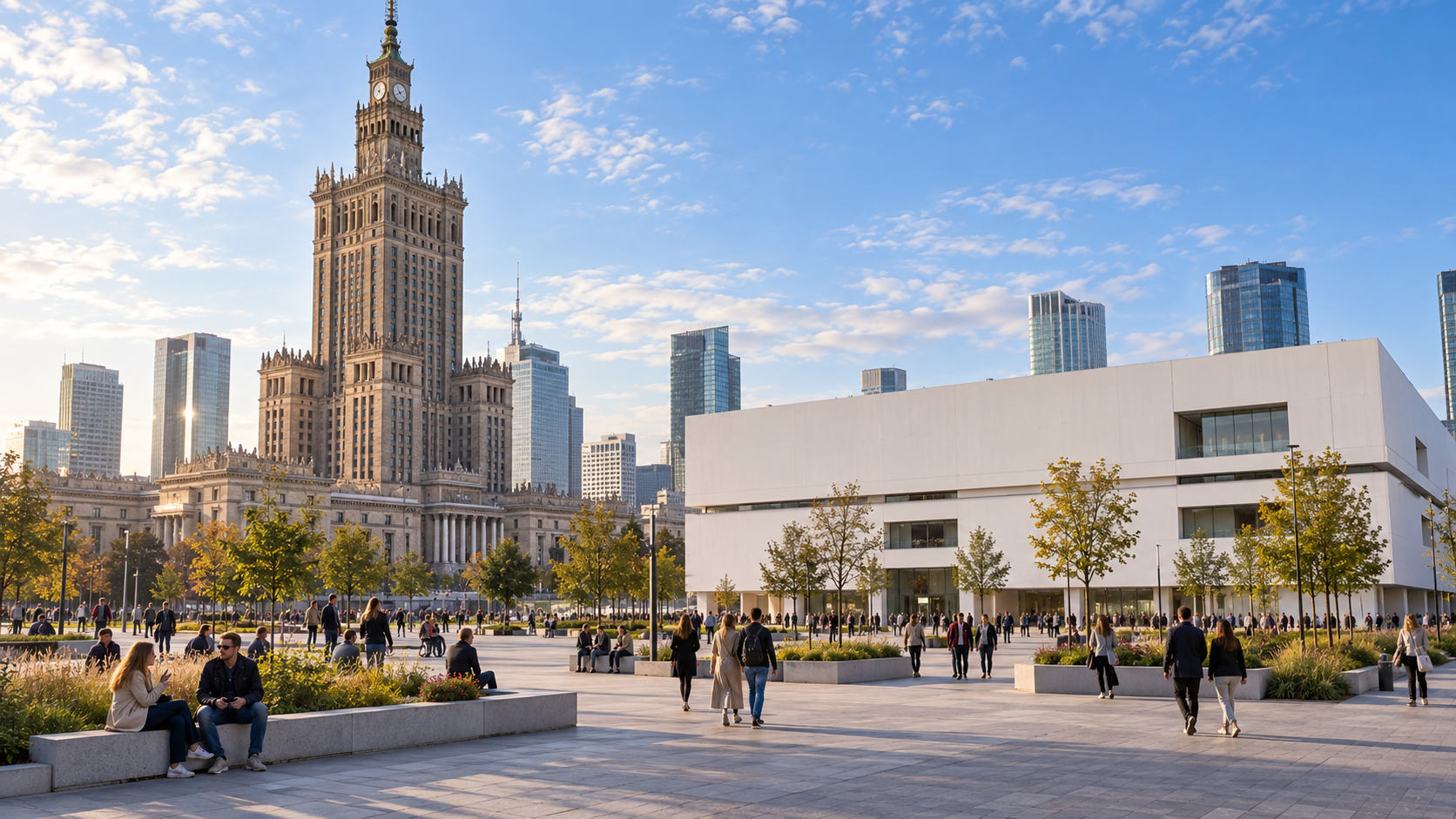
For decades, the vast space around the Palace of Culture and Science was one of Warsaw’s strangest urban environments: centrally located but dominated by concrete, roads, parking and enormous empty areas inherited from the post-war redevelopment of the city.
That landscape is changing.
The new permanent home of the Museum of Modern Art opened in October 2024 on Plac Defilad. The institution says its new building had already welcomed more than 800,000 visitors by the beginning of 2026.
The building is deliberately contemporary: a restrained white structure designed by Thomas Phifer and Partners facing the monumental Palace of Culture.
The contrast is difficult to miss.
One building represents the Stalinist transformation of Warsaw after the Second World War; the other is part of a 21st-century effort to remake the same central space around culture and public life.
That process continued in June 2025 with the opening of Plac Centralny.
Warsaw replaced part of the former concrete expanse with trees, planting, seating and pedestrian space while tracing the outlines of streets and buildings that stood there before the wartime destruction of the city.
It is exactly the kind of intervention international visitors increasingly notice.
Warsaw has not erased its layers.
The pre-war street plan, Stalinist Palace of Culture, new art museum and contemporary public square now occupy essentially the same view.
The New York Times also looked beyond architecture.
Its July follow-up highlighted Warsaw’s electronic dance music scene, reporting that the capital’s clubs are becoming increasingly established stops on the international circuit.
You May Also Be Interested In
That detail matters.
International perceptions of Warsaw were once dominated by history — wartime destruction, communist reconstruction and the extraordinary restoration of the Old Town.
Those things remain essential to understanding the city.
But they no longer describe everything happening there.
Contemporary art, restaurants, Vistula river life, new architecture and nightlife increasingly sit beside the museums, memorials and reconstructed streets that shaped earlier visitor itineraries.
The result is not a Warsaw that has abandoned its past.
It is a city increasingly comfortable allowing several eras to occupy the same space.
That may be why The New York Times’ original 2026 assessment argued that a capital long regarded as practical rather than magnetic now deserved to be looked at again.
By the middle of the year, its reporters had done exactly that.
They found a city still changing.