


Poland Launches First New Frigate in Major Naval Modernization Drive
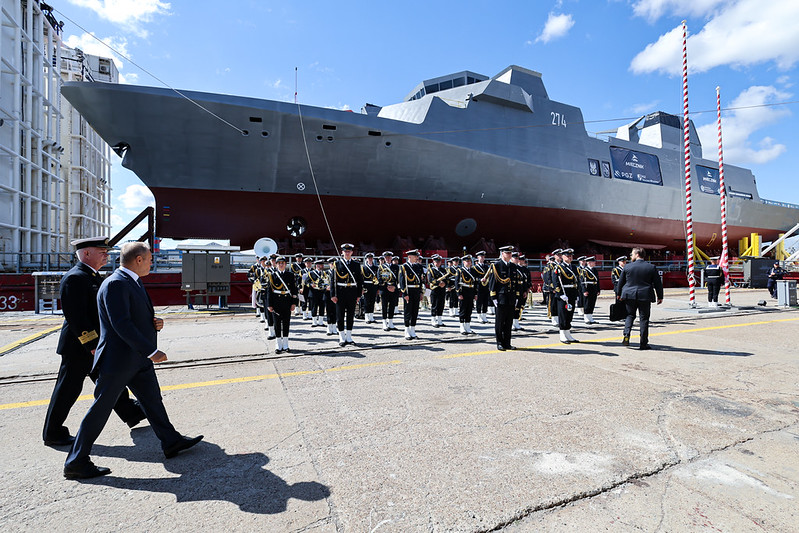
Poland has christened and launched ORP Wicher, the first of three multirole frigates that will form the backbone of the country’s future surface fleet, in a major step toward strengthening Baltic Sea security and NATO maritime defenses.
President Karol Nawrocki and Prime Minister Donald Tusk attended Tuesday’s naming ceremony at PGZ Naval Shipyard in Gdynia, where the warship was built under the Miecznik, or Swordfish, modernization program. The vessel was formally launched Thursday in an operation involving its transfer and controlled lowering into the water from a semisubmersible barge. Shipyard officials described the process as among the most demanding engineering operations undertaken by Poland’s shipbuilding industry.
The 15 billion-złoty, or about 3.5 billion-euro, program will deliver three frigates — ORP Wicher, ORP Burza and ORP Huragan — to replace Poland’s two aging Oliver Hazard Perry-class ships, built in the 1970s and transferred from the U.S. Navy in 2000 and 2002. The project is scheduled for completion by the end of 2031.
- Find more news from Poland on our Homepage .
Tusk called the arrival of Wicher a historic moment and said Poland was becoming a Baltic maritime power. He argued that modern naval capability would make any potential attacker reconsider hostile actions against the country.
“Steel, guns, engines, modern technologies and the best radars weigh a thousand times more and mean a thousand times more than slogans and political catchphrases,” Tusk said during the ceremony. He said maintaining security required long-term cooperation across political divisions.
The prime minister linked the frigate program to wider defense initiatives, including the East Shield border-defense project and Poland’s drone force. He said defense policy must remain a shared national priority regardless of which party holds power.
Tusk said the idea for the frigates emerged during his earlier term in office in 2013 and 2014, but that successive governments would be needed to ensure Wicher, Burza and Huragan enter service. He also stressed the importance of safeguarding the Baltic Sea and its critical subsea infrastructure.
Nawrocki described the frigate program as a milestone and a breakthrough after decades in which Poland’s Navy was underfunded. He said the 2021 contract, which gave the program its practical form, preserved Polish control over engineering, logistics, design capacity and systems integration while relying on cooperation with allied partners.
The president said the project should serve as a model for the future development of Poland’s armed forces. He pledged to support its completion regardless of future parliamentary election outcomes, saying the three ships must ultimately protect Polish waters.
Agata Ziemiańska, wife of Navy Inspector Vice Adm. Jarosław Ziemiański, served as the ship’s sponsor and performed the traditional christening, breaking a bottle of champagne against Wicher’s bow. She then gave the vessel its name, invoking safe voyages and the reputation of Polish shipbuilders and sailors.
The frigates are based on Britain’s Arrowhead 140 design, developed by Babcock and modified for Polish military requirements. The ships, which are more than 140 meters long, are being built by a PGZ-led consortium in cooperation with Babcock and other foreign partners.
The first vessel is designed for escort missions, air defense and fleet protection. It is expected to carry British CAMM and CAMM-ER surface-to-air missiles, naval guns and anti-ship missiles capable of striking targets more than 200 kilometers away, according to Notes from Poland.
Lt. Cmdr. Grzegorz Galikowski, Wicher’s commanding officer, said the ship represented a “quantum leap” for the Polish Navy’s capabilities in the Baltic. He cited its sensors, weapons and command system as key strengths and described the frigate as being among the top tier of vessels in its class.
Galikowski said Wicher will be able to conduct anti-submarine warfare, engage surface targets, provide air defense and counter asymmetric threats such as drones. The ship will also be able to support special forces operations, he said.
The commander said the frigates would give Poland a capability it previously lacked by serving as command platforms for Polish or multinational headquarters. Such capacity could be particularly significant during NATO operations in the Baltic Sea.
He noted that Poland faces conventional risks from Russia’s heavily armed Baltic Fleet in the Kaliningrad region, but said the Navy is also increasingly focused on asymmetric threats to critical infrastructure. Poland has responded to those concerns through Operation Bay, which is intended to help protect maritime infrastructure.
The second Miecznik-class ship began construction in May 2025, while work on the third started in April. Alongside the frigates, Poland is pursuing a broader naval buildup that includes the acquisition of three Swedish A26 stealth submarines from Saab in a deal valued at about 4.5 billion euros.
The Wicher launch underscores Poland’s attempt to build a stronger regional role at sea as the Baltic becomes increasingly central to European security following Russia’s full-scale invasion of Ukraine in 2022.