


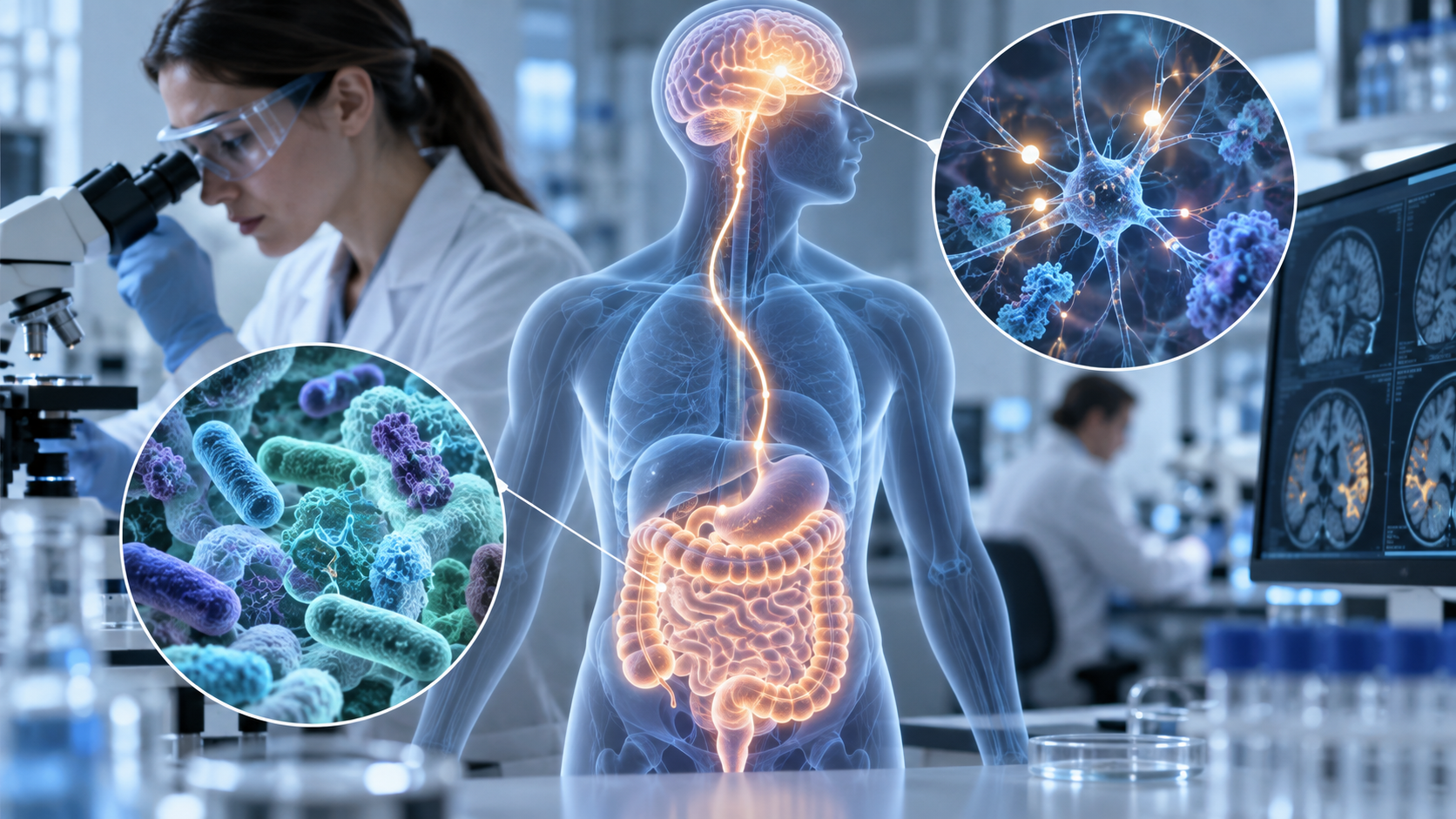
Polish researchers have identified bacterial proteins in the human gut that may help explain a possible biological link between the microbiome and neurodegenerative diseases including Parkinson’s and Alzheimer’s.
The team, led in part by researchers from Wrocław University of Science and Technology, analysed so-called functional amyloids produced by gut bacteria and found that some resemble the kinds of protein structures associated with neurodegeneration.
Their results were published in npj Biofilms and Microbiomes in a study titled “Aggregation in gut: on the link between neurodegeneration and bacterial functional amyloids”.
- Find more news from Poland on our Homepage .
The work does not show that gut bacteria cause Parkinson’s or Alzheimer’s, and it does not identify a treatment.
Instead, it offers a possible mechanism that could help researchers understand how processes in the gut might influence the brain.
What are amyloids?
Amyloids are protein structures that can form highly ordered aggregates.
In human disease, abnormal amyloid accumulation is strongly associated with several neurodegenerative conditions.
In Alzheimer’s disease, for example, amyloid-beta plaques and tau protein tangles are among the best-known pathological features. Parkinson’s disease is associated with aggregates of alpha-synuclein.
But amyloids are not unique to humans or to disease.
Many bacteria produce their own functional amyloids, which can serve useful biological roles, including helping to stabilise bacterial biofilms.
The Polish-led study used computational analysis to identify such bacterial amyloids across the human gut microbiome and investigate how they might interact with human biology.
Hundreds of potential bacterial amyloids identified
The researchers identified hundreds of candidate bacterial functional amyloids across a broad range of gut bacteria.
Their analysis suggested that these bacterial proteins may interact with human proteins involved in inflammation, cellular transport and signalling — processes already known to be important in the relationship between the microbiome and its human host.
The study authors stress that these are computationally predicted interactions rather than proof of a disease-causing process inside patients.
That distinction is important.
The results generate a biological hypothesis that can now be tested experimentally, rather than establishing that bacterial proteins trigger neurodegenerative disease.
Strongest signal seen in Parkinson’s datasets
One of the most notable findings came from datasets involving people diagnosed with Parkinson’s disease.


The researchers found a higher relative abundance of bacterial functional amyloids in two of the three Parkinson’s datasets they analysed.
That does not establish cause and effect.
People with Parkinson’s disease can have changes in diet, medication, gut function and microbiome composition, any of which could influence bacterial populations.
The study therefore describes the link as tentative and explicitly says experimental validation is still needed.
The picture for Alzheimer’s disease was less clear.
According to material from Wrocław University of Science and Technology, the researchers did not find a statistically significant overall increase in bacterial functional amyloids in the Alzheimer’s datasets compared with controls.
That means the study should not be read as showing the same association for Alzheimer’s as it did for Parkinson’s.
A possible gut-brain pathway
The wider scientific interest lies in the so-called gut-brain axis — the network of biological signalling between the digestive system and the central nervous system.
Researchers around the world are increasingly examining whether changes in the gut microbiome may influence inflammation, metabolism and neurological processes.
In this study, bacterial amyloids are one possible piece of that puzzle.
Because some microbial amyloids have structures similar to disease-associated protein aggregates, scientists are interested in whether exposure to them could influence human protein behaviour, immune responses or inflammation.
The new study does not prove that such a process occurs in people.
Its value is in identifying specific bacterial proteins and biological pathways that can now be studied in laboratory and clinical research.
International team led partly from Wrocław
The paper lists researchers from several institutions, including Wrocław University of Science and Technology, the Sano Centre for Computational Medicine in Kraków, the Małopolska Centre of Biotechnology at Jagiellonian University and the Max Planck Institute for Multidisciplinary Sciences in Germany.
The authors include Alicja Wojciechowska, Jakub Wojciechowski, Kinga Zielińska, Johannes Söding, Tomasz Kościółek and Małgorzata Kotulska.
Wrocław University of Science and Technology’s research database records the paper as a 2026 article in npj Biofilms and Microbiomes, volume 12, article 127.
The study was originally published in May, with its final bibliographic registration completed later in the summer.
Science in Poland highlighted the work again in August as part of wider reporting on Polish research into gut bacteria and neurodegenerative disease.
For now, the finding is best understood as a new mechanistic clue rather than a medical breakthrough: gut bacteria appear capable of producing amyloid proteins with properties that may be relevant to neurodegeneration, particularly Parkinson’s disease, but the biological consequences still need to be demonstrated experimentally.