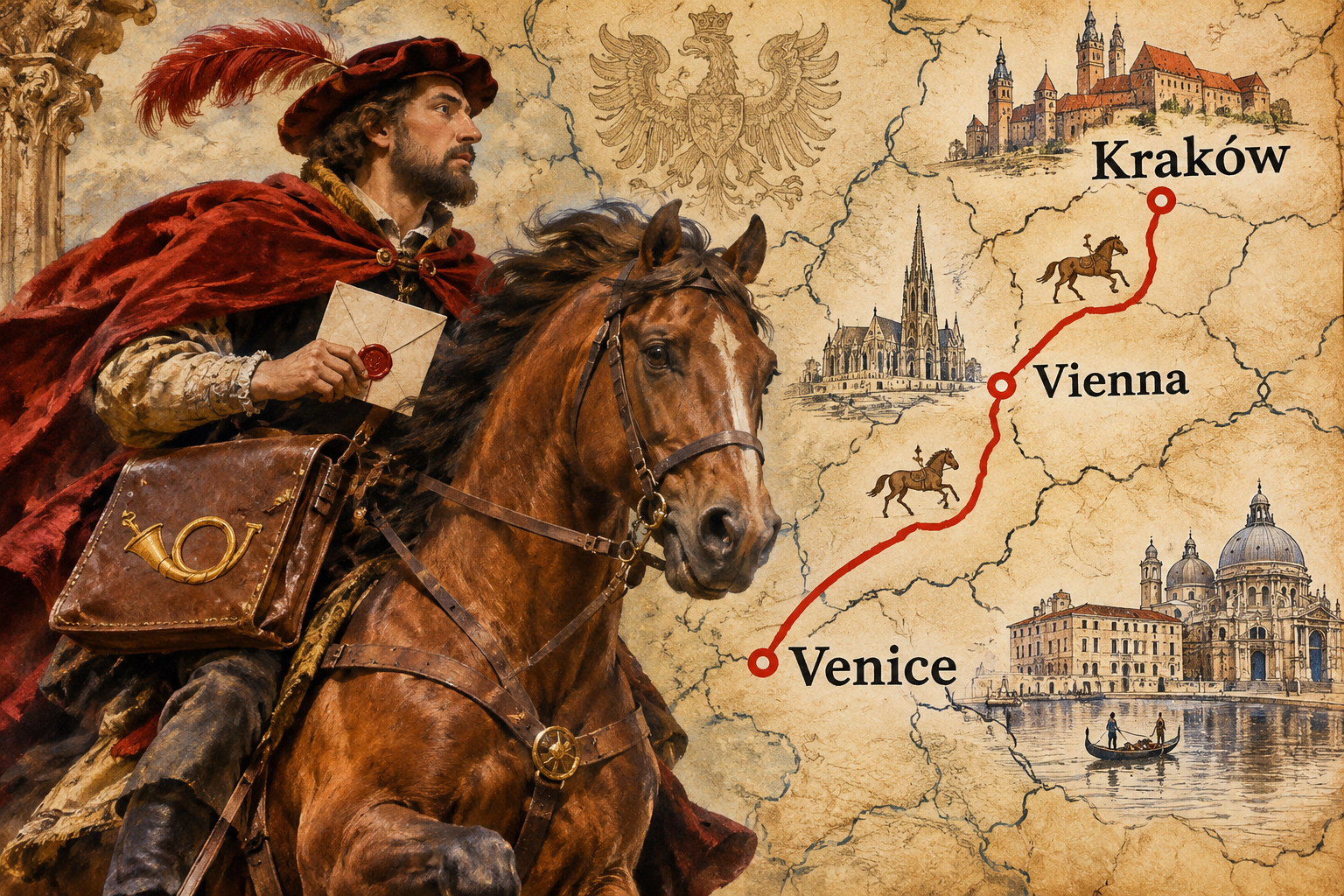
On 18 October 1558, King Sigismund II Augustus created a permanent postal connection linking Kraków, Vienna and Venice.
Historians and Poczta Polska treat that decision as the founding moment of Poland’s organised royal postal service.
At first glance, the route may seem surprising. Why Venice rather than a city within the Polish kingdom itself?
- Find more news from Poland on our Homepage .
The answer lies in the international world of Renaissance diplomacy, trade and dynastic politics. The new service was designed to speed communication with the wider European world and to reduce dependence on existing imperial postal arrangements controlled from outside the Polish court.
A postal road across Renaissance Europe
The route functioned through relay horses — the classic early modern postal method in which mounted couriers changed horses at designated stages to keep messages moving quickly over long distances.
According to Poczta Polska, the system created a regular information corridor for diplomatic and commercial contacts with other European states.
There was also a more personal and political motive behind it.
Many historians link the creation of the route to Sigismund Augustus’s effort to recover the so-called Neapolitan sums — the disputed inheritance connected to his mother, Bona Sforza, who died in 1557.
Poczta Polska notes that the king needed efficient communication with courts across Europe as he sought support in the struggle over that Italian inheritance.
Why Venice mattered
That background makes the Venice connection easier to understand.
Venice was one of Europe’s great hubs of finance, diplomacy and long-distance communication, while Vienna sat on a key route between Central Europe and the Italian world.
A permanent line running from Kraków through Vienna to Venice therefore served both practical state interests and the king’s own dynastic concerns.
The route’s importance was not that it marked the first time letters had ever travelled through Polish territory. Messages had of course moved across the region long before 1558.
What changed was the creation of an organised, permanent royal postal connection serving the monarchy’s regular needs and linking the Polish court to a wider European network in a more systematic way.
Prosper Provano and the first Polish post
Dzieje.pl records that the service was organised by Prosper Provano, acting on the king’s orders.
That helps place the event not just as an abstract reform, but as a concrete administrative step taken by the Polish crown during the reign of the last Jagiellonian king.
Seen in that light, the story is about more than couriers and horses.
It shows how Renaissance Poland was tied into continental politics, commerce and dynastic disputes. The first royal postal route linked Kraków to Venice not by accident, but because Poland’s rulers were operating in a European arena where communication itself had become a tool of statecraft.
That is why 18 October 1558 still matters. The route to Venice marked the beginning of Poland’s organised postal history and revealed a kingdom that was looking outward — towards Italy, the Habsburg world and the diplomatic networks of early modern Europe.