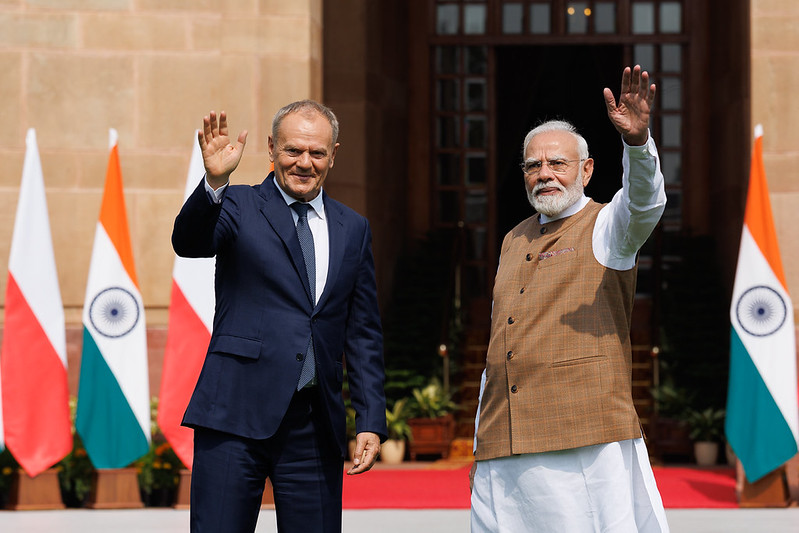
Poland and India have set a target of doubling bilateral trade by 2030 after Prime Ministers Donald Tusk and Narendra Modi held talks in New Delhi on Thursday, 22 October. Tusk said he wanted Poland to become a gateway to European markets for Indian businesses, while India could provide Polish companies with greater access to Asia. The two leaders also announced closer cooperation in defence manufacturing, space technology, nuclear energy and other strategic industries.
The announcements followed a meeting at Hyderabad House in the Indian capital, during Tusk’s first visit to India as Polish prime minister since 2010.
The visit marks a further step in developing the strategic partnership established when Modi travelled to Warsaw in August 2024.
- Find more news from Poland on our Homepage .
Tusk said Poland’s economic development had strengthened its ambitions to play a leading role in Central and Eastern Europe, making it a potential base for Indian companies seeking to expand across the continent.
Speaking alongside Modi, he welcomed the Indian prime minister’s support for Poland becoming a gateway for Indian cooperation with Europe, according to remarks reported by 300polityka.
The two governments subsequently confirmed several areas of cooperation in an official list of outcomes published by India’s Prime Minister’s Office, including the trade target and a new defence-industry dialogue.
Poland and India target doubling trade by 2030
Economic cooperation was central to the meeting.
According to the latest figures published by Poland’s embassy in India, bilateral goods trade reached €5.68 billion in 2025.
| Poland–India goods trade, 2025 | Value |
|---|---|
| Total bilateral goods trade | €5.68 billion |
| Polish exports to India | €1.37 billion |
| Polish imports from India | €4.32 billion |
Poland therefore imports substantially more goods from India than it exports.
The governments’ shared objective is to expand trade in both directions rather than simply increase Indian sales to the Polish market.
Poland’s main exports to India include machinery, industrial equipment, mineral products and metals. Indian exports to Poland include textiles, pharmaceuticals, machinery and other manufactured products.
Modi said that stronger economic ties could support the development of more reliable international supply chains, particularly as both countries seek opportunities in manufacturing and advanced technology.
He also invited greater Polish investment in India.
The leaders’ target is a political and economic objective, not a binding commitment guaranteeing that trade will double. No detailed annual targets or implementation timetable beyond the 2030 deadline were announced.
Nearly 100 Polish companies join the Asian mission
Tusk’s visit is accompanied by representatives of nearly 100 Polish companies participating in a wider mission to India and Vietnam.
Polish Finance and Economy Minister Andrzej Domański is also part of the delegation.
Before leaving Warsaw, Tusk described the visit as an opportunity to expand Poland’s commercial presence in markets expected to play a larger role in the global economy.
The Polish Investment and Trade Agency organised a business forum in New Delhi on 22 October focused on sectors including defence, dual-use technologies, mining, critical minerals, pharmaceuticals and food processing.
A second business event is scheduled for Friday, 23 October, in Bengaluru, a major centre for India’s technology and aerospace industries.
The Bengaluru programme will focus particularly on information technology, communications and the space sector.

Domański previously said Polish companies were seeking new customers and industrial partnerships, including opportunities for joint production rather than relying exclusively on exports.
Specific commercial agreements may emerge from the business events, but participation in the delegation does not itself establish that new investment or procurement contracts have been signed.
Defence cooperation moves towards a new dialogue
One of the most significant official announcements concerns defence manufacturing.
India and Poland agreed to establish a Defence Industry Dialogue intended to support closer cooperation between their defence sectors.
Modi also invited Polish companies to explore joint development and production in defence, space and nuclear energy.
His official statement following the talks identified these areas as priorities for deeper industrial cooperation.
The proposed dialogue could provide a framework for identifying business opportunities, exchanging expertise and developing potential manufacturing partnerships.
Poland has experience producing armoured vehicles, military electronics, air-defence equipment and unmanned systems.
India, meanwhile, is seeking to modernise its armed forces while expanding domestic defence manufacturing.
The countries have previously cooperated on military equipment, including armoured recovery vehicles.
However, Thursday’s announcements did not identify a newly signed major weapons-purchase contract or a confirmed joint factory project.
The distinction between establishing a cooperation mechanism and securing a commercial defence contract remains important.
Space, nuclear energy and emerging technologies
Beyond defence manufacturing, the two leaders discussed closer cooperation in space technology, nuclear energy and critical minerals.
Modi specifically invited Polish businesses to participate in joint development and production in strategic sectors.
The countries also agreed to establish an India–Poland start-up bridge, alongside proposed technology events for young innovators.
The initiative is intended to bring companies, entrepreneurs and research institutions into closer contact.
Artificial intelligence, cybersecurity, financial technology and other emerging industries were identified as possible areas for cooperation.
Poland already has an increasingly visible space-technology sector, including companies specialising in satellite manufacturing, Earth observation and data analysis.
India has an established national space programme and a growing commercial space industry.
These complementary capabilities offer potential opportunities for collaboration, but no newly completed satellite programme or nuclear-energy investment was confirmed during the leaders’ public statements.
EU–India trade agreement could create further opportunities
The developing relationship comes as India and the European Union seek to strengthen economic links.
The EU and India concluded negotiations on a free trade agreement on 27 January 2026.
According to the European Commission’s trade policy information, the proposed agreement would reduce or eliminate tariffs on a large proportion of goods traded between the two markets.
That could provide Polish manufacturers and exporters with opportunities in areas where high tariffs have historically complicated access to India.
The agreement could also support Indian companies seeking to invest in European production and distribution.
However, the trade agreement has not yet entered into force. Its negotiated text still requires the relevant legal procedures before its provisions become binding.
Poland’s ambition to serve as an Indian gateway to Europe is therefore a commercial and diplomatic strategy, not a change to the EU’s existing trade rules.
Ukraine war also on the agenda
The talks were not limited to economics.
Poland and India also discussed international security, including Russia’s war against Ukraine and conflicts in the Middle East.
Before departing Warsaw, Tusk said he wanted to explore how India could contribute constructively to efforts aimed at ending the war.
Modi reiterated India’s support for diplomatic initiatives designed to achieve peace.
The countries approach the war from different geopolitical positions.
Poland is a NATO member and one of Ukraine’s principal European supporters. India maintains longstanding economic and defence relationships with Russia while also engaging with Ukraine and Western governments.
The different relationships make diplomatic discussions significant, but no joint peace initiative, mediation agreement or change in India’s relations with Russia was announced.
According to the Polish Institute of International Affairs, Poland’s closer engagement with India could strengthen the strategic partnership while also creating opportunities to discuss European security and supply-chain diversification.
A strategic partnership established in 2024
The latest visit builds on an important development in August 2024, when Modi travelled to Warsaw.
During that visit, the leaders elevated bilateral relations to a strategic partnership and adopted a 2024–2028 action plan covering economic relations, defence, security, technology and cultural exchanges.
The framework established priorities for future cooperation but required subsequent political and commercial decisions to turn them into concrete projects.
Thursday’s announcements represent further steps in implementing that framework.
India also confirmed Poland’s participation in the Coalition for Disaster Resilient Infrastructure, an international initiative supporting infrastructure capable of withstanding natural disasters and other climate-related risks.
The leaders additionally agreed to establish a dialogue on counter-terrorism.
Both announcements are included in the Indian government’s official list of outcomes.
Historic ties provide another foundation
Both leaders also referred to the historical relationship between Poland and India.
During the Second World War, Indian princely states provided refuge to thousands of Polish civilians, including children displaced by the Soviet deportations and the wider conflict.
The best-known example was the refuge organised by Jam Saheb Digvijaysinhji, the Maharaja of Nawanagar, who welcomed Polish children in the 1940s.
The episode remains an important symbol of friendship between the two countries.
Modi highlighted this history while discussing cultural exchanges and educational cooperation, including initiatives intended to introduce younger generations to the relationship.
Such historical connections provide diplomatic context for the current partnership, although the immediate focus of the New Delhi talks was economic and technological cooperation.
What happens next?
Tusk’s visit to India continues with business meetings in Bengaluru before the Polish delegation proceeds to Vietnam.
For Poland and India, the principal tests will be whether the new defence-industry dialogue produces specific projects, whether businesses conclude commercial agreements and whether bilateral trade moves towards the target set for 2030.
The two governments have identified several areas where they want to cooperate more closely.
The next stage will determine how many of those ambitions result in investment, production, research partnerships and expanded trade.