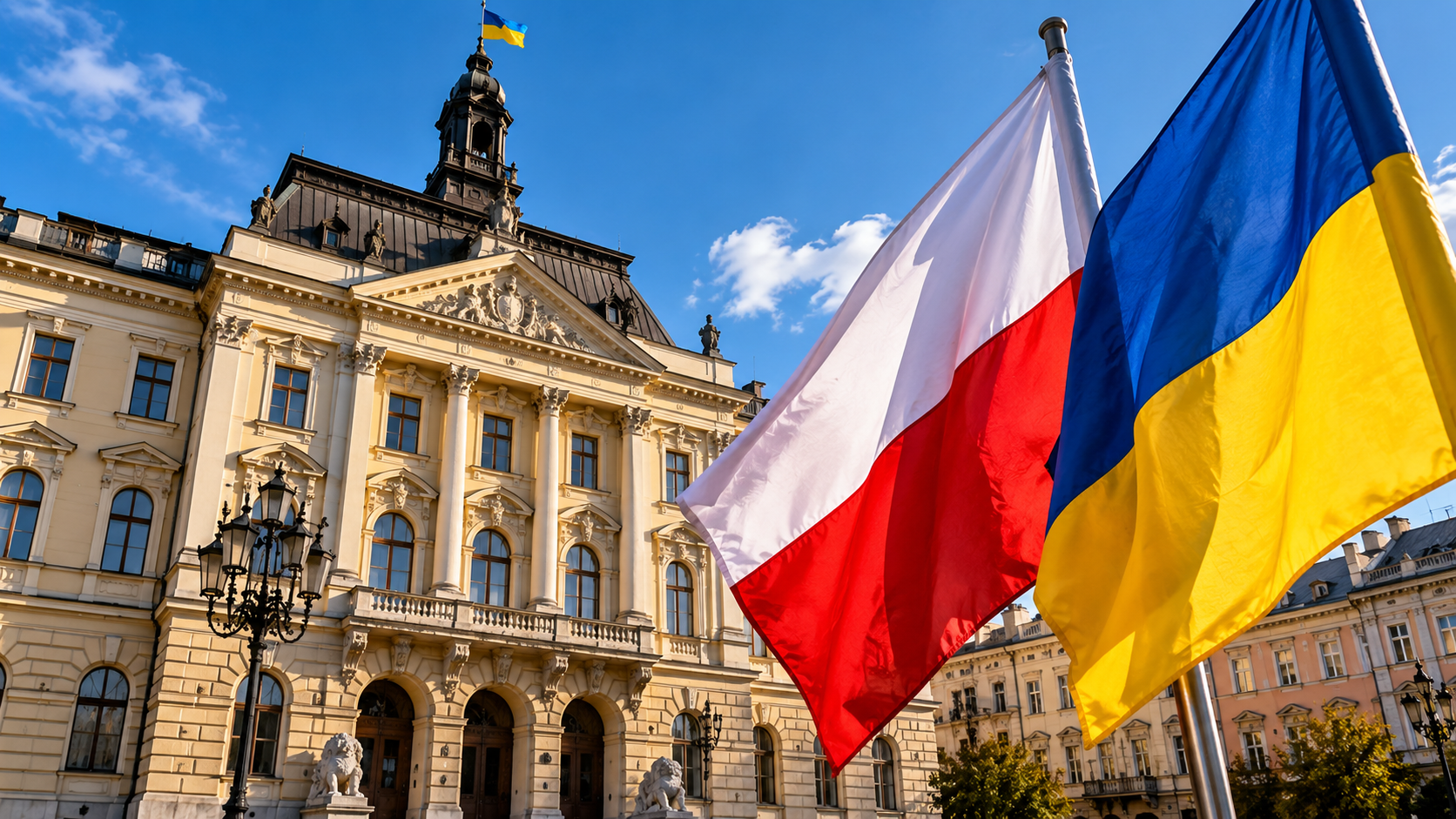
Poland has strongly condemned a decision by regional authorities in western Ukraine to honour the Ukrainian Insurgent Army (UPA) and its wartime commander Roman Shukhevych in 2027, with the Polish defence minister calling the move unacceptable and urging the Ukrainian government to distance itself from the commemorations.
The Lviv Regional Council adopted three resolutions on Tuesday, 20 October, designating 2027 as a year dedicated to the UPA, Shukhevych and Ukrainian poet and nationalist activist Oleh Olzhych.
The decision immediately drew criticism from Poland’s government, embassy in Kyiv and Institute of National Remembrance (IPN), which pointed to the UPA’s responsibility for mass killings of Polish civilians during the Second World War.
- Find more news from Poland on our Homepage .
The controversy adds to longstanding disagreements over historical memory between Poland and Ukraine, despite their close cooperation against Russia’s ongoing invasion.
Polish defence minister demands a response from Kyiv
Polish Deputy Prime Minister and Defence Minister Władysław Kosiniak-Kamysz denounced the decision in a statement published on X.
He described the regional council’s declaration as “unacceptable”, arguing that such commemorations deepen divisions rather than strengthen trust between Poles and Ukrainians.
As reported by TVP Info, Kosiniak-Kamysz also called on Ukraine’s national authorities to distance themselves from the position adopted in Lviv.
Poland’s Foreign Ministry expressed similar concerns.
Ministry spokesman Maciej Wewiór told Wirtualna Polska that honouring the UPA and individuals associated with wartime atrocities was incompatible with European values and the strategic, good-neighbourly relationship between Poland and Ukraine.
He argued that efforts by the Polish and Ukrainian leaderships to improve cooperation on historical issues risked being undermined by local political decisions.
The Polish embassy in Kyiv subsequently issued its own condemnation, accusing the organisers of glorifying figures associated with crimes against Polish civilians.
In its statement reported by Wirtualna Polska, the embassy also emphasised that Ukrainians who opposed the killings and helped their Polish neighbours were among those victimised by Ukrainian nationalist forces.
The embassy’s statement was also shared by Piotr Łukasiewicz, who heads Poland’s diplomatic mission in Kyiv.
Why Lviv is honouring the UPA and Shukhevych
The Lviv Regional Council, the elected regional authority rather than the municipal government of Lviv city, adopted the commemorative resolutions during a plenary session.
According to the council’s official announcement, the commemorations are intended to mark three historical anniversaries.
The year 2027 marks the 85th anniversary of the formation of the Ukrainian Insurgent Army and the 120th anniversaries of the births of Roman Shukhevych and Oleh Olzhych.
The council plans to organise memorial, educational, academic and cultural activities throughout the region.
Sviatoslav Sheremeta, chairman of the council’s committee responsible for culture and information policy, defended the decision by describing the organisation and individuals concerned as part of Ukraine’s history and national heritage.
The commemorations, he explained, would provide an opportunity to prepare events that had previously been disrupted by Russia’s full-scale invasion.
The regional initiative had been under consideration since July, but Tuesday’s vote formally adopted the commemorative designations.
It is a decision by the Lviv regional authorities, not a nationwide declaration by the Ukrainian government or parliament.
Why the UPA remains deeply controversial in Poland
The Ukrainian Insurgent Army was a nationalist armed organisation established during the Second World War and associated with the Bandera faction of the Organisation of Ukrainian Nationalists (OUN).
Its objective was an independent Ukrainian state, and its forces subsequently fought Soviet authorities as well as other armed opponents.
However, UPA units and associated nationalist formations also carried out systematic attacks against Polish civilians in Volhynia and Eastern Galicia, territories that belonged to Poland before the Second World War and are now primarily within western Ukraine.
Beginning in 1943, the attacks targeted Polish villages and settlements, killing men, women and children and forcing many survivors to flee.
The violence reached a particularly deadly point on 11 July 1943, when coordinated attacks were launched against numerous Polish communities in Volhynia.
The number of victims remains an estimate because of incomplete records and the destruction of entire communities.
Poland’s Institute of National Remembrance estimates that approximately 40,000–60,000 Poles were murdered in Volhynia, with further tens of thousands killed in Eastern Galicia and other affected regions.
Polish state institutions classify the massacres as genocide.
In Ukraine, the UPA is also commemorated for its struggle for independence and resistance to Soviet rule. That aspect of its history has shaped a very different national remembrance tradition.
The dispute concerns whether the organisation’s independence struggle can be commemorated without obscuring its documented crimes against civilians.
Roman Shukhevych, who became the UPA’s principal commander in 1943, is particularly divisive because of his senior leadership role during the campaign of anti-Polish violence.
Polish historians and state institutions hold him responsible for the organisation’s actions, including the mass killings in Eastern Galicia.
Polish historians denounce Shukhevych commemoration
Poland’s Institute of National Remembrance criticised the Lviv resolution, describing Shukhevych as a central figure responsible for the genocide of Polish civilians.
In a statement reported by Wirtualna Polska, the institute said honouring him represented an affront to the memory of the victims.
The IPN also recalled Shukhevych’s earlier involvement with military formations operating alongside Nazi Germany.
The institute questioned the decision to honour Oleh Olzhych alongside Shukhevych, noting that Olzhych belonged to a different faction of Ukrainian nationalism whose leadership opposed the Bandera faction’s mass killings.
Olzhych, a poet and political activist associated with the Melnyk faction of the OUN, died in German custody in 1944.
The distinction illustrates why the history of Ukrainian nationalism during the war cannot be reduced to a single organisation or a uniform political position.
Dispute comes as Poland and Ukraine make progress on exhumations
The latest disagreement comes at a particularly sensitive moment in the two countries’ efforts to address wartime atrocities.
On the same day as the Lviv vote, Poland’s Institute of National Remembrance presented the results of its 2026 searches and exhumations in Ukraine.
According to the IPN’s official report, investigators worked at several historical sites, including Ostrówki, Wola Ostrowiecka, Puźniki and Huta Pieniacka.
At Wola Ostrowiecka, where Polish civilians were massacred in August 1943, investigators recovered the remains of 48 people during this year’s work.
The institute’s preliminary examinations identified 24 children, 17 women and three men, while the sex of four other victims could not be determined at that stage.
The work forms part of a wider effort to identify victims, establish burial sites and provide dignified funerals.
These operations require cooperation between Polish researchers and Ukrainian authorities, making historical reconciliation a continuing practical issue rather than simply a dispute over national memory.
European Parliament previously raised concerns
The Lviv decision follows an earlier disagreement over the naming of a Ukrainian military unit after the heroes of the UPA.
That decision prompted criticism in Poland earlier in 2026.
In July, the European Parliament addressed the issue in a resolution concerning Ukraine’s progress towards European Union membership.
MEPs expressed regret that the naming decision had disregarded Polish historical sensitivities and grief, warning that it damaged neighbourly relations.
The parliament called for de-escalation and renewed reconciliation efforts.
At the time, Ukraine’s Foreign Ministry defended the military naming decision, saying it was not intended as an act against Poland and warning that Russia benefited from divisions between the two countries.
The continuing disagreement illustrates the difficulty of reconciling competing national interpretations of wartime history while maintaining a close strategic partnership.
What happens next?
Poland has now called on Ukraine’s national leadership to distance itself from the Lviv Regional Council’s decision.
There has been no verified announcement that the Ukrainian government has adopted, endorsed or overturned the regional commemorations.
The regional council’s resolutions provide a basis for planning events in 2027, but the details of individual commemorations have yet to be established.
The immediate diplomatic question is whether Kyiv will respond to Warsaw’s concerns or leave the matter to the regional authorities.
Despite their disagreements over wartime history, Poland remains an important political, military and humanitarian supporter of Ukraine against Russia’s invasion.
The latest controversy demonstrates that closer strategic cooperation has not resolved the two countries’ most sensitive historical disputes.