In northern Poland, boats travel across dry land on wheeled carriages. Further south, a medieval wooden church stands as a remarkable survivor of Gothic architecture. Elsewhere, castles rise above limestone cliffs, and quiet lakes lie among rolling hills shaped by ancient glaciers.
These are among 16 destinations chosen as the Wonders of Poland for 2026, following a nationwide readers’ vote organised by the Polish edition of National Geographic Traveler.
More than 220,000 votes were cast for 48 nominated attractions, with one winner selected from each of Poland’s 16 administrative regions, known as voivodeships.
- Find more news from Poland on our Homepage .
The results announced by National Geographic Traveler on 14 October reveal an unusually varied picture of the country, celebrating natural landscapes, historic buildings, engineering achievements and places that rarely feature in international travel guides.
The competition is designed to encourage travellers to look beyond Poland’s most familiar tourist destinations.
Castles, medieval churches and boats that travel over land
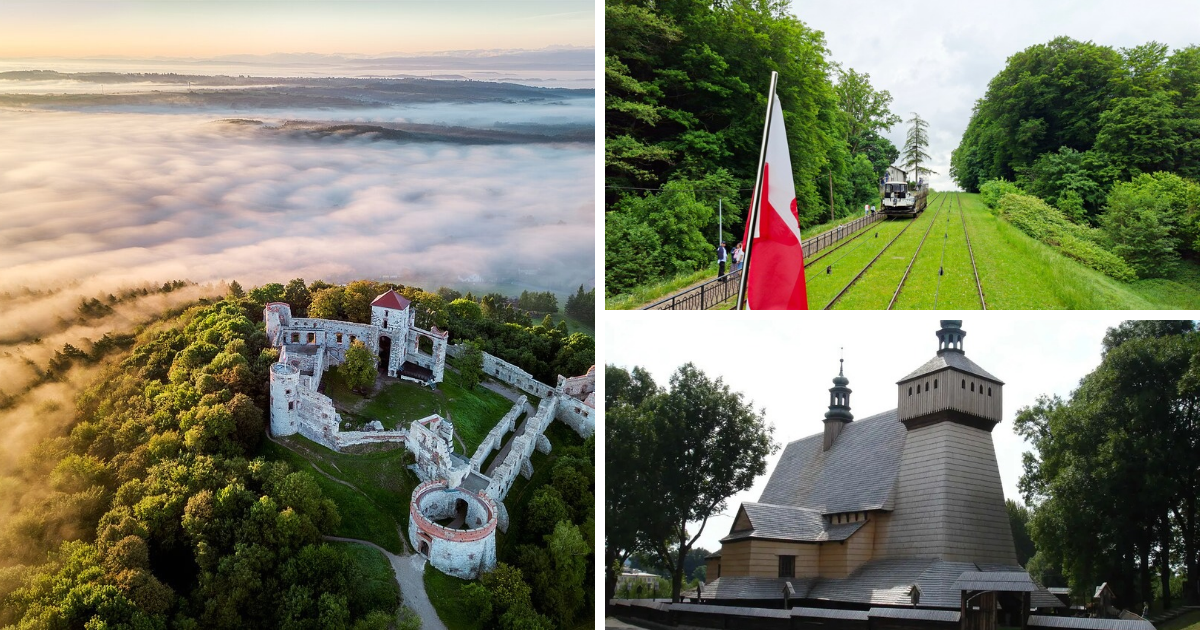
Among the most unusual winners is the Elbląg Canal, a nineteenth-century engineering achievement in northern Poland.
Its famous inclined planes allow boats to be transported over dry land on wheeled platforms running along tracks, overcoming substantial differences in water level between sections of the canal.
The system remains a working attraction and one of the most distinctive examples of Poland’s industrial heritage.
In south-eastern Poland, the wooden Church of the Assumption of the Blessed Virgin Mary and St Michael the Archangel in Haczów also secured a place among the winners.
The Gothic timber church, whose origins date to the fifteenth century, forms part of the six-site Wooden Churches of Southern Małopolska UNESCO World Heritage inscription, recognised in 2003.
Another winner, the Trail of the Eagles’ Nests, takes visitors through the limestone highlands between Kraków and Częstochowa.
The route is celebrated for its medieval castles and fortifications, many built or developed during the fourteenth century. Their dramatic hilltop positions gave the route its evocative name.
In Kruszwica, the Gothic Mouse Tower and Lake Gopło combine landscape with one of Poland’s best-known medieval legends, the story of King Popiel.
Further west, the Ducal Castle in Niemodlin represents centuries of architectural change, incorporating Gothic, Renaissance and Baroque influences.
The archaeological stronghold at Santok in western Poland was also selected, alongside the Calvary of Wejherowo in Pomerania, a historic pilgrimage complex containing numerous chapels set among wooded hills.
Poland’s lakes, rivers and Baltic coast
The natural landscape winners are just as varied.
In the north-east, the Suwałki Lake District and Lake Hańcza were recognised for a landscape of glacial hills, valleys and lakes. Hańcza is the deepest lake in Poland.
The Nida River, winding through the Świętokrzyskie region, was chosen for its natural surroundings, meandering waterways and opportunities for kayaking and wildlife observation.
In western Poland, the Land of 100 Lakes in Greater Poland received recognition for its wooded countryside, lakes and recreational trails.
The hills and river valleys of Kraszczady, in the Lublin region, also secured a place. The area offers a quieter alternative to some of Poland’s more heavily visited landscapes.


On the Baltic coast, the village of Chłopy was selected for preserving the character and layout of a traditional fishing settlement.
Its working fishing harbour, beach and coastal buildings offer visitors a glimpse of the region’s maritime heritage.
Gardens, spa towns and unusual wooden architecture
Several winners celebrate the relationship between nature, architecture and everyday life.
The Wojsławice Arboretum in Lower Silesia is known for its botanical collections, particularly rhododendrons, azaleas and daylilies. It combines ornamental gardens with scientific and educational activities.
In central Poland, Aflopark in Pabianice was selected for its themed gardens, plant collections, sculptures and educational spaces.
The historic spa town of Krynica-Zdrój, in southern Poland, also appears among the winners. Its promenade, mineral-water drinking halls and elegant spa architecture have long made it a distinctive destination in the Carpathian foothills.
Meanwhile, Otwock, near Warsaw, was recognised for its Świdermajer architecture.
This distinctive local wooden style is associated with elaborately decorated verandas, intricate timber details and historic summer villas, recalling the town’s past as a holiday and health resort.
A different way of discovering Poland
The voting took place over six weeks, from 2 September to 13 October 2026, with readers choosing between three candidates in each voivodeship.
The results represent a public vote rather than an international expert ranking of Poland’s greatest monuments.
That distinction also makes the selection interesting: it reflects the places that attracted public support within their respective regions.
Michał Cessanis, editor at National Geographic Traveler and ambassador of the competition, welcomed the range of destinations represented, highlighting the mixture of nature, history and architecture.
For travellers unfamiliar with Poland, the selection offers a useful alternative to the familiar circuit of Warsaw, Kraków, Gdańsk and the Tatra Mountains.
For those who already know the country, it provides another reason to explore its regional traditions and lesser-known landscapes.
Perhaps the most striking feature of the 2026 selection is its diversity. A nineteenth-century canal, a medieval church, a Baltic fishing village and a quiet river valley have little in common beyond their location in Poland.
Yet together they tell a broader story about the country’s heritage — one that extends well beyond its most famous landmarks.