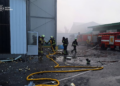
Polish building materials manufacturer Cersanit has announced the complete cessation of production at its factory in Ukraine following two Russian drone attacks that severely damaged the facility. The company says the destruction, repeated air-raid alerts and deteriorating security conditions have made it impossible to guarantee workers’ safety or resume manufacturing.
The decision, announced on 19 October, concerns Cersanit’s factory in Zviahel, in Ukraine’s Zhytomyr region, which was struck on the nights of 11–12 September and 15–16 October 2026.
Both attacks caused extensive damage to the building and essential production equipment, according to the company’s official statement published by its Ukrainian subsidiary.
- Find more news from Poland on our Homepage .
All employees present at the factory during the attacks were safely evacuated. Cersanit confirmed that nobody was killed or injured.
The announcement comes as Polish media also report that another manufacturer controlled by billionaire Michał Sołowow, wooden flooring producer Barlinek, is ceasing production at its factory in Vinnytsia, central Ukraine.
Both companies have suffered serious damage during Russia’s full-scale invasion, although their circumstances and the timing of their production stoppages differ.
Two attacks leave Cersanit unable to resume production
Cersanit’s factory in Zviahel produces ceramic tiles and bathroom equipment, including sanitary ware. It has operated for nearly two decades and forms an important part of the company’s Ukrainian manufacturing activities.
The first attack, overnight on 11–12 September, damaged critical components of its ceramic tile production lines.
Following that strike, Cersanit initially estimated that restoring production capacity would take at least six months, according to its September announcement reported by Forbes Ukraine.
The second attack, overnight on 15–16 October, caused further destruction.
In its latest statement, the company said the damage was now too extensive to repair under prevailing conditions.
Beyond the physical destruction, Cersanit pointed to the continuous disruption caused by Russian attacks on Ukraine.
Frequent air-raid warnings require workers to evacuate, sometimes several times in a single day. Electricity interruptions and voltage fluctuations have also made reliable industrial operations increasingly difficult.
The company’s management concluded that production could no longer continue safely.
Cersanit has not announced a new timetable for rebuilding or reopening the factory.
The decision concerns production at the Zviahel facility and should not be interpreted as confirmation that the company has permanently abandoned the Ukrainian market.
Barlinek’s Ukrainian factory also affected
The latest announcement has brought renewed attention to Barlinek, another major Polish-owned manufacturer with operations in Ukraine.
Barlinek’s wooden flooring factory in Vinnytsia was severely damaged during a Russian drone attack overnight on 15–16 July 2025.
The company’s management initially said production could not resume for at least six months because of the damage.
In a subsequent statement published by Barlinek’s management, the company confirmed that its factory was not operating and that it was continuing to pay employees despite the shutdown.


That statement also recorded the human consequences of the attack. Barlinek said it had provided support to 15 people affected by the strike, one of whom had died.
On 19 October 2026, Radio ZET reported that both Barlinek and Cersanit were ceasing production in Ukraine, citing information about management concerns over staff safety and the extent of the destruction.
However, unlike Cersanit, Barlinek has not been independently confirmed through a newly published company statement to have made a separate permanent-closure decision in October.
Its production difficulties therefore predate the latest attack on Cersanit.
Around 1,000 people employed in Cersanit’s Ukrainian operations
The shutdown has raised questions about employment at one of the major industrial businesses operating in the Zhytomyr region.
Cersanit says it has maintained a presence in Ukraine for more than 20 years and employs close to 1,000 people across its production, sales, marketing and customer-service teams in the region.
It has not announced how the latest production decision will affect employment, whether existing workers will remain on the payroll, or whether some operations can continue independently of the damaged manufacturing facilities.
Barlinek said in its July 2025 statement that more than 700 people remained employed at its Ukrainian factory while production was suspended.
The companies have not announced a verified combined financial cost arising from the latest situation.
Polish investment caught in Russia’s war
The disruption illustrates how Russia’s attacks on industrial and energy infrastructure continue to affect foreign companies that have invested in Ukraine.
Cersanit and Barlinek are both controlled by Michał Sołowow, one of Poland’s wealthiest businessmen, whose investments also include the chemicals group Synthos.
Their Ukrainian manufacturing operations were established long before Russia launched its full-scale invasion in February 2022.
The Cersanit factory is particularly significant because it had previously been identified as a potential contributor to Ukraine’s post-war reconstruction.
In April 2023, the European Bank for Reconstruction and Development announced a €42 million financing agreement supporting Cersanit’s operations and investment projects in Poland and Ukraine.
The financing included plans to expand production of ceramic tiles and bathroom equipment in Ukraine, products required for repairing damaged homes, public buildings and other infrastructure.
At the time, Sołowow expressed confidence in the company’s continued Ukrainian investment despite the war.
The latest destruction highlights the difficulties facing manufacturers that are expected to support reconstruction while their facilities remain exposed to further attacks.
Even businesses operating far from the main front lines face risks from drones, missiles and disruption to electricity supplies.
What happens next?
For Cersanit, the immediate priorities are employee safety, securing the damaged factory and assessing whether reconstruction will become possible.
The company’s earlier estimate of at least six months to restore production was made before the second October attack and cannot be treated as a current reopening forecast.
There is also no confirmed timetable for the resumption of manufacturing at Barlinek’s Vinnytsia facility.
Neither company’s situation establishes that it has permanently withdrawn from Ukraine.
For Polish businesses, the developments underline a difficult reality: maintaining investments in Ukraine may be commercially important for future reconstruction, but the continuing war can make ordinary industrial production impossible even in regions distant from the front line.