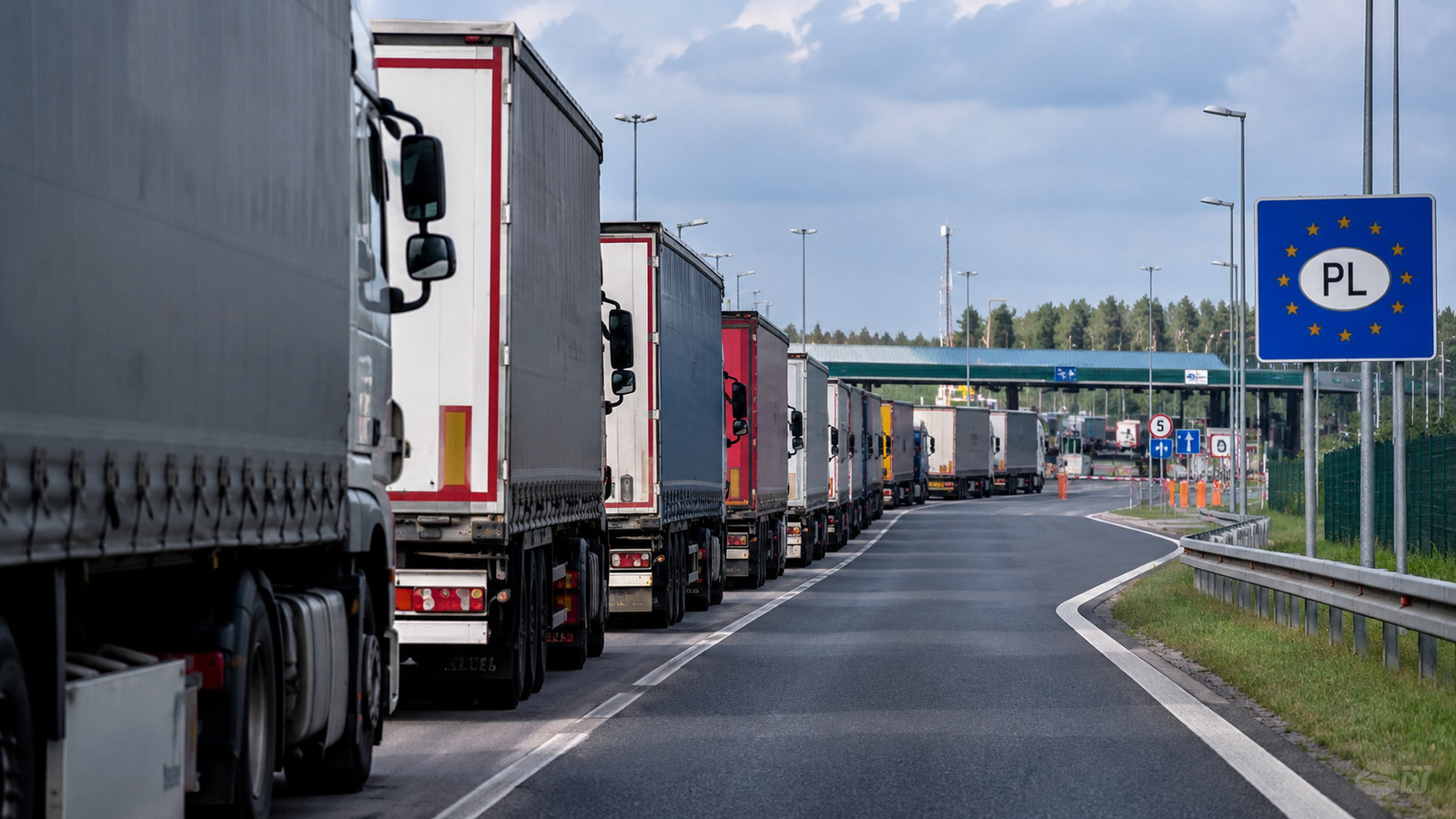
Ukraine is seeking an agreement with Poland to move customs inspections for lorries carrying Ukrainian grain exports away from vulnerable border crossings and onto Polish territory, as Russian drone attacks increasingly threaten transport operations near the frontier. Polish officials have confirmed discussions between border guards from the two countries but stressed that no political decision has been taken to introduce the proposed arrangements.
The initiative, also being discussed with Slovakia, is intended to reduce the amount of time freight vehicles spend waiting at locations exposed to Russian attacks, according to a Financial Times investigation published on 23 October, which cited people familiar with the negotiations.
Ukraine’s Foreign Ministry confirmed that Kyiv wants to extend joint border-control arrangements already established with Moldova to other neighbouring countries, including Poland.
- Find more news from Poland on our Homepage .
Ministry spokesperson Heorhii Tykhyi told the British newspaper that the proposal was a response to a deteriorating security situation, with Russia attempting to disrupt border crossings, transport connections and the movement of goods.
He said Ukraine wanted to reach an agreement with Poland as soon as possible.
The proposal comes as Polish authorities independently report serious disruption to freight traffic at several crossings with Ukraine because of Russian military attacks in the country’s western regions.
Poland confirms discussions but says no decision has been made
Poland’s Ministry of the Interior and Administration (MSWiA) has acknowledged that border guards from Poland and Ukraine met to discuss the possibility of changing border-control arrangements.
Ministry spokesperson Karolina Gałecka, speaking to Polish news outlet Interia, confirmed that the meeting took place in the context of Russian drone attacks.
According to Interia, the question of moving Ukrainian border controls to Poland was raised during a working-level meeting involving representatives of both countries at the Yahodyn–Dorohusk crossing.
Gałecka said she was not aware of high-level political negotiations concerning the introduction of joint border controls and emphasised that no political decision had been taken.
The ministry has nevertheless indicated that Poland could consider allowing controls to be conducted on its territory if the security situation in Ukraine made existing arrangements unsafe for officials and travellers.
Such a system would have to involve personnel from both countries, rather than Ukrainian authorities independently conducting border checks inside Poland.
Gałecka also said approval from the European Commission would be required because of the legal restrictions on third-country border officials exercising control functions within the Schengen area.
That is an important distinction. While the Financial Times reporting focuses specifically on customs inspections for agricultural freight, the Polish ministry’s comments address the wider question of joint border-control arrangements. The precise relationship between these two elements has not been publicly established.
No locations for new inland inspections, implementation timetable or detailed operational agreement have been announced.
Russian attacks are already disrupting Poland’s border crossings
The need for alternative arrangements is reinforced by reports from Poland’s own border authorities.
In an official notice published on 23 October, the Polish border information service warned that Russian attacks on western Ukraine were affecting freight clearances on both sides of the frontier.
The notice identified disruption at four major road crossings: Dorohusk and Hrebenne in Lublin province, and Korczowa and Medyka in Podkarpackie province. It also warned of possible difficulties at Zosin and Dołhobyczów.
Polish authorities explained that when Russian attacks threaten border areas, Ukrainian services temporarily suspend inspections. This leads to corresponding interruptions on the Polish side because vehicles cannot pass through the crossing.
In some cases, Ukrainian border facilities have to be evacuated. Polish facilities may also be evacuated when the safety of personnel or travellers is at risk.

Each interruption extends the queues of waiting vehicles, with weekend freight traffic adding to the congestion.
Poland’s National Revenue Administration, which includes the country’s customs service, and the Border Guard resume normal clearance operations as quickly as possible after the immediate danger has passed.
The Polish warning confirms that Russian attacks on Ukrainian territory are already affecting the functioning of Polish crossings. It does not establish that Russian drones have attacked Polish border facilities or vehicles on Polish territory.
Relocating some inspection procedures farther from the frontier could reduce the need for lorries to remain stationary in exposed areas. However, the practical benefits would depend on which controls were relocated and how border traffic was reorganised.
Moldova provides a possible model
Ukraine has already developed joint border-control arrangements with Moldova, offering an example of how neighbouring countries can adapt their procedures in response to security threats.
According to the Moldovan Border Police, joint control had been established at the Giurgiulești–Reni, Briceni–Rossoșani and Criva–Mămăliga crossings.
In September, Moldova announced temporary changes at those locations because of security risks arising from Russian attacks near the border.
Moldovan customs and border personnel who had been working on Ukrainian territory were moved back to facilities inside Moldova, allowing them to continue their duties in a safer environment.
The arrangements were designed to maintain cross-border movement without suspending checks or abandoning customs and immigration requirements.
Moldova’s experience demonstrates that the physical location of border-control activities can be changed through bilateral cooperation, although the legal arrangements required for Poland would differ because Poland is a member of both the European Union and the Schengen area.
Why grain exports are central to the proposal
The dispute over where to conduct customs inspections comes amid significant pressure on Ukraine’s agricultural export routes.
Russian attacks against Black Sea ports, shipping and transport infrastructure have forced Ukrainian exporters to depend increasingly on overland routes through neighbouring European countries.
Ukraine remains a major agricultural producer, and disruption to its exports affects shipping costs, the country’s economy and the availability of agricultural commodities on international markets.
The European Union established its Solidarity Lanes initiative in May 2022 to help Ukraine transport goods by road, rail and inland waterways after Russia’s full-scale invasion interrupted traditional trade routes.
According to the European Commission’s latest Solidarity Lanes figures, published on 19 October, approximately 90% of Ukraine’s exports of grain, oilseeds and related products travelled through these alternative routes in September 2026, compared with about 10% through the Black Sea.
The figures illustrate how heavily agricultural exports have recently depended on routes through neighbouring countries.
Ukraine’s agricultural authorities also reported that exports of agricultural products reached approximately 2.4 million tonnes in September, equivalent to just 46% of the country’s estimated potential export volume, according to figures cited by the Financial Times.
For Ukraine, reducing congestion and improving security at land crossings has consequently become a matter of considerable economic importance.
What would change at the Polish border?
The proposed arrangements raise several practical questions for the Polish authorities.
Currently, goods entering Poland from Ukraine must comply with the European Union’s customs framework, while border officials conduct checks on people, vehicles and cargo where required.
The European Commission’s guidance on customs declarations sets out rules governing where goods are presented and how customs procedures can be completed, including authorised simplifications.
Moving some inspections inland would therefore require clarity over which country’s officers would undertake particular checks, where vehicles would report, and how any new system would comply with European legislation.
Another question is whether facilities already available in Poland could be used or whether new designated inspection areas would be necessary.
The proposed changes would also have to preserve controls over the destination of Ukrainian agricultural goods.
Poland has maintained restrictions on imports of certain Ukrainian agricultural products while permitting specified transit movements under customs conditions, as explained in the National Revenue Administration’s published rules governing agricultural imports and transit.
Moving customs inspections would not, by itself, authorise restricted Ukrainian grain to be sold on the Polish market.
For Polish transport companies and customs authorities, the practical significance would depend on whether the arrangements reduced delays without weakening required inspections or creating additional administrative burdens.
What happens next?
Ukraine has made clear that it wants an agreement with Poland quickly, but there is no publicly confirmed timetable for implementing a new system.
The Polish government’s position remains conditional. Officials have acknowledged the security concerns and discussions at border-service level, while making clear that formal approval has not been granted.
Any proposed arrangement involving Ukrainian border personnel operating on Polish territory would need to address the legal and institutional requirements identified by the Polish Interior Ministry, including the European Commission’s role.
It also remains unclear whether any eventual agreement would cover all agricultural freight, selected types of cargo or only particular crossings.
For now, the immediate challenge is keeping Poland’s eastern border operational as Russian attacks continue to disrupt transport infrastructure on the Ukrainian side.
The discussions show how the consequences of Russia’s war are increasingly shaping not only Ukraine’s export routes but also the way neighbouring European countries organise border security and international trade.