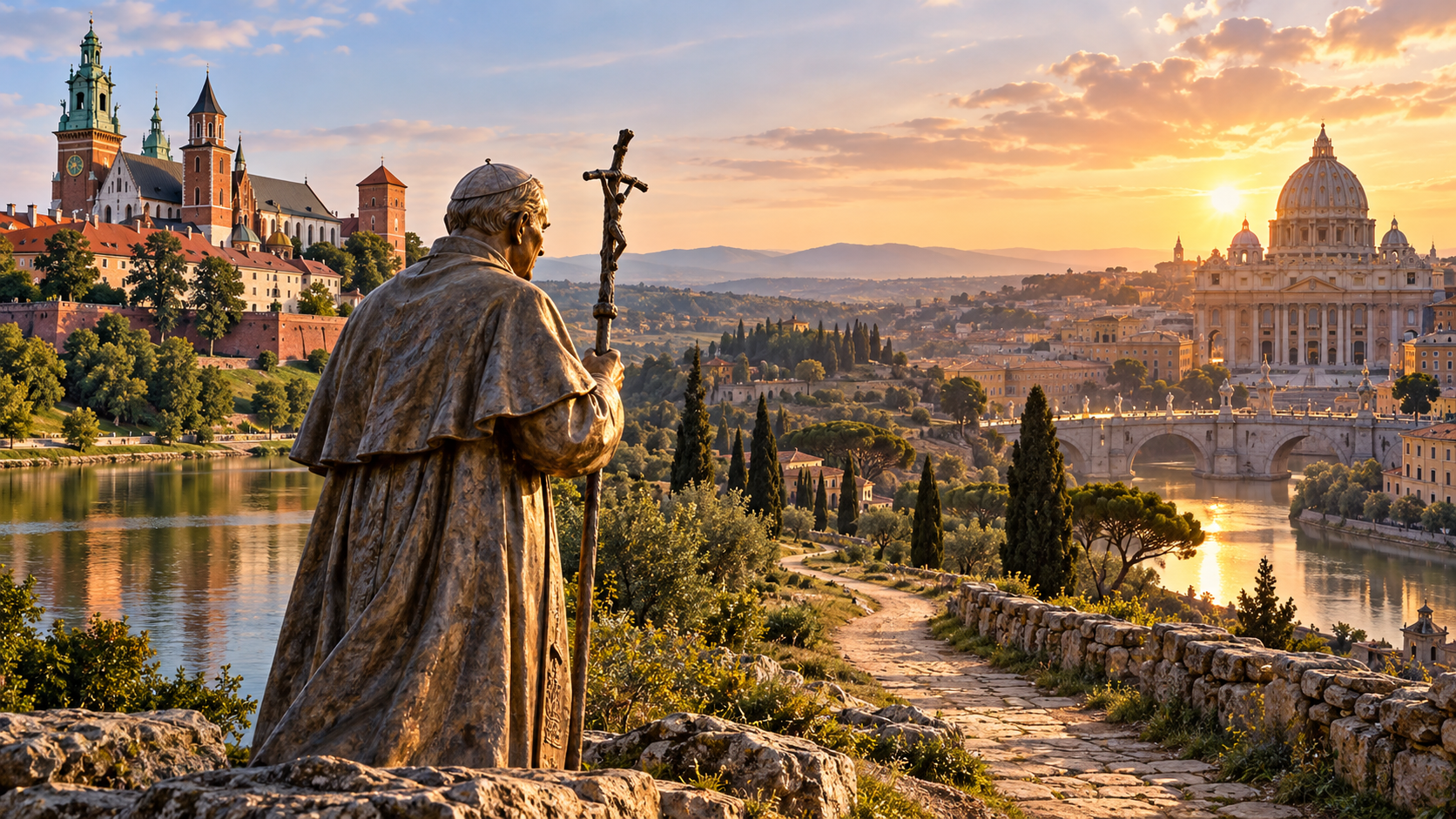
Poland and Italy have agreed to develop an international pilgrimage and tourism trail connecting Kraków with Rome in honour of Pope John Paul II. The planned route will pass through Slovakia and Austria, linking sites associated with the Polish-born pontiff while encouraging visitors to discover the history, culture and landscapes of four European countries.
The agreement was signed on Thursday, 15 October, at the TTG Travel Experience tourism fair in Rimini, Italy, one day before the 48th anniversary of Karol Wojtyła’s election as pope.
Poland was represented by Deputy Sport and Tourism Minister Ireneusz Raś, while Italian Tourism Minister Gianmarco Mazzi signed on behalf of Italy.
- Find more news from Poland on our Homepage .
The initiative, named the St John Paul II Trail, is intended to connect existing routes and tourist attractions into a broader European itinerary, with Kraków and Rome serving as its principal destinations.
According to the Polish Tourism Organisation’s official announcement, the agreement establishes cooperation on planning, signposting and promoting the route.
The Italian Tourism Ministry separately confirmed the agreement and identified four universities that will help develop the itinerary.
The trail remains a project under development. Officials have not announced a final route, total distance, budget or opening date. The agreement marks the beginning of coordinated planning rather than the opening of a completed pilgrimage route.
A route through four European countries
The proposed trail would begin in Kraków and continue through Slovakia and Austria before reaching Rome.
Kraków and Rome were selected because of their central importance in the life of John Paul II.
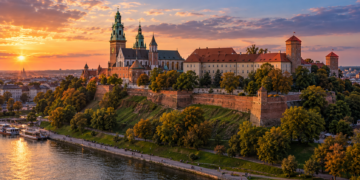
Before becoming pope, Karol Wojtyła spent much of his adult life in Kraków, where he studied, entered the priesthood and eventually became archbishop.
Rome became the centre of his nearly 27-year pontificate after his election on 16 October 1978.
The new route is intended to incorporate places connected with his life and legacy alongside historic towns, landscapes and cultural attractions across the four countries.
Rather than creating an entirely separate network of paths, organisers intend to make use of existing tourist routes and connect them into an international project.
The plans also include coordinated signposting and promotional activities that would allow travellers to recognise the trail across national borders.
The countries and two principal destinations have been identified, but no complete sequence of towns, individual sites or stages has been published.
Consequently, the announcement does not yet establish whether travellers will eventually be able to follow a single continuously waymarked walking route from Kraków to Rome.
Designed for tourists as well as pilgrims
Although the route will commemorate a Catholic pope, its organisers emphasise that it is not intended exclusively for religious pilgrims.
The project is also aimed at people interested in European history, architecture, local traditions and nature.
Magdalena Krucz, president of the Polish Tourism Organisation, said the idea was to encourage a more leisurely form of travel in which visitors discover lesser-known places and engage with local communities.
The organisation hopes that incorporating smaller towns and regional attractions will help spread tourism beyond major destinations.
That could provide opportunities for accommodation providers, restaurants, guides and other businesses in communities along the eventual route.
These economic benefits remain potential outcomes rather than established results, as the itinerary and investment requirements have not yet been finalised.
Italy’s Tourism Ministry has described the project as an initiative intended to strengthen cultural and spiritual tourism while promoting shared European heritage.
The approach reflects wider interest in long-distance cultural routes that combine pilgrimage traditions with walking, heritage and regional tourism.
Four universities will help design the itinerary
Academic institutions in Poland and Italy will play a central role in determining which places are included along the trail.
The four participating universities are the Pontifical University of John Paul II in Kraków, the John Paul II Catholic University of Lublin, the Pontifical University of Saint Thomas Aquinas (Angelicum) in Rome and the Catholic University of the Sacred Heart in Milan.
Their task will be to help develop the historical, cultural and spiritual concept of the route, identifying places that can tell the story of John Paul II and the regions through which the trail passes.
The agreement also envisages cooperation between national tourism organisations, regional authorities, religious institutions, universities and tourism businesses.
The Polish Tourism Organisation confirmed that joint promotion at international tourism fairs, coordinated information for travellers and common route signage form part of the intended cooperation.
Although the initiative was agreed between Poland and Italy, the proposed journey would also pass through Slovakia and Austria.
The Italian Tourism Ministry has indicated that the two founding partners are open to broader international cooperation involving other countries connected with John Paul II’s life and teachings.
The announcement does not establish that Slovakia and Austria have signed equivalent agreements or approved the final alignment of the trail.
Why John Paul II connects Kraków and Rome
John Paul II, born Karol Józef Wojtyła in Wadowice in 1920, became one of the most internationally recognised figures in modern Polish history.
He moved to Kraków to study at the Jagiellonian University in 1938. During the German occupation of Poland, he worked in a quarry and chemical factory while pursuing his religious vocation.
After becoming a priest, he continued his academic and religious career, eventually becoming Archbishop of Kraków in 1964 and a cardinal in 1967.
His election as pope on 16 October 1978 was a landmark event for Poland, then governed by a communist regime.
He became the first non-Italian pope in more than four centuries and led the Roman Catholic Church until his death on 2 April 2005.
During his pontificate, he made 104 international pastoral journeys and became an influential voice on human rights, religious freedom and political change in Central and Eastern Europe.
His contribution to the opposition to communist rule, particularly through the influence of his visits to Poland and his support for human dignity and freedom, remains an important part of his historical legacy.
The Vatican’s official biography records his life from Wadowice and Kraków through his long papacy in Rome.
The proposed trail seeks to bring those connections into a shared international visitor experience rather than treating them as separate religious destinations.
Agreement marked by anniversary visit to the Vatican
The agreement was deliberately signed ahead of the anniversary of Wojtyła’s election.
On Friday, 16 October, a Polish-Italian delegation visited his tomb in St Peter’s Basilica at the Vatican and laid flowers to mark the occasion.
The delegation included Polish Deputy Sport and Tourism Minister Ireneusz Raś and Polish Tourism Organisation president Magdalena Krucz.
The visit also included the Angelicum university in Rome, one of the academic partners responsible for developing the new route.
In its 16 October report on the commemorations, the Polish Tourism Organisation described the initiative as an opportunity to turn the memory of John Paul II into wider cultural cooperation between European countries.
The anniversary provided a symbolic starting point for the project, linking the Polish pope’s historical significance to a new tourism initiative.
When will the Kraków–Rome trail open?
For travellers interested in following the route, several important details remain unresolved.
Neither tourism ministry has announced a launch date, a final route map or an estimated journey time.
The authorities have also not disclosed an overall project budget or a completed plan for waymarking and infrastructure.
The immediate next steps are expected to involve academic research, consultation with regional and local organisations, identification of suitable existing routes and preparation of shared promotional materials.
The memorandum establishes the framework for this work but does not mean that the full trail is already open and signposted.
If completed, the project could offer a new way of experiencing the connection between Poland and Italy while introducing visitors to communities and heritage sites in Slovakia and Austria.
For now, the confirmed achievement is a bilateral agreement to develop the route, supported by tourism organisations and academic partners in both countries.