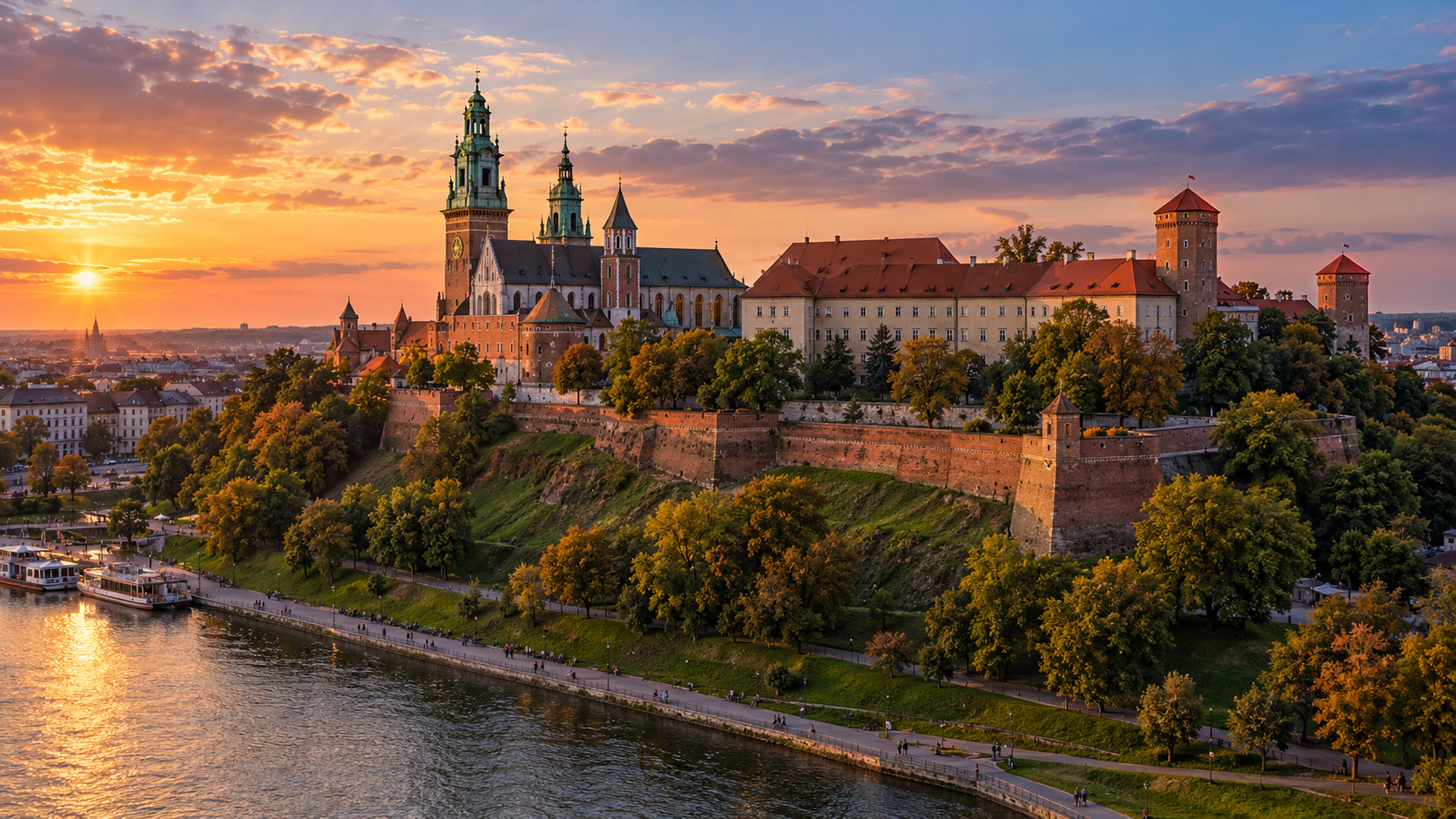
Scientists are using technology originally developed in particle physics to investigate what lies beneath Wawel Castle, the historic residence of Poland’s kings. A specialised detector installed inside a cave beneath the famous Kraków landmark is recording particles produced by cosmic rays, allowing researchers to search for hidden chambers, tunnels and geological formations without drilling into the centuries-old site.
The research is taking place beneath Wawel Royal Castle, one of Poland’s most recognisable historical landmarks, as part of an international project bringing together Polish technology specialists, Swiss physicists and museum archaeologists.
The device was installed inside Smocza Jama, or the Dragon’s Den, in late September and has been continuously collecting measurements since then.
- Find more news from Poland on our Homepage .
The project, known as VIEW — Visualizing the Interior and Exploring Wawel — is led by Polish technology company MUOTECH in cooperation with the Royal Castle on Wawel Hill and researchers from Switzerland’s École Polytechnique Fédérale de Lausanne (EPFL).
According to MUOTECH’s original project announcement, the technology is designed to reveal differences in the density of material beneath the historic hill, potentially identifying spaces that conventional archaeological investigations have not fully mapped.
The installation was detailed in earlier reporting, while new coverage on 16 October highlighted the research and its potential to guide future archaeological work.
No previously unknown chamber or tunnel has yet been confirmed as a result of the project.
How particles from space can reveal what lies underground
The technique being used at Wawel is known as muography, or muon imaging.
Muons are subatomic particles produced when high-energy cosmic rays interact with the Earth’s atmosphere.
Millions of these particles continuously pass through the environment, including buildings, the ground and the human body.
Unlike visible light, muons can penetrate considerable thicknesses of rock and other dense materials.
Scientists can exploit this property to investigate objects whose interiors would otherwise be difficult or impossible to examine.
When muons travel through rock, some are absorbed or deflected. Their measured numbers and directions provide information about the density of the material they have passed through.
A hidden cavity would generally allow more muons to pass through than an equivalent volume of solid rock.
By comparing the recorded particle measurements with a model of Wawel Hill, researchers hope to identify unusual patterns that could indicate underground spaces.
Dr Noemi Zabari, an astrophysicist and executive director of MUOTECH, explained in comments reported by the Polish Press Agency that the process resembles medical tomography, but uses naturally occurring particles rather than an artificial radiation source.
Crucially, the detectors are passive. They register particles already passing through the site rather than transmitting radiation into the historic structure.
This makes the technique particularly suitable for protected monuments where drilling, excavation or other intrusive investigations could cause damage.
The Dragon’s Den becomes a scientific laboratory
The detector has been positioned inside the Dragon’s Den, a limestone cave on the western slope of Wawel Hill.
The cave is one of Kraków’s best-known attractions, closely associated with the legend of the Wawel Dragon, a creature said to have terrorised the city before being defeated.

According to the Royal Castle’s official description of the cave, the natural formation developed approximately 12 million years ago through geological processes affecting the limestone beneath the hill.
Its known passages extend for around 270 metres, although only 81 metres are accessible to ordinary visitors.
The cave contains chambers, narrow passages, fissures and areas that remain closed to tourists.
These existing underground features make the area a suitable location from which to investigate the structure of the hill.
Dr Monika Kamińska, head of the castle’s archaeology department and coordinator of the research on the museum’s behalf, said investigators want to understand the location of caves and other structures beneath Wawel that have not been fully identified.
Her comments, reported by the Polish Press Agency and carried by RMF Classic on 16 October, emphasised that the method could provide information without invasive work.
The research is not limited to the possibility of man-made tunnels.
Scientists may also identify natural cavities, cracks and other geological features that could improve understanding of the hill’s structure.
The project has been organised so that measurements can continue without disrupting the museum’s normal operations.
The same technology revealed a hidden space inside Egypt’s Great Pyramid
The research has attracted interest partly because muon imaging has already produced significant archaeological findings elsewhere.
In 2017, an international scientific collaboration used muon detectors to identify a previously unknown large void inside the Great Pyramid of Giza in Egypt.
The discovery, published in the scientific journal Nature, identified a space at least 30 metres long above the pyramid’s Grand Gallery.
Researchers used three independent detection techniques to confirm the anomaly, demonstrating that naturally occurring cosmic particles could reveal substantial internal structures without physically opening the monument.
A separate investigation subsequently identified a previously unknown corridor-shaped structure elsewhere in the pyramid.
Muon imaging has also been used to investigate underground structures around Buda Castle in Budapest.
MUOTECH describes Wawel as the first historic site in Poland to be examined using this particular technique, placing it among a small number of European heritage locations investigated with particle-physics technology.
However, success in Egypt does not guarantee an archaeological discovery beneath Wawel.
A density anomaly may indicate a natural geological formation rather than a hidden human-built chamber. Additional research would be needed to establish what any detected feature actually represents.
An international project with Polish technology at its centre
The VIEW project combines the expertise of researchers from several fields.
MUOTECH provides the technological and analytical expertise for the investigation, while the Royal Castle on Wawel Hill supplies access to the site and archaeological knowledge.
Swiss physicists from EPFL participated in installing the equipment, with the university providing an experimental muon detector for the research.
The programme also receives scientific support from Dr Ewelina Miśta-Jakubowska, affiliated with the Jagiellonian University’s Institute of Archaeology and Poland’s National Centre for Nuclear Research.
The project operates within the Feasibility Collaboration EDIH Saxony programme, which is co-funded by the European Union.
The same principles used to investigate historic monuments have applications in engineering, mining and infrastructure safety.
Muon imaging can help identify voids inside tunnels, assess large structures such as dams and investigate inaccessible underground formations.
At Wawel, however, the immediate purpose is archaeological and geological: to improve understanding of the hill without disturbing its protected heritage.
What scientists hope to discover beneath Wawel
The detector is expected to collect measurements over an extended period, allowing researchers to build a more reliable picture of the underground structure.
Dr Zabari told National Geographic Polska that the first preliminary information could be examined after approximately one week of measurements, while the overall project was expected to continue until the end of December 2026.
Scientists intend to investigate different parts of the hill during that period.
The resulting analysis could identify areas where further archaeological or geological investigation would be worthwhile.
Such information could be particularly valuable at Wawel, where centuries of construction, reconstruction and excavation have left overlapping layers of historical remains.
The castle served as the residence of Polish monarchs and remains one of the country’s most important symbols of statehood.
Wawel Hill is also part of Kraków’s historic centre, which was inscribed on the UNESCO World Heritage List in 1978.
The castle’s existing underground exhibitions already preserve and display archaeological remains from different periods, illustrating the complexity of the site’s history.
The new imaging project could add to that knowledge by examining areas that cannot easily be accessed through conventional excavation.
For now, the main achievement is the successful deployment of a non-invasive scientific technique at a major historic monument.
Whether it reveals an unknown chamber, a natural cavity or simply a more detailed picture of Wawel’s geology will become clearer as the measurements are analysed.