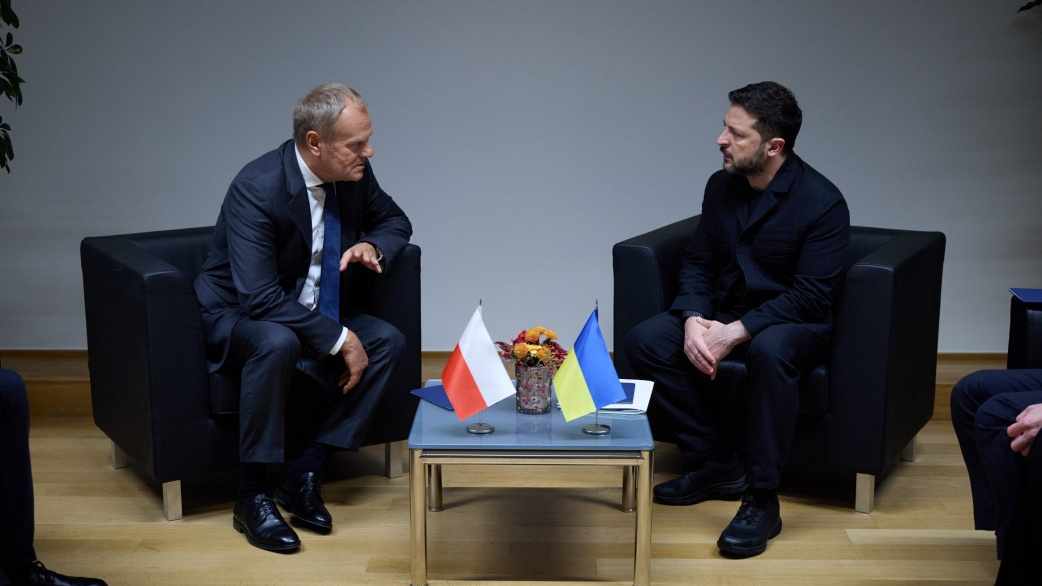
Polish Prime Minister Donald Tusk has told Ukrainian President Volodymyr Zelenskyy that there is no justification for weakening sanctions against Russia, pledging continued Polish support during talks in Brussels on Thursday, 15 October. The meeting also brought an acknowledgment from Zelenskyy that Poland has supplied military assistance to help defend Kyiv against Russian attacks, including support whose details remain undisclosed.
The two leaders met on the sidelines of a European Council summit as tensions between Ukraine and the United States intensified over Washington’s recent approach to Russia, restrictions affecting Ukrainian military communications and disagreements about attacks on Russian energy infrastructure.
Tusk reassured Zelenskyy that Poland and its European partners would continue supporting Ukraine and would oppose measures that could strengthen Russia’s ability to wage war.
- Find more news from Poland on our Homepage .
According to Radio Free Europe’s correspondent, who reported from the meeting, the Polish prime minister said there was no reason for the European Union to relax its sanctions against Moscow or permit additional financing of Russia’s military campaign.
Zelenskyy welcomed the position, thanking Poland for its political and military assistance.
The Ukrainian presidential office confirmed that the leaders discussed intensified Russian strikes and measures to improve Ukraine’s protection against further attacks.
No new bilateral defence agreement, specific additional military package or fresh EU sanctions measure was announced as an outcome of the meeting.
Tusk promises continued support and pressure on Moscow
Speaking during the meeting, Tusk emphasised that Ukraine could continue relying on Poland despite the increasingly difficult international situation.
He also stressed that Warsaw regarded Russia’s continuing invasion as a threat to European security and opposed steps that could make it easier for Moscow to finance its military operations.
Tusk told Zelenskyy:
“We are not just neighbours. We are friends who can count on each other in difficult times.”
The remarks, reported by Euronews during the Brussels summit, reinforced the Polish government’s stated position that European pressure on Moscow should continue.
Zelenskyy responded by thanking the Polish leader for his position on sanctions, arguing that European countries must avoid decisions that help Russia sustain its invasion.
The exchange came during a European Council meeting at which Ukraine’s military needs, Russia’s attacks on civilian infrastructure and further economic pressure on Moscow were among the principal issues under discussion.
Zelenskyy acknowledges Polish military assistance to defend Kyiv
One of the meeting’s most significant details emerged when Zelenskyy thanked Poland for assistance already provided to help protect Ukraine’s capital.
The Ukrainian president referred to support whose precise nature, he indicated, should remain between the two governments.
He also specifically acknowledged the provision of 20mm ammunition, which can be used by certain anti-aircraft weapons.
As European Pravda reported from the Brussels meeting, Zelenskyy said Ukraine was grateful for the assistance because of the difficulty of defending Kyiv against large-scale Russian attacks.
His remarks provide a rare public acknowledgment of some aspects of Poland’s defence cooperation that have not been described in detail.
However, the Ukrainian president did not identify the undisclosed equipment, quantities, delivery dates or specific systems involved.
Nor did he announce that the assistance had been newly agreed during Thursday’s talks.

The distinction is important: Zelenskyy’s comments confirm his acknowledgment of Polish assistance, not the signing of a new military supply agreement.
Meeting comes amid growing tensions between Washington and Kyiv
The talks took place against the background of renewed disagreements between Ukraine and the administration of US President Donald Trump.
Washington’s recent agreement with Russia concerning diesel supplies has generated concern in Ukraine and among European governments about the consequences of easing economic pressure on Moscow.
The arrangement was presented by Trump as an effort to bring additional fuel onto international markets and reduce energy prices.
Zelenskyy criticised the decision, arguing that revenues from Russian energy exports could contribute to Moscow’s ability to continue the war.
Further tensions followed US pressure on Ukraine to suspend attacks against Russian oil refineries.
Ukraine initially observed a temporary pause but subsequently announced that it would resume strikes after accusing Russia of continuing attacks against Ukrainian energy infrastructure.
Zelenskyy has also complained about restrictions affecting satellite communications used by Ukrainian forces and disruptions to the intelligence information available to Kyiv.
The exact extent and circumstances of the intelligence-sharing problems remain disputed. Trump has denied that the United States stopped sharing intelligence, while the European Commission said it had no indication of a complete suspension.
As the Associated Press reported on 15 October, the disagreements have complicated relations between Kyiv and Washington at a time when Ukraine continues to depend on Western military technology and intelligence.
The Polish government’s position therefore carries particular diplomatic significance: Warsaw is publicly reaffirming its opposition to sanctions relief as Washington pursues a different approach to parts of its relationship with Moscow.
EU has already expanded sanctions on Russian defence industry
Tusk’s remarks followed a substantial expansion of European sanctions earlier this week.
On 12 October, the Council of the European Union adopted restrictive measures targeting 1,569 individuals and entities associated with Russia’s military-industrial complex.
The measures cover 826 companies and 743 senior executives involved in supplying components and equipment for Russia’s military production, including missiles, drones and aircraft.
The Council’s official sanctions record confirms that the measures were adopted before Thursday’s meeting.
They should not therefore be presented as a new outcome of the Tusk–Zelenskyy talks.
Poland’s government has separately stated that Tusk would advocate stronger sanctions during the European Council summit, arguing that maintaining pressure on Moscow is necessary while Russia continues its aggression.
The Polish Prime Minister’s Office outlined that position ahead of the meeting, alongside discussions concerning Ukraine’s needs during the coming winter.
European leaders are considering further support for Ukraine, including efforts to strengthen its energy infrastructure against Russian attacks.
Ukraine seeks stronger European defences ahead of winter
Zelenskyy’s Brussels visit follows intensified Russian strikes against Ukrainian cities, energy facilities and transport infrastructure.
During a separate meeting with NATO Secretary General Mark Rutte earlier on Thursday, the Ukrainian president called for additional air-defence equipment, particularly interceptors capable of countering ballistic missiles and ammunition for F-16 aircraft.
According to the Ukrainian presidential office, Zelenskyy reported that Russia had launched approximately 1,000 drones over the preceding period beginning on Wednesday.
The president argued that additional deliveries from NATO partners were particularly important because of the sustained intensity of Russian aerial attacks.
Poland has played a significant role in supporting Ukraine since Russia launched its full-scale invasion in February 2022, including providing military equipment, facilitating international assistance and supporting refugees.
Warsaw also regards Ukraine’s ability to resist Russian aggression as important to Poland’s own security and that of NATO’s eastern flank.
Thursday’s meeting reaffirmed that strategic relationship despite differences between the two countries over some historical and political issues.
For now, the most concrete development from the talks is the public acknowledgment of previously supplied Polish defence assistance, alongside Tusk’s renewed commitment to oppose weakening European sanctions.
Whether the meeting leads to additional military deliveries or new bilateral commitments will depend on subsequent announcements from Warsaw and Kyiv.