By 2040, there could be more British-born people living in Poland than Polish-born people living in Britain — a remarkable reversal of one of Europe’s most significant migration stories. Figures showing a sharp increase in UK-born residents in Poland suggest such a crossover is mathematically possible, although it would depend on continued growth in one population and a decline in the other.
For much of the past two decades, migration between Poland and Britain has been associated with Polish workers heading west in search of higher wages and better opportunities.
Now, a combination of Poland’s economic development, returning families and changing migration patterns is raising a question that would once have seemed extraordinary: could the direction of that relationship be reversed within the next 14 years?
- Find more news from Poland on our Homepage .
According to figures highlighted by the UK Office for National Statistics in May 2026, the number of UK-born people living in Poland rose from approximately 42,000 in 2015 to 185,000 in 2024.
That represents an increase of about 340% in nine years.
Meanwhile, data published by Statistics Poland show that the number of Polish residents temporarily living in Britain has been declining.
The two developments do not yet establish that a complete reversal will occur. However, they provide a basis for exploring what the relationship could look like by 2040.
How the two populations could cross by 2040
The latest United Nations migrant-stock estimates put approximately 185,000 UK-born people in Poland in 2024, compared with 902,000 Polish-born people living in Britain.
The gap remains enormous. Poland’s UK-born population is less than a quarter the size of Britain’s Polish-born population.
But the speed of growth in the smaller population is striking.
Between 2015 and 2024, Poland’s UK-born population increased at an average compound rate of approximately 18% annually.
If that percentage growth continued unchanged, the UK-born population would increase extremely rapidly. Such a projection would be highly speculative, however, because growth rates rarely remain constant indefinitely.
A more restrained scenario assumes that the annual growth rate slows to 10%, substantially below the rate recorded over the previous nine years.
Under that assumption, Poland’s UK-born population would approach 850,000 by 2040.
If the Polish-born population in Britain simultaneously declined by an illustrative 5,000 residents annually from its 2024 level, it would fall to approximately 822,000.
The result would be a crossover.
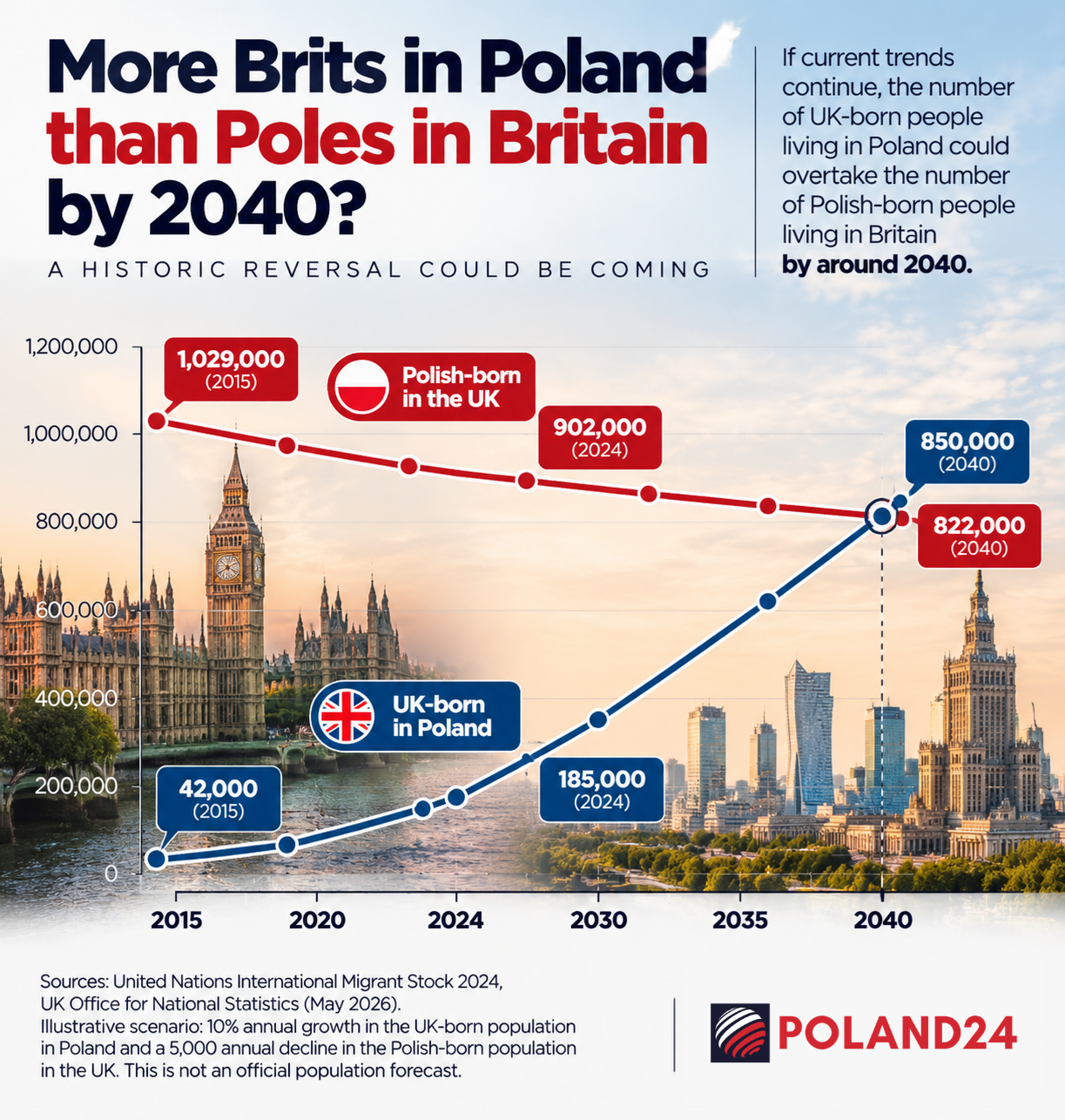
The scenario demonstrates how a reversal could occur, not that it is likely.
A straight-line projection using the average numerical increase recorded between 2015 and 2024 would produce a considerably smaller UK-born population of approximately 439,000 in 2040. Under that alternative, the Polish-born population in Britain would have to decline much faster for the crossover to happen.
The eventual outcome will depend on how migration, family decisions, economic conditions and population growth develop.
Why Poland’s British-born population is growing
The change is rooted partly in Poland’s economic transformation.


After joining the European Union in 2004, Poland experienced sustained economic growth, rising incomes and expanding employment opportunities.
While Britain once offered Polish workers salaries considerably higher than those available at home, that difference has narrowed in many occupations.
For some Polish families, returning home has become a more attractive option.
Importantly, however, the growing UK-born population does not consist exclusively of British people moving to Poland for the first time.
The ONS notes that Polish parents returning from Britain with children born there have contributed to the increase.
Those children are counted as UK-born residents of Poland, even when they hold Polish citizenship, speak Polish and have Polish families.
This is an important limitation when describing the numbers as a rise in British immigration.
The ONS also warns that comprehensive information about the actual flows of British nationals into Poland is unavailable.
Nevertheless, the growth in UK-born residents demonstrates how deeply connected the two countries have become.
Are Poles beginning to leave Britain?
There is also evidence that the era of steadily expanding Polish migration to Britain has changed.
According to Statistics Poland’s August 2026 estimates, approximately 412,000 Polish residents were living temporarily in Britain at the end of 2025.
Revised figures indicate that this narrower population numbered approximately 454,000 in 2020, a decline of around 42,000 over five years.
That represents an average decrease of more than 8,000 annually.
However, this is not the same population as the estimated 902,000 Polish-born residents recorded in the United Nations figures for 2024.
Statistics Poland’s measure concerns people who remain permanently registered in Poland while living abroad temporarily. It excludes many long-established Polish migrants who have settled permanently in Britain.
Consequently, the decline cannot automatically be applied to Britain’s entire Polish-born population.
The latest figures nevertheless illustrate a changing pattern of migration involving Poland.
Britain remains home to one of the world’s largest Polish communities, but the economic circumstances behind its expansion are no longer the same as those of the early 2000s.
Could the reversal happen sooner?
A crossover before 2040 is also mathematically possible under assumptions involving faster growth among UK-born residents in Poland or greater contraction of Britain’s Polish-born population.
Conversely, a slowdown in the growth of Poland’s UK-born community could delay a crossover for decades, or prevent it entirely.
There is no official demographic forecast establishing when, or whether, the populations will exchange positions.
The central uncertainty is whether the extraordinary increase recorded between 2015 and 2024 represents a lasting trend.
The ONS cautions that migrant-stock estimates measure populations at a particular time, rather than new arrivals. They can be influenced by returning families, departures, deaths and differences in national statistical systems.
The 2040 scenario should therefore be understood as an exploration of what could happen if particular demographic assumptions hold.
It is not a prediction that either population will reach a specific number.
A historic reversal of the post-2004 migration story
Whatever happens by 2040, the relationship between Poland and Britain is already different from the one that emerged after EU enlargement.
Two decades ago, the dominant story was the movement of Polish workers into the British economy.
Today, returning Polish families, British-born children growing up in Poland and the country’s expanding economic opportunities are reshaping that picture.
A future in which Poland has more British-born residents than Britain has Polish-born residents remains uncertain.
But the possibility is no longer impossible to illustrate mathematically.
If Poland’s UK-born population continues expanding rapidly while the Polish-born population in Britain gradually contracts, one of Europe’s most recognisable migration relationships could reverse within a generation.