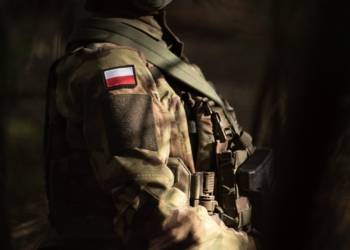


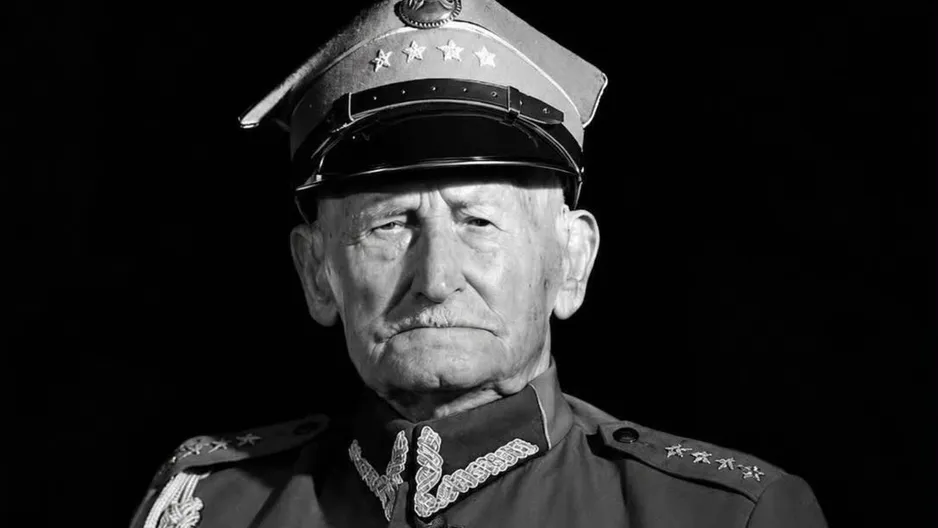
Captain Tadeusz Lutak, Poland’s oldest living military veteran and one of the country’s last surviving soldiers from the September 1939 campaign, has died aged 109, Poland’s Territorial Defence Forces announced on Monday evening. Lutak, who used the wartime pseudonym “Pancerz”, later served in the Home Army resistance during the German occupation.
Born on 29 August 1917 in Żarnowa, near Strzyżów in south-eastern Poland, Lutak volunteered for military service before the Second World War. He joined the 2nd Armoured Battalion in Żurawica in 1937, trained at its non-commissioned officer school and was subsequently assigned to a company equipped with British-built Vickers tanks.
His precise role during Germany’s invasion of Poland in September 1939 was more specific than the description of him simply as a tank crewman. According to the Institute of National Remembrance’s biography of Lutak, he served as a motorcycle messenger in the 121st Light Tank Company of the 10th Cavalry Brigade, commanded at the time by Colonel Stanisław Maczek.
- Find more news from Poland on our Homepage .
The brigade fought delaying actions against German forces in southern Poland, including around Jordanów and Myślenice. Lutak was eventually captured near Stary Dzików but escaped from a prisoner transport and returned home.
Maczek would later become one of Poland’s best-known wartime commanders, leading the Polish 1st Armoured Division during the liberation of parts of France, Belgium and the Netherlands. Lutak’s service in 1939 therefore linked him directly to the formation from which Maczek’s later armoured forces developed.
After Poland’s defeat, Lutak became involved in the underground resistance. From 1940 he served first in the Union of Armed Struggle, or ZWZ, which later became the Home Army, Poland’s principal underground military organisation loyal to the government-in-exile.
Under the pseudonym “Pancerz”, he worked in intelligence and sabotage structures in the Strzyżów area. The IPN records that in 1944, holding the underground rank of corporal, he became commander of a sabotage squad within the local Home Army organisation.
His wartime experience also included forced work on the German railway bunker complex at Strzyżów. While working there, Lutak obtained information and materials useful to the underground. The complex was later associated with Adolf Hitler’s 1941 meeting with Benito Mussolini in nearby Stępina.
After the war, Lutak returned to the Strzyżów region, worked as a butcher and farmer and remained active in veterans’ organisations. He also spent decades sharing his recollections with historians and younger generations, including through the Institute of National Remembrance’s oral-history work.
In 2001 he was promoted to second lieutenant, and in March 2023 he was formally promoted to captain. The IPN recorded the promotion ceremony in Strzyżów, where military representatives, historians and members of the local community gathered to honour him.
Among his decorations were the Officer’s Cross of the Order of Polonia Restituta, the Home Army Cross, the Partisan Cross and the medal for participation in the 1939 defensive war. He also received the IPN’s honorary “Witness of History” award.
When Lutak celebrated his 109th birthday on 29 August 2026, Poland’s Office for War Veterans and Victims of Oppression described him as the oldest living soldier of the Polish Armed Forces and the oldest man in Poland. It also identified him as the last surviving soldier of the 121st Light Tank Company.
The distinction is important: some Polish media headlines described Lutak as the “oldest Pole”, but the official wording established him as Poland’s oldest living man, not necessarily its oldest person overall.
Poland’s Territorial Defence Forces said Lutak’s experience and memory had been particularly important for subsequent generations of soldiers. Members of the 3rd Podkarpacka Territorial Defence Brigade had met him repeatedly in recent years as part of efforts to preserve the memory of Poland’s wartime veterans.
His death removes another direct witness to two defining chapters of Poland’s Second World War experience: the armed defence of the country in September 1939 and the underground resistance that continued during German occupation.