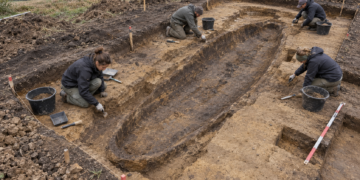


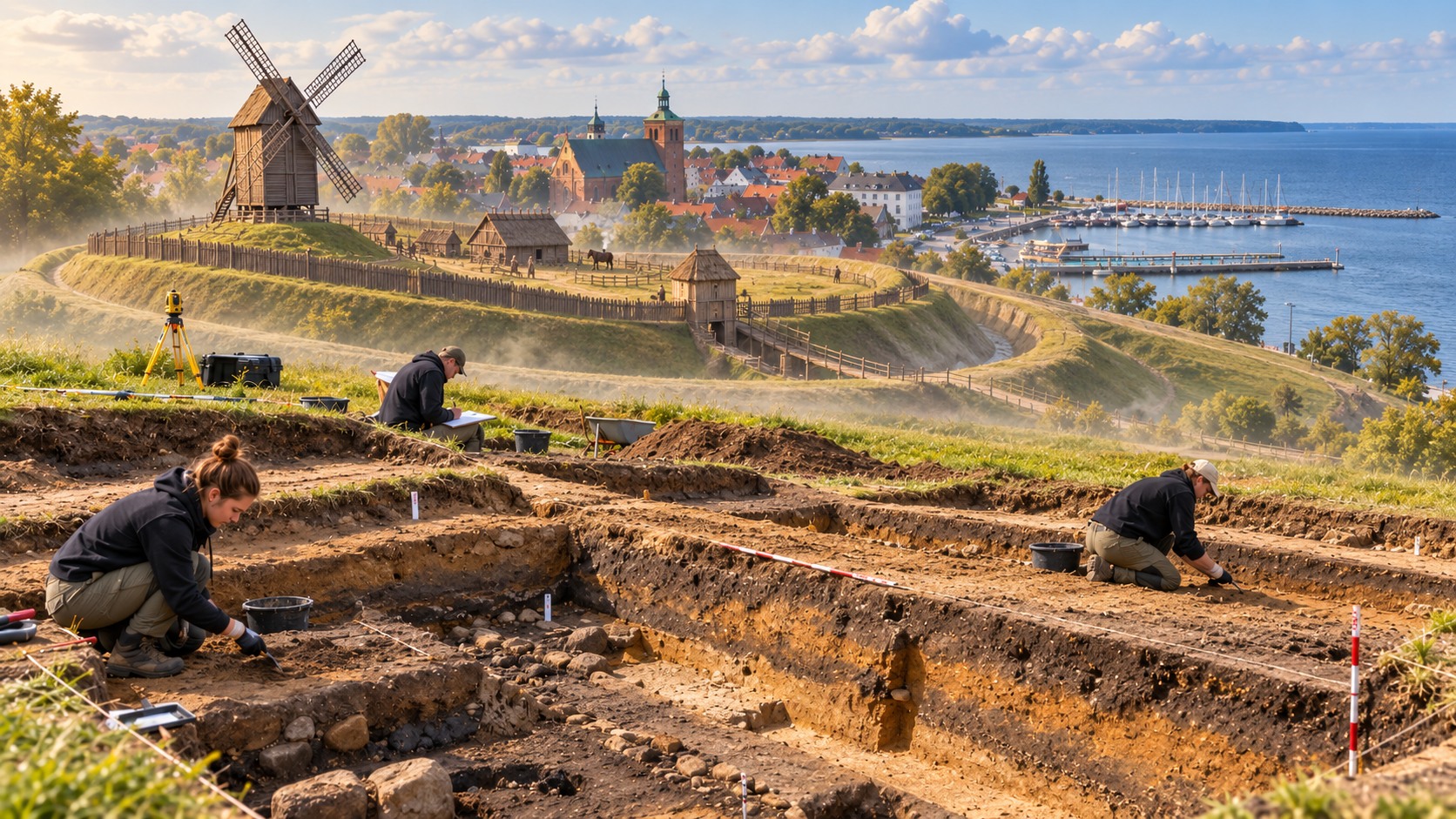
Archaeologists on Poland’s Baltic coast have uncovered more than 300 structures documenting nearly 3,000 years of activity at a single site, including prehistoric settlement traces, a probable 15th-century windmill, possible fortifications from the Thirteen Years’ War and around 150 graves from a later Lutheran cemetery. The discoveries were made on Windmill Hill in Puck, where a University of Warsaw team examined more than 5,000 square metres during this year’s excavations.
The site lies about 300 metres west of Puck’s medieval town centre and appears to have been repeatedly reused by very different communities over many centuries.
Researchers stress, however, that it should not be interpreted as a single settlement continuously occupied for 3,000 years. Instead, the excavations have exposed separate phases of human activity stretching from the first half of the first millennium BC into the modern period.
- Find more news from Poland on our Homepage .
The earliest traces date back almost 3,000 years
The oldest structures have been provisionally associated with people of the Lusatian culture, an archaeological culture that occupied large parts of Central Europe during the late Bronze and early Iron Ages.
The University of Warsaw team dates those traces to the first half of the first millennium BC. Archaeologists also identified more than a dozen pits from the early medieval period, demonstrating that the hill was being used long before the medieval town of Puck developed nearby.
But it is the evidence from the late Middle Ages that has generated the greatest interest.
Two large circular ditch systems were uncovered in the central part of the hill, measuring approximately 30 metres and 50 metres in diameter.
The ditches were roughly 1.5 metres deep and between about 1.5 and 2.5 metres wide. Inside one of the circles, archaeologists discovered the filled-in cellar of a building together with substantial fragments of grooved granite millstones.
Those fragments are particularly important because historical sources record windmills in the area during the 15th century.
Was a Teutonic windmill fortified during a medieval war?
Dr Michał Starski of the University of Warsaw believes the evidence may point to a 15th-century windmill known from written sources, possibly surrounded by two defensive ditches and a small earthwork.
No surviving wooden structure from the windmill itself has been found, so the interpretation depends on the ditches, millstone fragments, documentary evidence and the archaeological context.
Researchers also found more than a dozen stone cannonballs, strengthening the possibility that the hill had a military function during a period of conflict.
One hypothesis is that the fortifications date from the Thirteen Years’ War of 1454–1466, fought between the Teutonic Order and the Kingdom of Poland together with the Prussian Confederation.
Puck changed hands during that conflict.
Teutonic forces captured the town in 1460, while forces associated with Gdańsk later besieged the Teutonic garrison before Puck returned to the Polish side in 1464.
Starski said the hill’s position would have made securing it strategically important during fighting around the town.
If the dating and interpretation are confirmed, the archaeologists believe the structures could represent the first field fortifications from the Thirteen Years’ War identified archaeologically.
That conclusion remains a working hypothesis rather than a final determination. Further analysis will be needed to establish exactly when the ditches were constructed and whether they were directly connected to the fighting of the 1460s.
A 17th-century map provided an important clue
Before excavation began, researchers examined historical maps and documents.
A map from 1634 labels the area Muhlenberg — or Mill Hill — and shows a Lutheran cemetery nearby. Historical sources also record two windmills in the area during the 15th century.

The archaeological work has now provided physical evidence that may help explain why the hill carried that name.
Alongside the defensive-looking ditches and millstone fragments, researchers found evidence of a small neighbouring building, including the remains of a wooden cellar.
The combination of documentary evidence and archaeology makes the windmill interpretation plausible, but researchers are still testing precisely how the individual structures relate to one another.
Around 150 graves uncovered
The hill entered another phase of use after the medieval period.
During the 16th century, much of the area was allocated to Puck’s Protestant community and became a Lutheran cemetery.
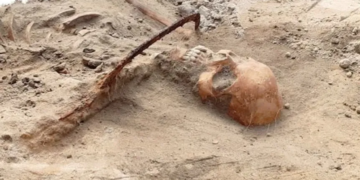
Archaeologists uncovered around 150 graves, although the human remains were generally in poor condition.
Among the small number of surviving objects were four coins dating from the second half of the 15th and the 16th centuries, as well as a one-piece clay pipe from the 17th century.
Researchers believe some of the coins may have been placed with the dead in a continuation of the funerary custom sometimes described as Charon’s obol, in which money was deposited in graves.
The clay pipe may instead have been a personal possession of one of the people buried there.
One hill, many different chapters of Puck’s history
The discoveries make Windmill Hill unusual not because of a single spectacular object, but because so many different periods of Puck’s history are preserved in the same landscape.
The site contains evidence of prehistoric settlement, early medieval activity, late-medieval industry and possible military preparations, followed by centuries of funerary use.
That layered history reflects Puck’s position on the southern Baltic coast, an area repeatedly affected by trade, political change and warfare.
University of Warsaw archaeologists have a long-running research interest in the town. Starski has previously led excavations examining Puck’s medieval urban development and material culture, while the university continued archaeological fieldwork in Puck during 2026.
The newly uncovered structures could now add an entirely different chapter to that work.
Further study will focus on refining the dates of individual structures and burials, analysing the human remains and testing whether the suspected windmill fortifications can genuinely be tied to the Thirteen Years’ War.
For now, the excavations have established one thing clearly: a relatively small hill just outside medieval Puck preserves traces of human activity separated by almost three millennia.