In a solemn ceremony near the German Chancellery and Bundestag, Berlin on Monday unveiled a temporary memorial honoring millions of Polish victims of Nazi Germany’s aggression and occupation during World War II, marking a significant step toward deeper German-Polish reconciliation and remembrance.
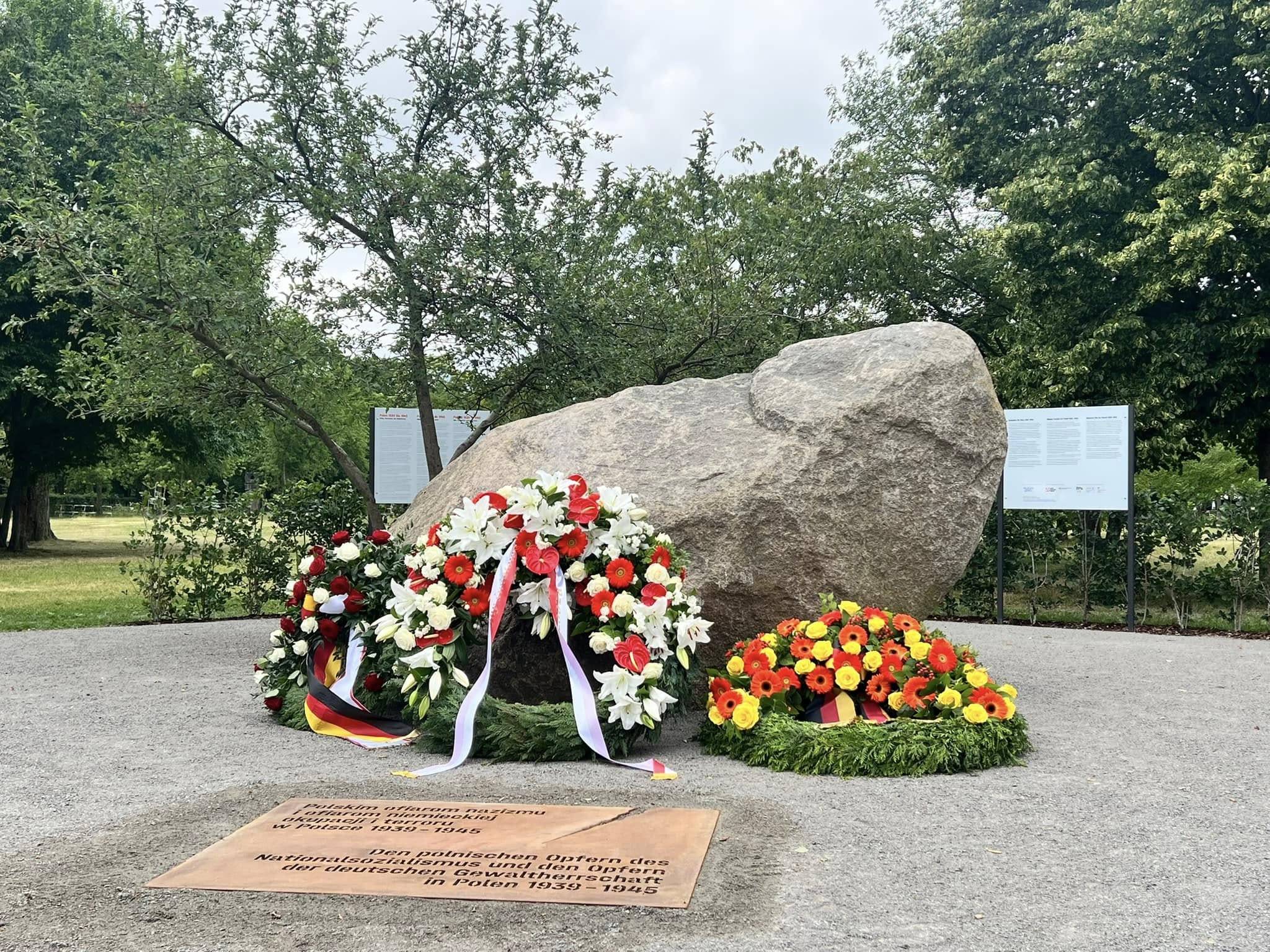
The memorial, a 30-ton glacial boulder engraved in Polish and German, stands on the historic grounds of the former Kroll Opera House. It was at this site on September 1, 1939, that Adolf Hitler announced the invasion of Poland, igniting the Second World War124. The boulder’s inscription reads: “To the Polish victims of National Socialism and the victims of German tyranny in Poland 1939-1945,” serving as a stark reminder of the immense suffering endured by Poland under Nazi rule.
The memorial, a massive 30-ton glacial boulder known as the “Stone of Remembrance for Poland,” has been installed at the former site of the Kroll Opera House. This location is deeply symbolic: it was here, on September 1, 1939, that Adolf Hitler announced the invasion of Poland, setting off the deadliest conflict in modern history.
- Find more news from Poland on our Homepage .
The boulder, inscribed in both Polish and German, stands as a tribute to the more than five million Polish citizens who perished under Nazi occupation, including three million Polish Jews. Its presence in the heart of Berlin is intended to confront the painful legacy of the war and to acknowledge the scale of destruction inflicted upon Poland, where cities like Warsaw were left in ruins and cultural treasures were plundered or destroyed.
Polish Victims of Nazi Occupation
The victims of the German occupation of Poland during World War II were staggering in number and suffered extreme brutality. Approximately 6 million Polish citizens perished, which was about one-fifth of Poland’s pre-war population. This included around 3 million ethnic Poles and 3 million Polish Jews, the latter being victims of the Holocaust. The German occupation was marked by systematic terror aimed at destroying Polish society and culture.
The Nazis considered Poles racially inferior and launched campaigns such as the AB-Aktion to eliminate the Polish leadership class, including teachers, priests, and intellectuals, through mass shootings and deportations to concentration camps. Over 1.8 to 1.9 million non-Jewish Polish civilians were killed by the Germans, alongside the 3 million Jewish victims. The occupation also involved forced labor, mass deportations, and brutal reprisals against resistance activities, with entire families broken up and children subjected to Germanization policies. The scale and cruelty of the German actions left deep scars on the Polish nation and its people
Years of Advocacy and Political Debate
The unveiling follows years of advocacy from Polish and German civic groups, historians, and politicians who have long called for a central Berlin memorial to Polish victims. In 2020, the German federal parliament approved plans for such a memorial, and the government has since committed to establishing a permanent institution—the German-Polish House—at this historic site. This future center will serve not only as a monument but also as an educational and cultural venue to foster dialogue and understanding between the two nations.
The temporary memorial has drawn mixed reactions. German officials, including Culture Minister Claudia Roth, have emphasized its importance as a sign of Germany’s ongoing responsibility and a step toward strengthening German-Polish relations. Polish leaders, such as Culture Minister Hanna Wróblewska, have highlighted the memorial’s role in ensuring that the memory of Polish suffering is preserved and respected.
However, the choice of a boulder as a temporary tribute has sparked criticism among some Polish politicians and commentators, who see it as an inadequate response to decades of suffering and destruction. Critics argue that a more substantial and permanent gesture is needed, especially as debates over wartime reparations and historical responsibility continue to shape relations between the two countries.
Political and Public Criticism in Poland
The memorial, a large boulder, sparked a wave of critical reactions on social media and among Polish politicians. Many users expressed disbelief and frustration over the modest form of the temporary memorial, with some calling it a “slap in the face” and a symbol of years of neglect and lack of genuine will to properly commemorate Polish victims.
Former Polish Prime Minister Beata Szydło and other opposition figures mocked the memorial, suggesting the boulder was a poor substitute for a dignified monument and linking it to broader grievances over reparations and historical recognition.
Law and Justice (PiS) MP Szymon Szynkowski vel Sęk described the gesture as “unbelievable,” criticizing Germany for offering a boulder instead of reparations or a more substantial memorial. Other politicians echoed this sentiment, calling the stone a symbol of neglect rather than reconciliation.
Toward a Permanent Memorial
The German-Polish House, once completed, will be more than a monument. It is envisioned as a center for exhibitions, education, and cultural exchange, exploring not only the brutality of the occupation but also the centuries of intertwined history between Germany and Poland. The Bundestag is expected to finalize decisions regarding the project’s full implementation, with the goal of creating a lasting space for remembrance and dialogue.
The new memorial stands as both a gesture of reconciliation and a reminder of the enduring impact of the past. For many, it is a long-overdue acknowledgment of the immense losses suffered by Poland—a step toward healing historical wounds and building a shared European future.