Two Polish-built satellites have captured detailed images of Warsaw from orbit, photographing the capital during the same flight over Poland just 16 days after their launch into space. The photographs, released ahead of Polish Independence Day, offer a new demonstration of the country’s growing satellite-imaging capabilities.
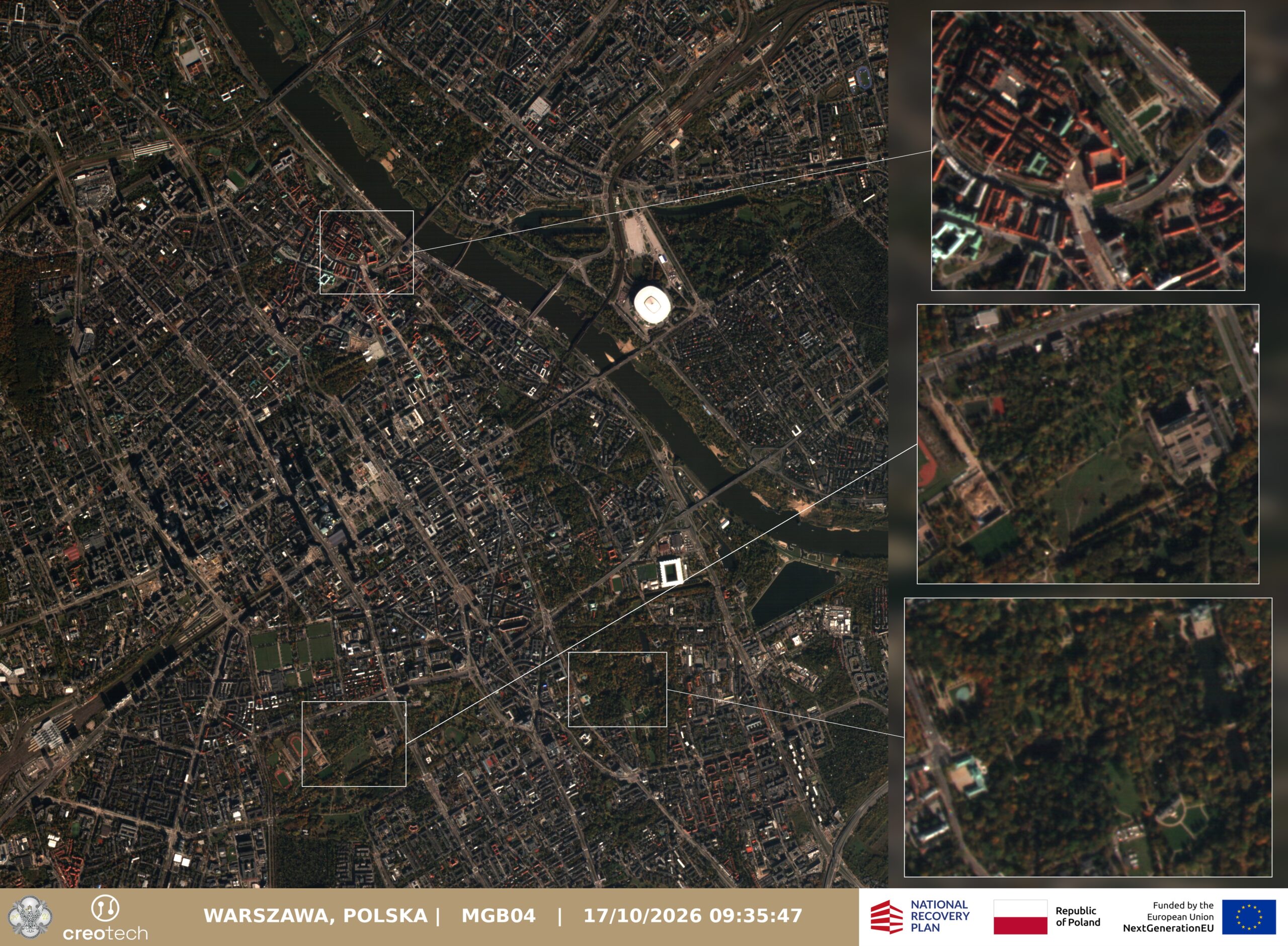
Polish space technology company Creotech Instruments presented the images on Tuesday, 10 November, revealing views of central Warsaw recorded by the Mikroglob-2 and Mikroglob-4 satellites.
Both spacecraft were launched on 1 October 2026 aboard a SpaceX Falcon 9 rocket as part of the Transporter-18 mission. The newly published photographs were taken on 17 October, approximately one minute apart.
- Find more news from Poland on our Homepage .
The release comes as Poland develops a four-satellite Earth-observation system intended to strengthen its ability to collect imagery independently for security and defence purposes.
Warsaw’s famous landmarks seen from space
The two satellites photographed much of central Warsaw, but used different imaging methods.
Mikroglob-4 captured a colour image using a multispectral RGB imaging channel. The photograph shows the capital in morning light, covering an area that includes Powązki, Pole Mokotowskie and the Warsaw Citadel.
According to Creotech’s original announcement, which includes the satellite photographs, closer views reveal several of Warsaw’s best-known landmarks, including the Royal Castle and Old Town, the National Library, Belweder Palace and the Royal Łazienki park complex.
The other image was taken by Mikroglob-2, approximately one minute earlier.
It used a panchromatic imaging channel, recording light across the visible spectrum to produce a monochrome image rather than a conventional colour photograph.
Among the landmarks identifiable in the published material are the Warsaw Citadel, the National Stadium, the Tomb of the Unknown Soldier and the Saxon Garden.
The two images demonstrate how separate satellites within the same constellation can capture imagery of a similar area during a single orbital pass.
Creotech has not provided a confirmed ground-resolution figure for these particular photographs in its public announcement. The images therefore should not be used to infer precisely which smaller objects the system can identify.
A symbolic release for Polish Independence Day
Creotech deliberately published the photographs shortly before 11 November, when Poland celebrates the restoration of its independence in 1918.
The company presented the images as a symbol of technological independence, connecting the country’s national anniversary with its ability to design, build and operate satellite systems.
Grzegorz Brona, president of Creotech Instruments, said the latest photographs demonstrate that the technology is progressing beyond the capabilities of a single spacecraft towards a complete observation system.
He also argued that developing domestic space infrastructure and independently obtaining information from orbit have become important aspects of national security.
The company’s comments reflect its ambitions for the programme, although the constellation has not yet completed its commissioning and acceptance procedures.
Poland’s four-satellite constellation is now in orbit
The Mikroglob programme comprises four Earth-observation satellites developed by Creotech Instruments under a contract with Poland’s Armament Agency, part of the Ministry of National Defence.
The spacecraft use the company’s proprietary HyperSat satellite platform.
The first satellite, Mikroglob-1, was already in orbit when the remaining three — Mikroglob-2, Mikroglob-3 and Mikroglob-4 — were launched together on 1 October from Vandenberg Space Force Base in California.

Following the launch, Creotech announced that all three new satellites had established two-way communications with ground infrastructure and begun orbital testing.
Poland-24 previously reported on the successful deployment of the complete four-satellite Mikroglob constellation, a milestone in the country’s development of domestically controlled reconnaissance technology.
Earlier imagery released by Creotech came from Mikroglob-1 and included locations outside Poland, such as airports in the United States and the Chinese city of Dalian.
The latest photographs are significant because they demonstrate imaging capabilities from two additional satellites in the constellation.
However, the system remains in the commissioning phase.
Creotech says engineers are continuing to calibrate imaging instruments and systems responsible for precisely orientating the spacecraft in orbit.
These tests are needed before the constellation can meet its intended operational performance requirements. Releasing photographs is evidence of progress, rather than confirmation that the entire system has entered full operational service.
Why Poland is developing its own satellite capabilities
The Mikroglob programme is part of a broader effort to expand Poland’s ability to gather information from space.
Under the government’s satellite Earth-observation programme, the Armament Agency signed a contract with Creotech on 20 December 2024 worth approximately PLN 556.7 million.
The project is co-financed through Poland’s National Recovery and Resilience Plan, which includes funding from the European Union.
The four satellites are designed to collect imagery in visible and near-infrared wavelengths and transmit the data to ground systems.
Operating several satellites provides opportunities to revisit selected locations more frequently than would be possible with one spacecraft alone.
Such capabilities can support defence and security applications, including the observation of changes in infrastructure, terrain and other areas of interest.
Poland is also investing in other satellite reconnaissance programmes, including higher-resolution optical systems and radar satellites.
These technologies serve different purposes. Optical satellites collect images using available light, while radar-based systems can observe the Earth’s surface at night and through cloud cover.
The Mikroglob constellation is therefore intended to complement, rather than replace, Poland’s other satellite investments.
For Creotech, the programme also represents an opportunity to demonstrate its ability to deliver an integrated space system — from satellite design and manufacturing to launch preparation and orbital operations.
The company says the Warsaw photographs mark another stage in that process.
For the wider public, the significance is more immediate: familiar streets, parks and landmarks of the Polish capital can now be seen through imaging equipment developed and operated as part of a Polish satellite programme.