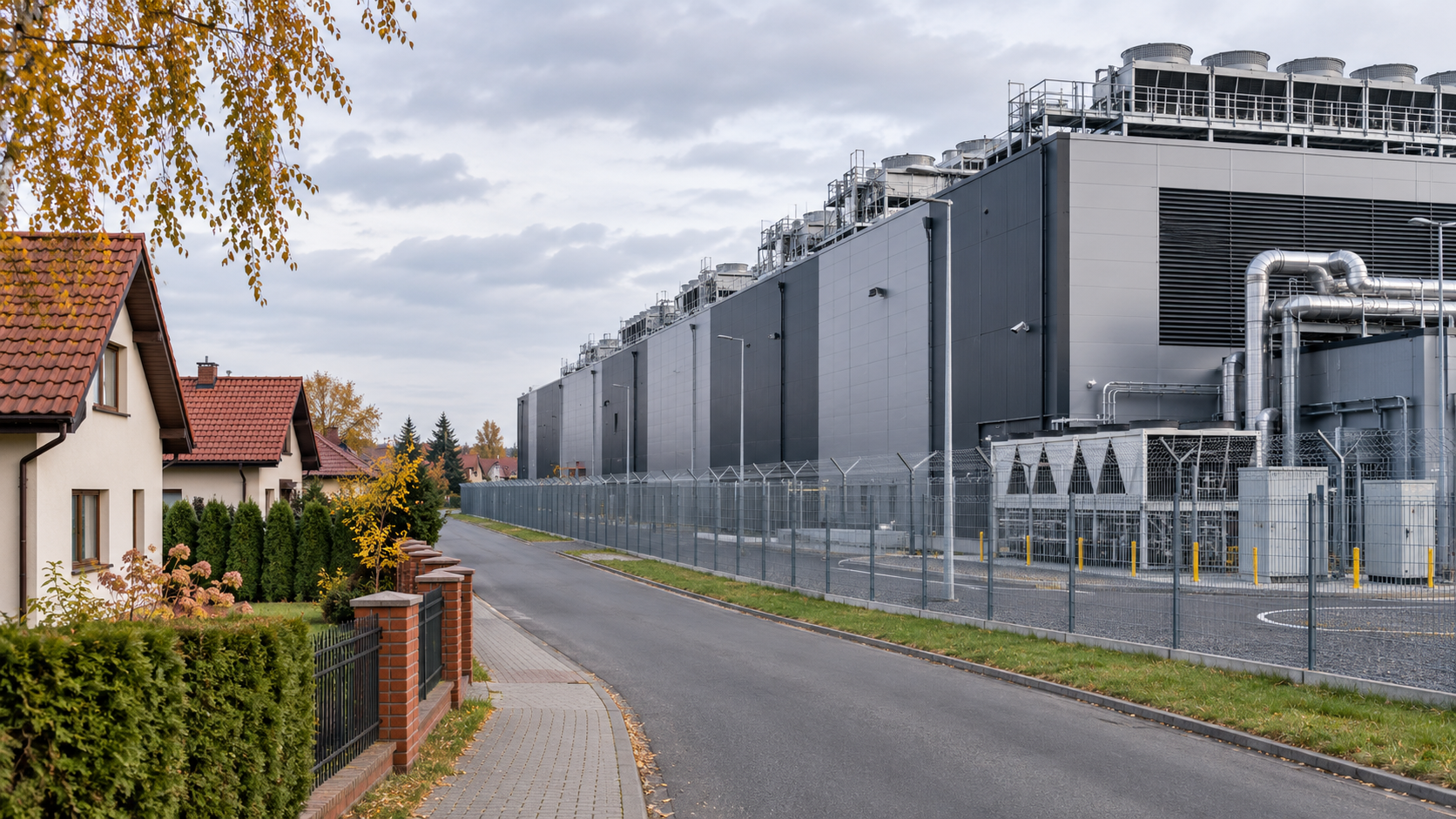
Protesters gathered outside Poland’s parliament in Warsaw as part of a Europe-wide campaign demanding tighter controls on the expansion of large data centres, amid growing concerns over electricity consumption, water supplies, noise and the impact of developments built close to residential areas.
The demonstration took place on Friday, 6 November, drawing several dozen participants, including residents from communities near Warsaw where major data-centre projects are planned or under construction.
The Warsaw protest formed part of the Stop Dirty Data Centres campaign, which organised actions across approximately 15 European countries on 6 and 7 November. According to international reporting by Le Monde, the coalition recorded approximately 90 events across the participating countries.
- Find more news from Poland on our Homepage .
Campaigners are calling for a temporary moratorium on large-scale developments until governments introduce stronger environmental protections, transparent planning procedures and greater public involvement in decisions about where facilities should be built.
Polish residents take demands to parliament
The Warsaw demonstration was organised by local groups including Stop Serwerowni Piaseczno and Stowarzyszenie Aktywnych Sąsiadów (Association of Active Neighbours), both of which are campaigning over planned data-centre investments near residential communities.
The protest took place outside the Sejm, Poland’s lower house of parliament, where demonstrators called for national legislation governing the location and environmental impact of large computing facilities.
According to Radio dla Ciebie’s reporting from the demonstration, participants chanted slogans including “People first, data later” and expressed concern about the potential burden of new facilities on electricity networks and water supplies.
Environmental organisations, trade union representatives and members of the left-wing Razem party also participated.
The Association of Active Neighbours prepared a petition addressed to the Sejm, seeking a temporary suspension of procedures for new construction permits and related administrative approvals for very large data centres.
Its proposal would apply to projects with information technology equipment exceeding 10 megawatts of power.
The petition is a demand from campaigners, not an existing government policy or an adopted parliamentary measure.
Data centre near Warsaw becomes focus of local opposition
One of the main disputes behind the Warsaw demonstration concerns a major data-centre development on Energetyczna Street in Piaseczno, south of the Polish capital.
The project involves four buildings on a former industrial site and is being developed by Sien Real, a company involving Polish construction group Budimex.
Residents from neighbouring Piaseczno and Józefosław argue that they were not adequately informed about the scale of the investment before construction preparations became visible.
They are particularly concerned that the development will stand approximately 30–35 metres from the nearest residential buildings.
In its reporting on the protest, TVP3 Warszawa quoted Anna Rzeźnicka of Stop Serwerowni Piaseczno, who said residents had learned about the project when fencing appeared and construction machinery arrived.
The residents are concerned about possible noise from cooling equipment, additional electricity demand and the availability of water in a district that has already experienced supply-pressure problems.
However, those concerns should not be confused with established environmental damage.
Sien Real maintains that its project complies with applicable Polish and European environmental regulations and that the development obtained the required environmental decision.
In a statement published by the Piaseczno municipal authorities, the developer said normal water consumption would not exceed approximately 55 cubic metres per day when all four buildings were operating.

The company also said its cooling systems would operate largely through a closed circuit, limiting water consumption.
Residents have challenged aspects of the environmental documentation and the company’s explanations of the projected water requirements. Their campaign has requested further independent examination and monitoring.
The dispute therefore involves not only the potential environmental consequences of the development, but also whether existing planning and consultation procedures provide sufficient protection for neighbouring communities.
Data centres become a growing issue across Europe
The Polish protest was one element of a wider campaign that brought together environmental groups, digital-rights organisations and local residents’ associations.
Actions took place in countries including Spain, France, Germany, Ireland, the Netherlands and the United Kingdom.
In Zaragoza, Spain, approximately 2,000 people marched amid concerns about the water demands of large computing facilities in a region affected by drought.
In Amsterdam, campaigners entered the construction site of a planned Microsoft data centre, temporarily disrupting work. Dutch police detained between 150 and 200 people suspected of trespassing, according to the Associated Press’s account of the demonstration.
The European campaign argues that rapid construction is proceeding without sufficient examination of the cumulative impact on electricity systems, natural resources and neighbouring populations.
Its proposed moratorium is intended to create time for new rules and public debate, rather than permanently prohibit all data-centre construction.
Poland faces growing demand for digital infrastructure
The protests come as Poland seeks to expand its role in Europe’s digital economy, particularly in cloud computing, artificial intelligence and data processing.
A report prepared by PwC and the Polish Data Centre Association estimated that the sector generated PLN 10.6 billion in gross value added in 2025 and supported approximately 41,000 jobs directly and indirectly across the Polish economy.
These are industry-commissioned estimates of the sector’s wider economic contribution, rather than a count of employees working exclusively inside data centres.
Meanwhile, Poland’s National Institute of Telecommunications highlighted the growing energy demands of the industry in an October 2026 report.
Citing forecasts from the national electricity transmission operator PSE, the institute said Polish data centres could consume approximately 17–18 terawatt-hours of electricity annually by 2035.
That is a forecast, not current consumption, and depends on how quickly new facilities are developed.
The Polish government has also identified expanded computing capacity as an economic and technological priority, including through planned AI infrastructure and initiatives intended to strengthen the country’s technological independence.
The Ministry of Digital Affairs has separately supported projects examining how waste heat from data centres could be reused to heat homes and other buildings.
For policymakers, the challenge is therefore not simply whether Poland should develop more digital infrastructure, but how to accommodate additional demand for land, electricity and cooling without imposing unreasonable costs on neighbouring communities.
For the protesters who gathered outside parliament in Warsaw, that question has become increasingly urgent.
They want national authorities to establish clearer requirements before more large facilities are approved, while developers and public institutions continue pursuing investments considered important for Poland’s digital future.