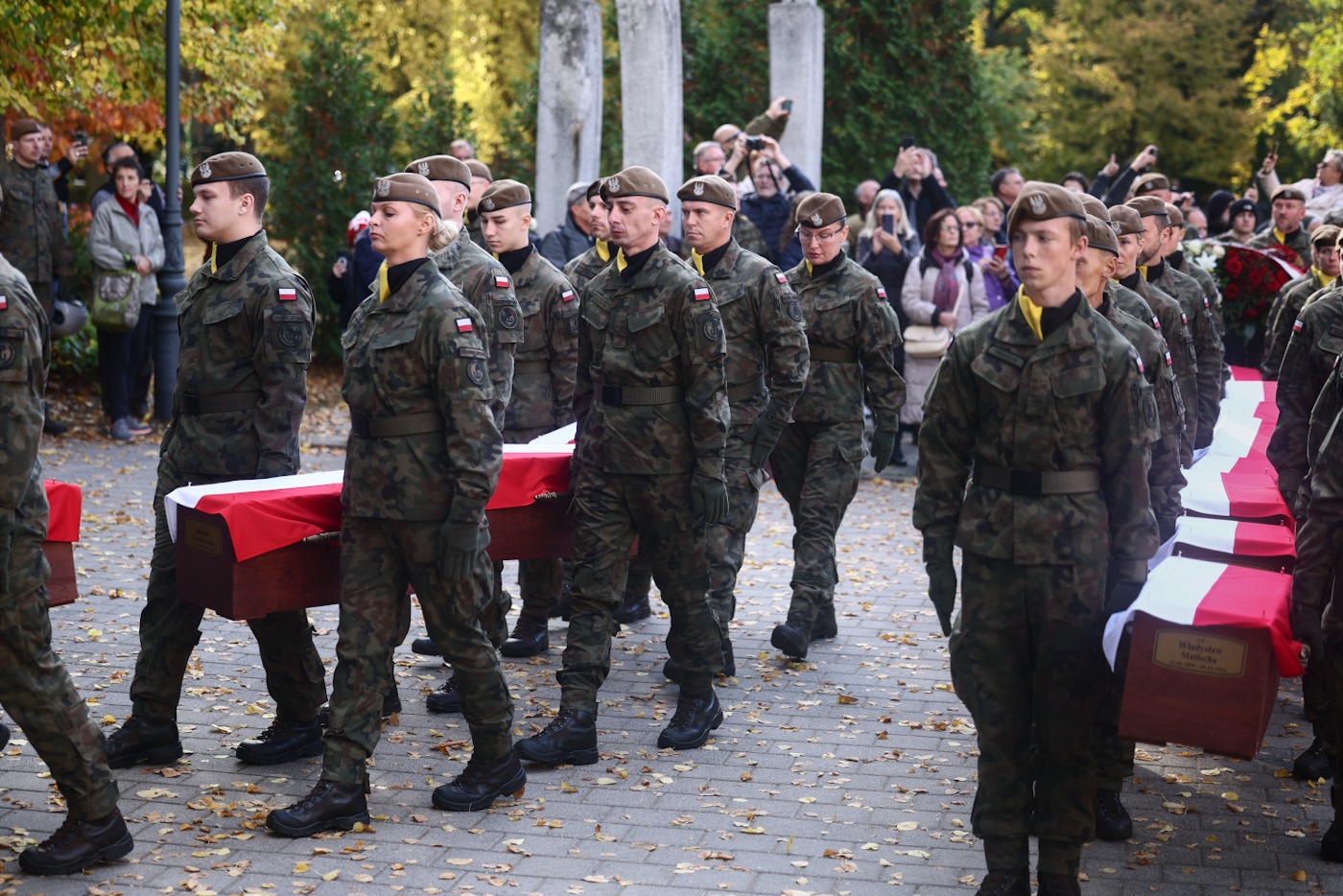
Poland has held a state funeral for 49 soldiers and underground independence activists who died under communist repression more than seven decades ago, following years of work to recover their remains from former prison burial grounds in the southwestern city of Wrocław. President Karol Nawrocki attended Wednesday’s ceremony, which also marked the opening of a new memorial section dedicated to victims of the Stalinist-era security apparatus.
The funeral took place on 21 October at Osobowicki Cemetery, where prisoners executed or killed while in custody were buried during the years following the Second World War.
The ceremony followed archaeological investigations and exhumations carried out by Poland’s Institute of National Remembrance (IPN) between 2024 and 2026.
- Find more news from Poland on our Homepage .
The institute, which investigates crimes committed under Nazi and communist rule and works to identify their victims, has now published the names and biographical details of the 49 people buried in the newly established section.
Their backgrounds range from Second World War resistance veterans to members of post-war underground organisations who opposed Poland’s Soviet-backed communist authorities.
President pays tribute to victims of communist repression
The funeral began with a Catholic Mass in the cemetery chapel, led by Bishop Wiesław Lechowicz, the bishop responsible for Poland’s military chaplaincy.
President Karol Nawrocki joined relatives, representatives of state institutions, military personnel, veterans’ organisations and local residents.
Speaking at the ceremony, the president said the victims had suffered not only imprisonment and death but also attempts by the communist authorities to suppress the memory of their lives.
According to the President’s Office account of his address, Nawrocki described those being buried as people who had fought for Poland’s freedom, sovereignty and independence.
He argued that communist repression had extended beyond the killing of political opponents to the destruction or concealment of their graves.
The president also recalled the words of Łukasz Ciepliński, a leader of the anti-communist Freedom and Independence organisation who was executed in 1951.
Nawrocki said the persistence of families, historians and anti-communist opposition activists had helped preserve the memory of people whom the authorities had sought to erase from public history.
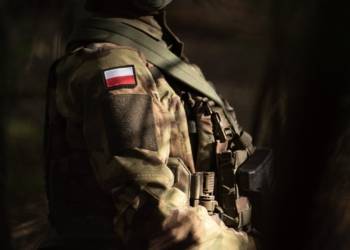
The ceremony concluded with the burial of the recovered remains in the newly established Quarter of the Steadfast Soldiers (Kwatera Żołnierzy Niezłomnych), accompanied by a military salute.
Secret prison burial grounds in Wrocław
The remains came from two former prison burial areas at Osobowicki Cemetery, identified as plots 81A and 120.
Between 1948 and 1956, these areas were used to bury people executed or deceased in Wrocław’s prisons and security-service detention facilities.
They included prisoners from Prison No. 1 on Kleczkowska Street and Prison No. 2 on Sądowa Street, as well as people held by the communist security apparatus.
Among the dead were former members of the wartime Home Army (Armia Krajowa, or AK), which had fought against Nazi Germany, and activists who continued underground resistance after communist authorities consolidated control of Poland.
Others belonged to organisations such as Freedom and Independence (WiN), the National Armed Forces (NSZ) and the National Military Union (NZW).
The burial grounds also contained people imprisoned for reasons unrelated to the independence underground.
According to the IPN’s account of its investigation, communist-era burial practices mixed the graves of political prisoners with those of other prisoners, including people convicted of ordinary crimes.

That complicated later efforts to establish where individual victims had been buried.
The institute said that some graves were subsequently threatened by plans to reuse the burial areas in the 1970s and 1980s, although those plans were not fully carried out at Osobowicki Cemetery.
The cemetery became an important place of remembrance for victims of Stalinist repression, but the condition and organisation of the former prison plots remained unresolved for decades.
The 49 people who have now been buried
The IPN’s published list of the 49 individuals provides their names, dates of birth and death, and known involvement in wartime or post-war independence activities.
Among those named is Lieutenant-Colonel Ludwik Marszałek, whose underground name was Zbroja.
Born in 1912, Marszałek served as a professional Polish Army officer and member of the Home Army before becoming the final head of the Lower Silesian regional organisation of Freedom and Independence.
He died on 27 November 1948.
Also included is Wiktor Komorowski, a Polish military aviator and fighter ace who later became involved in an intelligence network connected to the Polish government-in-exile. He died in August 1952.
Another is Józef Błaszczak, a Home Army veteran who participated in the 1944 Warsaw Uprising and died in December 1950.
The list also includes Halina Załęska, a woman involved in an underground National Military Union network, who died in October 1952.
These examples illustrate the varied experiences of those who resisted or were persecuted by the post-war authorities.
Some had fought against Nazi Germany before continuing their activities under communist rule. Others belonged to smaller, sometimes locally organised resistance movements.
The IPN’s list establishes the identities and documented biographies of the people commemorated in Wednesday’s burial.
However, the publicly available post-ceremony information does not provide a complete explanation of the forensic identification process for each set of remains, including whether DNA testing was used in every case.
The distinction matters: identifying a victim through historical records and establishing the identity of recovered remains through genetic or other forensic evidence are related but separate investigative processes.
‘Great-grandfather, after all these years, we are here’
For relatives of the victims, the funeral represented a long-awaited opportunity to commemorate family members who had died under repression.
Speaking on behalf of the families, Magdalena Ziółkowska, the great-granddaughter of Lieutenant-Colonel Ludwik Marszałek, described the personal consequences of the loss.
As reported in the IPN’s official account of the ceremony, she explained that her knowledge of her great-grandfather came partly through the memories passed down by his daughter, her grandmother.
Those memories preserved not just the history of a resistance fighter but also the story of a father whose children had grown up without him.
Addressing her great-grandfather, she said:
“Great-grandfather, after all these years, we are here.”
Her remarks highlighted the experience of families who had spent generations preserving the memory of relatives whose deaths and burial places were obscured by the communist authorities.
Why Poland is still recovering victims of communist rule
Poland emerged from the Second World War under a Soviet-backed communist government.
The new authorities treated many members of the wartime independence underground and opponents of communist rule as political enemies.
The security apparatus carried out arrests, interrogations, imprisonment and executions as part of the effort to suppress organised opposition.
Many of those killed became known in modern Poland as the Żołnierze Wyklęci, commonly translated as the “Cursed Soldiers”, or Żołnierze Niezłomni, the “Steadfast Soldiers”.
The terms are used to describe participants in the post-war anti-communist underground, although the organisations involved differed in their political affiliations, methods and wartime records.
The biographies of individual participants therefore require historical examination rather than treating the entire underground as a single organisation.
After communist rule ended in 1989, historians, families and public institutions increasingly sought to establish what had happened to those imprisoned, executed or buried without adequate identification.
The IPN, founded in 1998, later became a central institution in that work.
Its investigations involve archival research, historical analysis, archaeology, exhumations and forensic identification.
The work at Wrocław’s Osobowicki Cemetery is part of this wider effort to document the victims of communist-era repression and restore identifiable graves where possible.
A new memorial section after years of investigation
The project to reorganise the former prison burial grounds began in 2023, with cooperation between the IPN, the Wrocław city authorities and the Lower Silesian regional administration.
A specialist team examined historical records to establish which people buried in plots 81A and 120 had been persecuted because of activities connected to Polish independence.
Exhumation work followed during 2024–2026.
At an October 2025 press conference, IPN officials explained that a central objective was to distinguish the graves of independence activists from those of other prisoners and establish a dedicated military memorial section.
The project included new graves bearing names, dates and biographical information.
Officials also outlined plans to preserve the site’s historic memorial crosses within a commemorative arrangement, known as a lapidarium.
The newly established Quarter of the Steadfast Soldiers was formally opened on 21 October 2026, according to the IPN’s post-ceremony announcement.
This marks a significant stage in restoring the former prison burial areas as a place of public remembrance.
What happens next?
Wednesday’s funeral formally completed the reburial of the 49 people named by the IPN and marked the opening of their new commemorative section.
However, the wider memorial project has involved additional work on the surrounding former prison burial grounds.
Plans presented in 2025 included landscaping, retaining historic memorial elements and creating a space for reflection rather than further ordinary burials.
The extent to which every part of that wider design has been completed was not specified in the post-ceremony announcements.
Similarly, the IPN has not published a consolidated account establishing the precise forensic identification method used for each of the 49 people commemorated.
Those details remain important for understanding the full archaeological and historical results.
For the families who gathered in Wrocław, Wednesday nevertheless marked a significant moment.
More than 70 years after the deaths of their relatives, 49 people associated with Poland’s wartime and post-war independence movements have been given a formal burial in a dedicated place of remembrance.