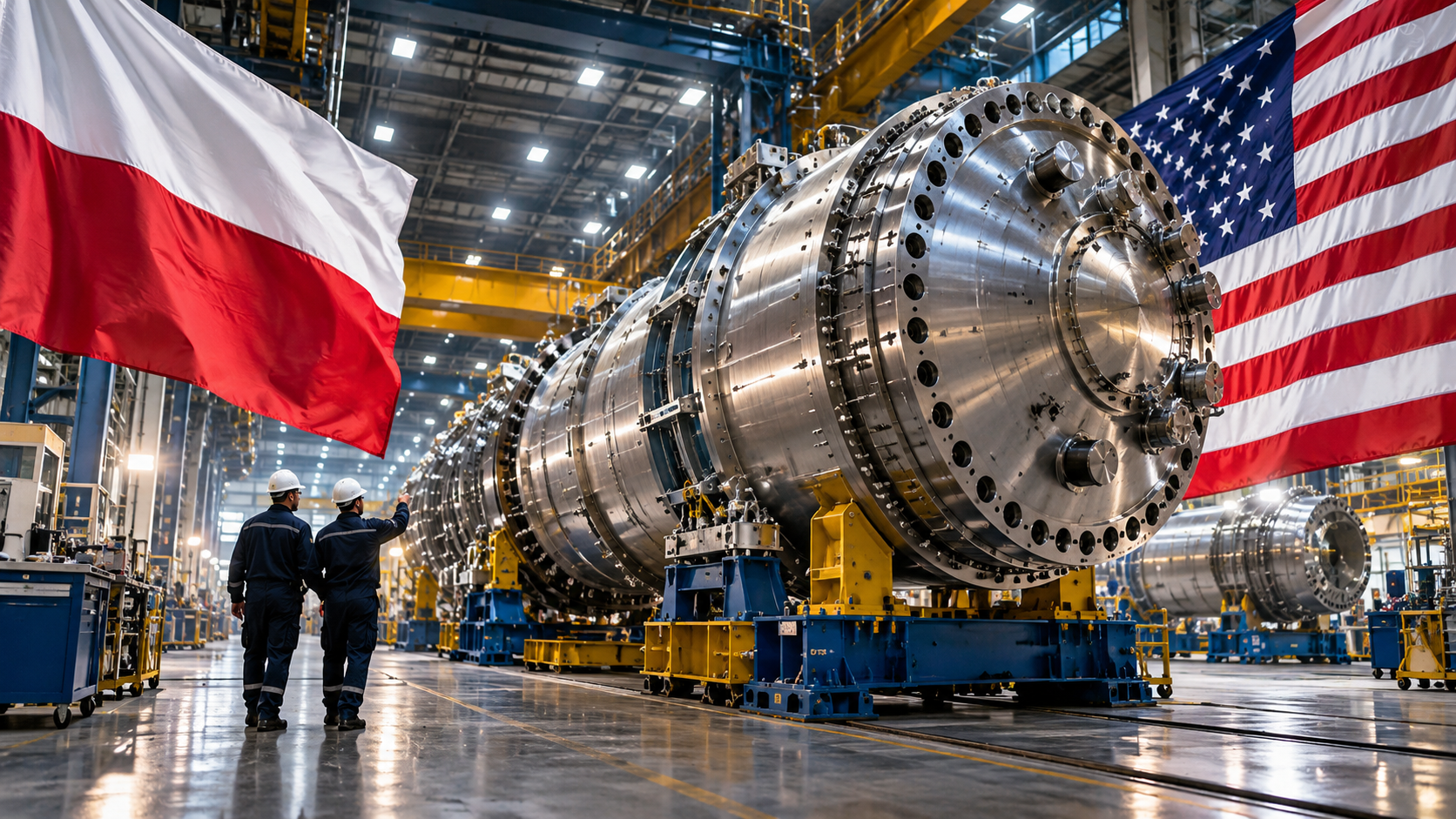
American nuclear technology company BWXT, a major supplier to the US Navy, is considering an investment worth up to $1.5 billion in Poland, according to a new report, as the country seeks to attract strategic American manufacturers and develop nuclear technology for both civilian and military applications.
The proposed investment would be located in northern Poland and involve producing components for small nuclear reactors, nuclear fuel and other advanced nuclear technologies.
According to Business Insider Polska, which first reported the plans on Thursday, 22 October, the potential investment could reach $1.5 billion.
- Find more news from Poland on our Homepage .
The report said BWXT president and chief executive Rex D. Geveden and company representatives were due to meet Polish Defence Minister Władysław Kosiniak-Kamysz in Warsaw on Thursday.
No signed investment agreement, final location or construction timetable has been publicly confirmed. The reported investment value is based on Business Insider’s sources familiar with the discussions.
An American company at the heart of the US nuclear navy
BWX Technologies, commonly known as BWXT, is one of the United States’ most important nuclear engineering and manufacturing companies.
Headquartered in Lynchburg, Virginia, the company supplies reactors, components and nuclear fuel for American submarines and aircraft carriers.
BWXT describes itself as the sole manufacturer of naval nuclear reactors for the US Navy. Its work dates back to the 1950s, when it helped develop components for USS Nautilus, the world’s first nuclear-powered submarine.
The company continues to support the US Navy’s submarine and aircraft carrier programmes, including the Virginia, Columbia and Ford classes.
In May 2026, BWXT announced naval nuclear propulsion contracts worth more than $1.4 billion, demonstrating the scale of its established work for the American military.
Its potential entry into Poland would therefore involve a company with extensive experience supplying nuclear technology to one of NATO’s largest armed forces.
However, there is no indication that the reported Polish investment would involve manufacturing classified US naval propulsion systems or transferring sensitive American military nuclear technology.
The activities identified in Business Insider’s report concern reactor components, nuclear fuel and related technologies.
Northern Poland targeted for new nuclear manufacturing
The proposed project would form part of Poland’s Green Industrial District, known as Kaszubia.
Launched by the Ministry of National Defence in May 2025, the initiative aims to develop industrial, technological and logistical capabilities across northern Poland.
It covers the Pomeranian, West Pomeranian and Kuyavian-Pomeranian regions, bringing together defence manufacturing, energy projects, critical infrastructure and international investment.
According to the Defence Ministry’s announcement on 7 October, projects associated with Kaszubia already represent more than PLN 20 billion in investment plans and industrial initiatives involving Polish companies and partners from several NATO countries.
One recently announced initiative involves approximately PLN 800 million of planned investment by Polish defence manufacturer WB Group, alongside cooperation with Norway’s Kongsberg Defence & Aerospace.
The ministry presents Kaszubia as a way to integrate economic development with national security, particularly in the strategically important Baltic Sea region.
A substantial BWXT investment would extend that strategy into advanced nuclear manufacturing.


Business Insider reports that the American company is considering production facilities capable of supplying components for small modular reactors, nuclear fuel and associated technologies.
However, the precise scope of any Polish facilities, including what categories of nuclear fuel could be manufactured, has not been independently established.
Could nuclear reactors power Polish military bases?
The potential cooperation also has a military energy dimension.
Poland has been examining whether small nuclear reactors could provide electricity for military installations and other critical defence infrastructure.
The idea is to reduce dependence on external electricity grids, which may be vulnerable to disruption during a crisis or armed conflict.
BWXT is developing a technology known as the BWXT Advanced Nuclear Reactor, or BANR.
It is a compact, high-temperature, gas-cooled nuclear reactor designed to provide electricity and potentially industrial heat.
In August 2026, the US Army selected BWXT as one of five companies participating in its Janus programme, which aims to introduce nuclear microreactors at American military installations.
BWXT’s reactor was selected for Fort Campbell, an Army installation spanning parts of Kentucky and Tennessee.
The company says its planned reactor for the project would generate approximately 20 megawatts of electricity.
That capacity could provide a substantial source of power for a military installation, although practical deployment depends on engineering, financing, regulatory approval and security requirements.
BWXT currently expects construction work associated with its Fort Campbell project to begin in late 2028, with reactor operations targeted for the early 2030s.
The US Army’s wider Janus programme involves potential government funding of up to $2.2 billion across five selected suppliers. That figure refers to the American programme, not BWXT’s proposed investment in Poland.
Business Insider reports that similar technology is being considered as a possible future source of power for Polish military installations and potentially an expanded American military presence in Poland.
No purchase of BANR reactors for Polish military bases has been confirmed.
Poland’s growing small-reactor ambitions
BWXT’s potential investment would also connect with Poland’s wider plans to develop small modular nuclear reactors, commonly known as SMRs.
These are smaller than conventional large nuclear power stations and are being developed for applications including industrial electricity generation, district heating and supplying large facilities.
BWXT already manufactures components for the BWRX-300 reactor designed by GE Vernova Hitachi Nuclear Energy.
The American company’s Canadian operations are producing a reactor pressure vessel for the first BWRX-300 unit at the Darlington nuclear site in Ontario.
The technology is also central to Poland’s commercial SMR ambitions.
In February 2026, Polish company Orlen Synthos Green Energy signed an agreement with GE Vernova Hitachi to develop a standardised BWRX-300 reactor design adapted to Polish regulations.
According to the Polish government’s announcement, the arrangement is intended to support potential future deployment of multiple reactors and expand the involvement of Polish manufacturers in the nuclear supply chain.
The BWRX-300 is a different technology from BWXT’s BANR.
The former is designed to generate approximately 300 megawatts of electricity, while the version of BANR selected for the US Army’s Janus programme is designed to produce around 20 megawatts.
A BWXT manufacturing presence in Poland could create opportunities for participation in nuclear projects serving both commercial customers and the defence sector, although no specific Polish supply contracts have been announced.
Investment still requires agreements and regulatory approval
The reported plans remain at an exploratory stage.
Any manufacturing facility involving nuclear materials would need to comply with applicable Polish nuclear safety requirements and other relevant authorisations.
Poland’s National Atomic Energy Agency, known as PAA, is responsible for regulating nuclear safety and radiation protection.
The agency’s licensing guidance explains that nuclear installations require detailed safety assessments and authorisations covering their construction, commissioning and operation.
A future reactor project would therefore need to proceed through regulatory processes before it could become operational.
Similarly, any advanced nuclear fuel production involving sensitive materials or technology would require appropriate legal and regulatory arrangements.
At present, there is no publicly confirmed investment decision, employment forecast, construction date or reactor deployment agreement associated with BWXT’s reported Polish plans.
Nevertheless, the discussions come as Poland seeks deeper industrial relationships with American defence suppliers while developing domestic manufacturing capabilities.
For Poland, the significance of a potential BWXT investment extends beyond its reported $1.5 billion price tag.
It would represent an opportunity to establish an advanced nuclear industrial presence in the country, connecting civilian energy projects with the increasingly important requirement to make military infrastructure more resilient.
Whether those ambitions translate into new factories, supply contracts or operational reactors will depend on the outcome of negotiations and subsequent investment decisions.