Nine artworks that disappeared from Polish collections during the Second World War and in subsequent decades have been brought together in Warsaw, following years of international investigations that traced missing cultural treasures to auction houses and private collections across Europe, the United States and Japan.
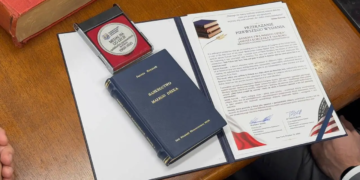
The exhibition, Utracone / Odzyskane. Oblicza kobiet (Lost / Recovered: Faces of Women), opens to the public on Thursday, 22 October, at the Kordegarda gallery in central Warsaw, following an official evening opening scheduled for Wednesday.
Among the recovered objects are a 17th-century painting of the Madonna and Child found at an auction in Tokyo, a portrait returned from Denmark, an artwork voluntarily handed back by a German couple and a historic bronze wall light identified at a London auction.
- Find more news from Poland on our Homepage .
The exhibition also includes works stolen from Polish museums long after the war, illustrating how the country’s efforts to recover its missing cultural heritage extend beyond the Nazi occupation.
Organised by Poland’s Ministry of Culture and National Heritage and the National Centre for Culture, the exhibition is the tenth instalment in a series documenting successful art restitution cases.
According to the National Centre for Culture’s exhibition announcement, the works have been temporarily reunited from museums and collections across Poland, offering visitors an opportunity to see objects whose whereabouts remained unknown for decades.
A missing Madonna traced from Poland to New York and Tokyo
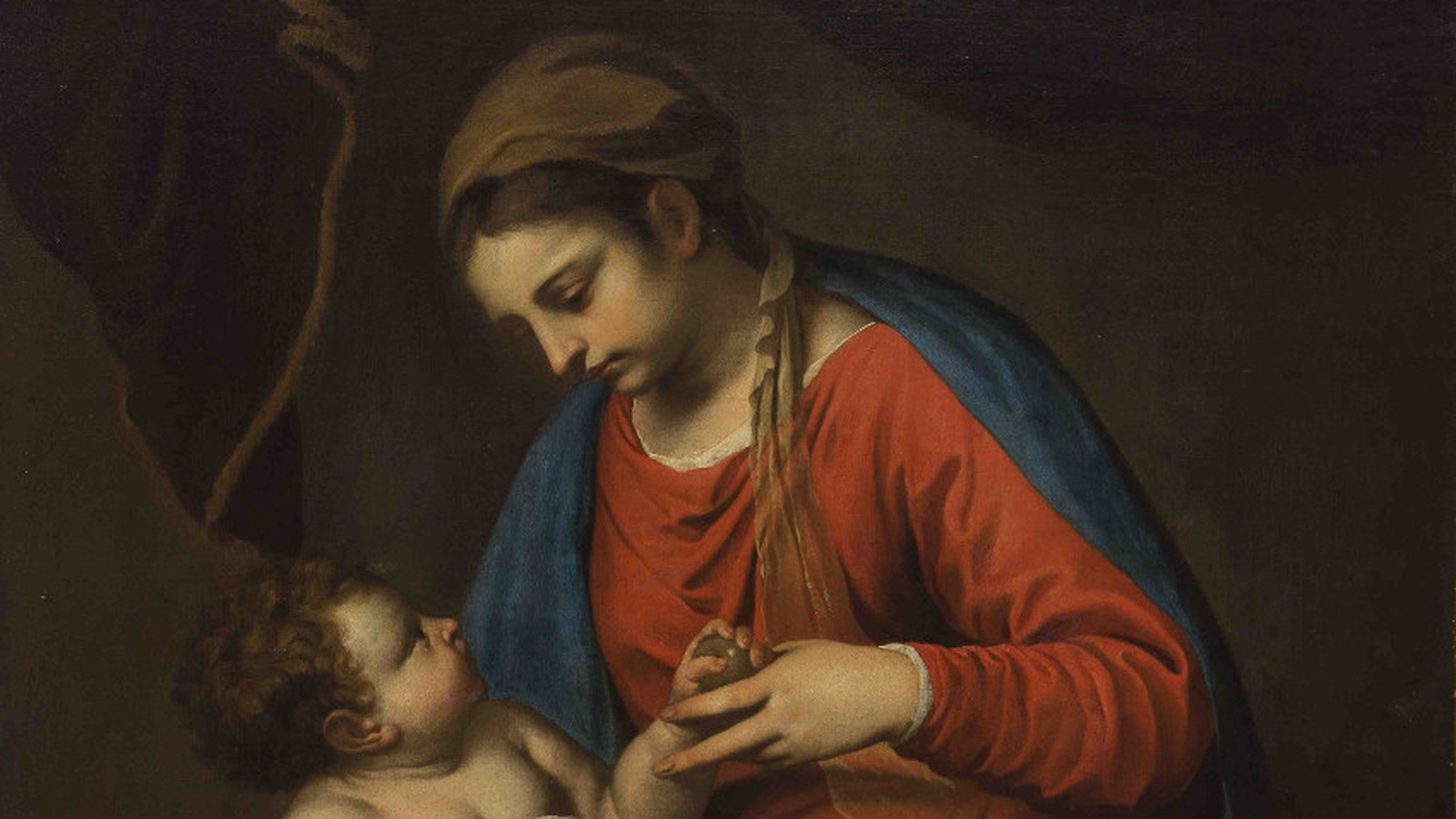
One of the exhibition’s central works is Madonna and Child, a painting attributed to the Italian Baroque artist Alessandro Turchi, who lived from 1578 to 1649.
The work once belonged to the historic Lubomirski collection at the family’s palace in Przeworsk, southeastern Poland.
Its presence in the collection can be traced to an inventory prepared in 1823, which also recorded an earlier connection with Polish aristocrat and art collector Stanisław Kostka Potocki.
During the Second World War, the painting was seized by Nazi German authorities and taken from Poland.
It subsequently disappeared from public view.
According to the Ministry of Culture’s detailed account of the recovery, the painting resurfaced at an auction in New York in the late 1990s before eventually entering the Japanese art market.
In January 2022, a Polish restitution specialist identified the painting in an auction catalogue in Tokyo.
The discovery triggered a formal investigation into its provenance.
Polish officials and art historians examined archival material and compared the painting with historical documentation, including a wartime catalogue compiled by Nazi officials of valuable artworks seized from occupied Poland.
The evidence established that the painting had been among the works taken from Polish collections.
Following negotiations with Mainichi Auction Inc. and the painting’s holder, the Japanese auction house agreed to facilitate its return without payment.
A handover ceremony was held at the Polish Embassy in Tokyo in May 2023, and the artwork returned to Poland that July.
It is now held within the collections of the Ossoliński National Institute in Wrocław.
Its journey from a Polish aristocratic palace through Germany, New York and Tokyo illustrates how artworks displaced by war can pass through multiple countries and generations before their original ownership is rediscovered.
A German couple discovers a Polish museum stamp
Another exhibit, Lady with a Fan (Dama z wachlarzem), returned to Poland through a very different route.
The 19th-century hand-coloured print had belonged to the collection of Wilanów Palace in Warsaw, the historic residence associated with King John III Sobieski.
The artwork was recorded in Wilanów’s inventories during the 19th century but disappeared during the Second World War.
For almost eight decades, its whereabouts were unknown.
In May 2023, a married couple living in Berlin contacted Polish authorities after discovering historical markings on the reverse of an artwork in their possession.
According to the Ministry of Culture’s account of the return, these included an old inventory number and a stamp identifying the Wilanów picture gallery.
The markings helped establish its provenance.
The couple agreed to return the work unconditionally to the Museum of King Jan III’s Palace at Wilanów.
Its recovery demonstrates how historic inventory records and markings on the backs of artworks can help resolve cases many decades after the original loss.
A painting stolen in 1994 reappears at a German auction
Not all the works on display were lost during the Second World War.
One of the more recent thefts involved Portrait of a Young Woman, painted in 1863 by Wilhelm Volkhart.
The painting belonged to the National Museum in Wrocław and was stored at the former Cistercian abbey in Lubiąż, which served as a museum storage facility.
Between 1 and 5 April 1994, thieves broke into the facility and stole 16 paintings.
Among them was Volkhart’s portrait.
The work remained missing for nearly three decades.
In February 2023, it was identified when it appeared on the German art market.
As Polish Radio reported in its account of the exhibition, Poland’s Ministry of Culture intervened to halt the planned sale.
After evidence of the painting’s provenance was presented, the work was returned to the National Museum in Wrocław in May 2023.
The recovery highlights another challenge facing museums: artworks stolen long after the war can enter international commercial markets and become difficult to trace as they change hands.
A Danish portrait rediscovered after decades abroad
The exhibition also includes Summer (Lato), painted by Danish artist Bertha Wegmann before 1906.
The painting, showing a woman breastfeeding two infants, had belonged to a museum collection in Wrocław before the Second World War.
At that time, the city was known as Breslau and was part of Germany.
The work disappeared in the post-war years, when the city came under Polish administration.
Its later history took it through the international art market, including appearances in Britain, Israel and Denmark.
The painting remained unidentified partly because no historical photograph of it survived.
In January 2024, the Art Loss Register referred the work to Polish restitution specialists after it was offered for sale at the Bruun Rasmussen auction house in Copenhagen.
According to the Ministry of Culture’s October 2025 announcement, experts used a surviving pre-war catalogue description and evidence on the reverse of the painting to establish its identity.
The auction house withdrew the work from sale and contacted its holders.
The painting had been inherited by two Danish siblings who, officials said, were unaware of its earlier history.
After learning about its provenance, they agreed to return it.
The work was formally handed over to the National Museum in Wrocław in October 2025.
A bronze relic recovered from London
Another unusual exhibit is a gilded bronze wall light decorated with the head of Medusa.
The object once formed part of the furnishings of the Palace on the Isle at Warsaw’s Łazienki Królewskie, or Royal Baths, park.
Dating from the late 18th century, it was installed in the palace’s Salomon Room and disappeared during the Second World War.
The wall light resurfaced at an auction in London in November 2017.
Following investigations and negotiations involving Polish authorities and Christie’s auction house, its holder agreed to return it.
The object was presented at the Polish Embassy in London in October 2023 before returning to the Royal Łazienki collection.
The recovery is particularly significant because it demonstrates that Polish wartime losses include not only paintings but also decorative arts, furniture and architectural furnishings.
Nine works spanning four centuries
The exhibition’s theme is the representation of women in art.
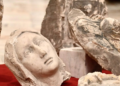
The nine objects date from the 17th to the early 20th century and include portraits, religious imagery, representations of motherhood and allegorical figures.
In addition to the works already described, the exhibition includes Leopold Löffler’s Girl with a Canary, recovered in 2015, and Leon Wyczółkowski’s Highland Girl, also known as Village Girl in a Yellow Headscarf.
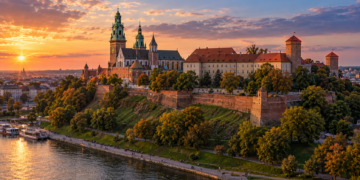
The latter, a pastel created in 1900, disappeared from the Wawel Royal Castle collection during the Second World War.
It was identified on the Polish art market in 2020 and returned to Wawel in December 2021.
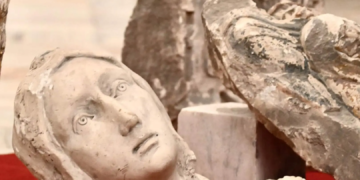
Two further works complete the selection: Motherhood, a small drawing by Michał Płoński recovered in 2024, and an early-17th-century alabaster sculpture, Personification of Faith, originally associated with St Mary Magdalene’s Church in Wrocław.
The full nine-object selection is documented in the Ministry of Culture’s exhibition object list, prepared for the exhibition’s production.
The range of artworks is an important part of the exhibition’s message.
Many were lost during wartime upheaval and systematic plunder, while others disappeared through later thefts or unlawful movements across borders.
Their return required different methods, from identifying archival catalogue entries and museum stamps to negotiations with private collectors and auction houses.
Poland still pursuing more than 200 restitution cases
The Warsaw exhibition represents only a small part of Poland’s broader cultural restitution efforts.
According to Culture Minister Marta Cienkowska, the ministry has recovered more than 920 cultural objects and is currently pursuing over 200 restitution cases across 18 countries.
The figures were provided in the National Centre for Culture’s official exhibition announcement.
The cases cover both artworks displaced during the Second World War and cultural property lost or illegally removed during later decades.
Poland suffered extensive cultural losses during the war as Nazi Germany and the Soviet Union occupied different parts of its territory.
Museums, religious institutions, private collectors and historic residences lost paintings, manuscripts, sculptures, furniture and other valuable objects.
Many were destroyed, while others were removed and dispersed internationally.
Today, restitution investigations often require cooperation between Polish museums, foreign authorities, auction houses, collectors, researchers and specialist art-market organisations.
The processes can take years, particularly when ownership records are incomplete or an artwork has passed through numerous private collections.
The current exhibition illustrates how those investigations can end with the return of objects once considered permanently lost.
How to visit the exhibition
Lost / Recovered: Faces of Women is presented at Kordegarda, the National Centre for Culture’s gallery on Krakowskie Przedmieście in the historic centre of Warsaw.
The exhibition is curated by Ewa Witkowska and runs from 22 October to 6 December 2026.
Admission is free.
The gallery is open Tuesday to Friday from 11am to 7pm, and on weekends from 11am to 5pm. It is closed on Mondays.
Further visitor information is available through the National Centre for Culture’s exhibition page.
For visitors, the exhibition offers more than a chance to see nine recovered artworks in one place.
Each object carries a record of disappearance, investigation and eventual recovery — a reminder that Poland’s search for cultural property lost during the war and its aftermath is still continuing more than eight decades later.