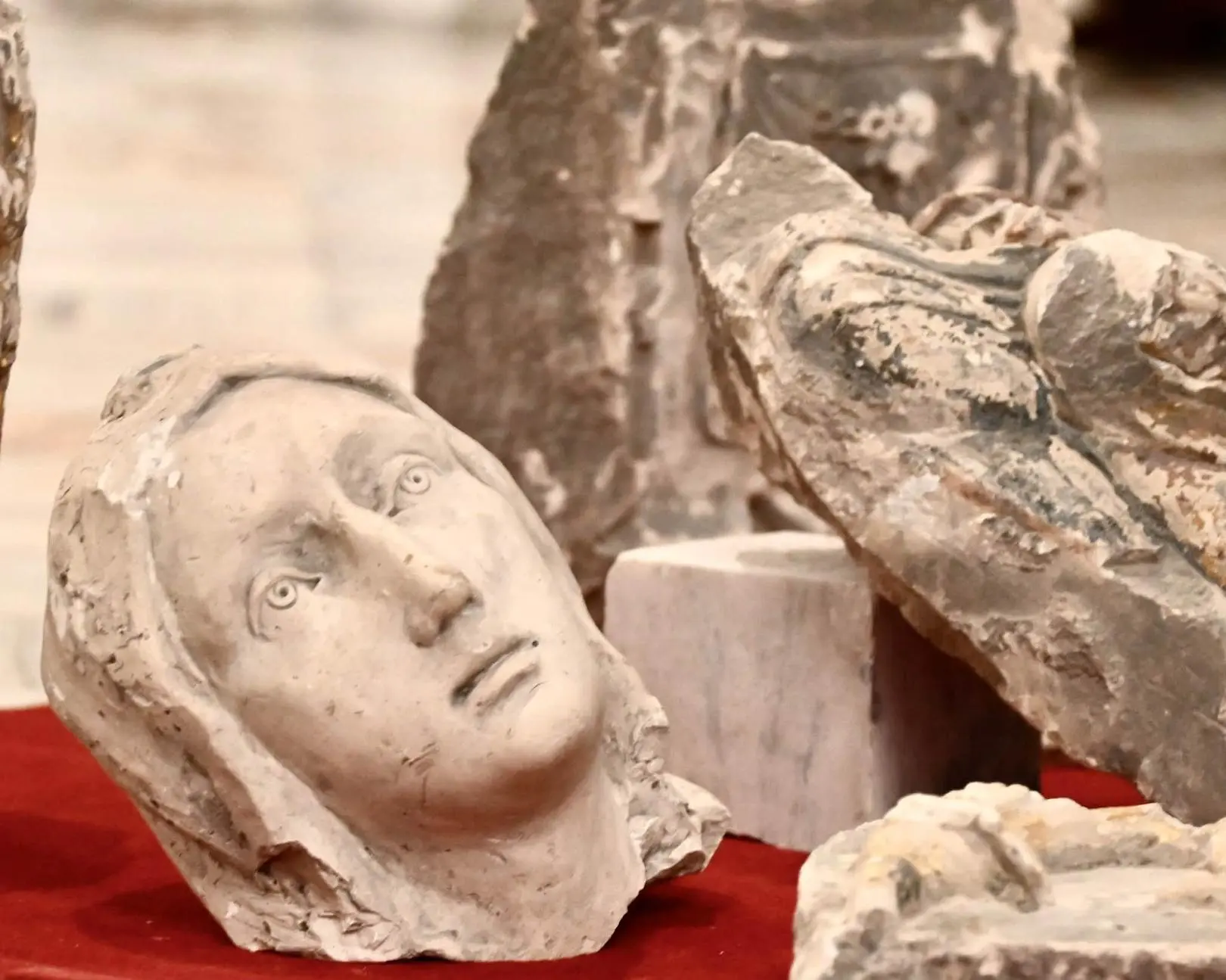
Fragments of a Renaissance altar dating back approximately 450 years have been recovered from beneath a historic church in Warsaw, revealing a rare work of Polish sculpture believed to have been lost during the Second World War.
The discovery was made in the underground chambers of the Church of the Visitation of the Blessed Virgin Mary in Warsaw’s New Town, where researchers uncovered carved stone fragments buried among rubble and material stored beneath the building.
The surviving pieces are believed to date from between 1565 and 1580 and may have been created by Jan Michałowicz of Urzędów, one of the most prominent Polish sculptors of the Renaissance.
- Find more news from Poland on our Homepage .
Despite decades underground and the destruction caused by the war, several fragments retain traces of their original gilding and painted decoration.
The findings were officially presented on Monday, 19 October, during an event attended by senior Polish heritage officials, conservators and researchers from the Polish Academy of Sciences.
According to Poland’s Ministry of Culture and National Heritage, the discovery could provide important new evidence about Renaissance art in Warsaw and the work of a sculptor whose surviving output is dominated by funerary monuments.
A remarkable discovery beneath a medieval church
The fragments were identified during an inspection of the underground rooms of the Church of the Visitation of the Blessed Virgin Mary, situated on Przyrynek Street in Warsaw’s historic New Town.
The initial discovery occurred in August, when officials from the regional heritage protection office noticed elements of historic church furnishings among material stored beneath the building.
Specialists from the Institute of Art of the Polish Academy of Sciences subsequently joined the investigation.
Dr Piotr Jamski and Professor Marcin Zgliński worked alongside heritage officials to examine the recovered pieces and identify their original purpose.
As debris was gradually cleared during August and September, investigators uncovered further carved fragments, including a sculpture depicting the face of Christ.
Zgliński told the Polish Press Agency that finding the sculpture was an unexpected moment during the exploration of the crypt.
The discovery led researchers to examine the remaining stone pieces more closely.
According to the Polish Press Agency’s report published by the historical service Dzieje.pl, the fragments are made from Pińczów limestone, a stone used extensively by Renaissance sculptors working in Poland.
The recovered elements have now been preliminarily cleaned and placed in a temporary collection area while conservation work is prepared.
Historic photographs reveal the altar’s identity
At first, the researchers believed the carved pieces belonged to an unidentified Renaissance tomb.
That interpretation changed after investigators examined archival photographs held by the Polish Academy of Sciences.
Images dating from approximately 1895 and 1936 showed an altar containing decorative elements matching those discovered underground.
The photographs enabled researchers to identify the fragments as parts of a much larger Renaissance altar that had once stood inside the church.
They also provided evidence of the monument’s appearance before its wartime destruction.


Among the recovered pieces are intricately decorated column shafts, sections of architectural entablature and ornamental friezes featuring symbols associated with the Passion of Christ.
A particularly important fragment comes from a large relief depicting the Crucifixion that originally occupied the centre of the altar.
Investigators have also identified remnants of gilding and polychromy — the coloured decoration applied to sculpted surfaces.
These traces are especially valuable because they provide information about the altar’s original appearance, rather than simply its surviving architectural form.
Researchers estimate that roughly one-fifth of the monument has been recovered.
Although much of the original structure is missing, the surviving fragments and historical photographs may allow specialists to establish how the complete altar looked.
Could this be a previously unknown work by a Polish Renaissance master?
One of the most significant aspects of the discovery is its possible connection to Jan Michałowicz of Urzędów.
Michałowicz, who lived during the 16th century, is regarded as one of the leading Polish sculptors and architects of the Renaissance.
He belonged to a generation of native artists who developed a sophisticated command of styles and techniques introduced into Poland by Italian Renaissance craftsmen.
His best-known surviving works include elaborate funerary monuments and sculptural commissions for important ecclesiastical patrons.
Examples associated with him can be found in Kraków’s Wawel Cathedral, Łowicz and several other Polish churches.
However, no altar securely identified as his work had previously been known, according to the Culture Ministry.
The Warsaw fragments could therefore represent an important addition to the understanding of his artistic career.
Researchers have identified stylistic similarities between the discovered pieces and the sculptor’s known works.
Of particular importance is the tomb of Bishop Andrzej Zebrzydowski in Wawel Cathedral, created in 1562–1563 and signed by Michałowicz.
Specialists have also identified parallels with later monuments associated with the sculptor, including the tombs of Bishop Filip Padniewski and Primate Jakub Uchański.
The comparison supports a proposed creation date of approximately 1565–1580.
The attribution nevertheless remains provisional. Further archival research and art-historical analysis will be needed before the altar’s authorship can be established with greater certainty.
How did the altar end up in this Warsaw church?
Despite the discovery’s location, researchers do not believe the altar was necessarily created for the Church of the Visitation.
The Culture Ministry says it may have been transferred there from another Warsaw church towards the end of the 18th century or during the 19th century.
That would mean the monument could already have been more than 200 years old when it arrived at its last known location.
The church’s documented history shows that the altar stood in a side aisle during the interwar period.
Archival photographs establish its presence, but its earlier history remains unclear.
Investigators are now examining historical records to determine which church originally commissioned the work and how it was subsequently relocated.
This is particularly interesting because Warsaw was a much smaller religious and political centre when the altar was created.
According to the ministry, only eight churches existed at the time across Old and New Warsaw and their immediate surroundings.
Identifying which of those institutions originally housed the altar could provide important clues about its patron, artistic purpose and history.
For now, those questions remain open.
How the monument survived the destruction of Warsaw
The Church of the Visitation of the Blessed Virgin Mary is itself one of Warsaw’s oldest surviving religious foundations.
Established through the patronage of Duchess Anna of Masovia, it was built between 1409 and 1411.
The church suffered extensive damage during the Swedish invasion of Poland in the 17th century and underwent substantial alterations over the following centuries.
Its most devastating destruction came during the Second World War.
During the 1944 Warsaw Uprising, German forces destroyed the building, its vaulting collapsed and fire devastated the interior.
Much of its historic furnishing was lost.
The church was subsequently rebuilt, with the main reconstruction reaching its unfinished structural stage in 1956.
The surviving interior retains important Gothic architectural features, including pointed arches and star-shaped vaulting.
For decades, however, fragments of the earlier Renaissance furnishings remained beneath the reconstructed building.
The pieces may have been moved underground during the post-war clearance of the ruined church, although researchers have not yet established a definitive account of how they were deposited there.
The recovery therefore connects two very different periods of Warsaw’s history: its Renaissance artistic heritage and the destruction it suffered in 1944.
A rare survival of Renaissance sculpture
The discovery is especially significant because monumental stone altars from the Polish Renaissance are relatively uncommon.
While Renaissance funerary sculpture survives in several major Polish churches, large stone altars associated with leading sculptors of the period are much rarer.
The Ministry of Culture considers the find an exceptional example of Renaissance, or possibly Mannerist, craftsmanship.
Its architectural decoration and sculpted reliefs provide evidence of the artistic influences present in Poland during the second half of the 16th century.
For researchers, the fragments could reveal how Michałowicz or his artistic circle approached religious commissions beyond the funerary monuments for which he is best known.
The discovery is also a reminder that Warsaw’s historical architecture preserves more than the visible results of post-war reconstruction.
At Monday’s presentation, Deputy Culture Minister Bożena Żelazowska, who also serves as Poland’s General Conservator of Monuments, emphasised the importance of patient historical research in identifying previously unrecognised heritage.
Regional heritage conservator Marcin Dawidowicz also highlighted the possibility that the surviving fragments and archival photographs could eventually support a reconstruction.
However, any such project would depend on further investigation and a careful assessment of the monument’s condition.
Could the altar eventually be reconstructed?
The immediate priority is protecting the recovered stonework.
According to the Culture Ministry’s conservation announcement, the fragments have survived in comparatively satisfactory condition despite exposure to explosions, fire and decades of damp underground storage.
Specialists are preparing professional conservation measures under the supervision of the Mazovian Regional Conservator of Monuments.
Researchers from the Polish Academy of Sciences are also compiling a detailed study of the altar and other historical elements uncovered during the investigation.
The first stage will involve stabilising the fragments and documenting their surviving decorative features.
Restoration work may follow, potentially including attempts to reconstruct parts of the original structure.
Dawidowicz has suggested that the surviving material provides a basis for considering whether the work might eventually be returned to the church’s interior.
Nevertheless, no complete reconstruction has been approved or announced, and most of the original monument remains missing.
The ultimate form of any restoration will depend on further research, conservation assessments and the available historical evidence.
For now, the discovery has brought back into view a rare part of Poland’s Renaissance artistic heritage, long hidden beneath a church that itself had to be rebuilt after the destruction of Warsaw.