As darkness falls over Poland on 1 November, cemeteries begin to change.
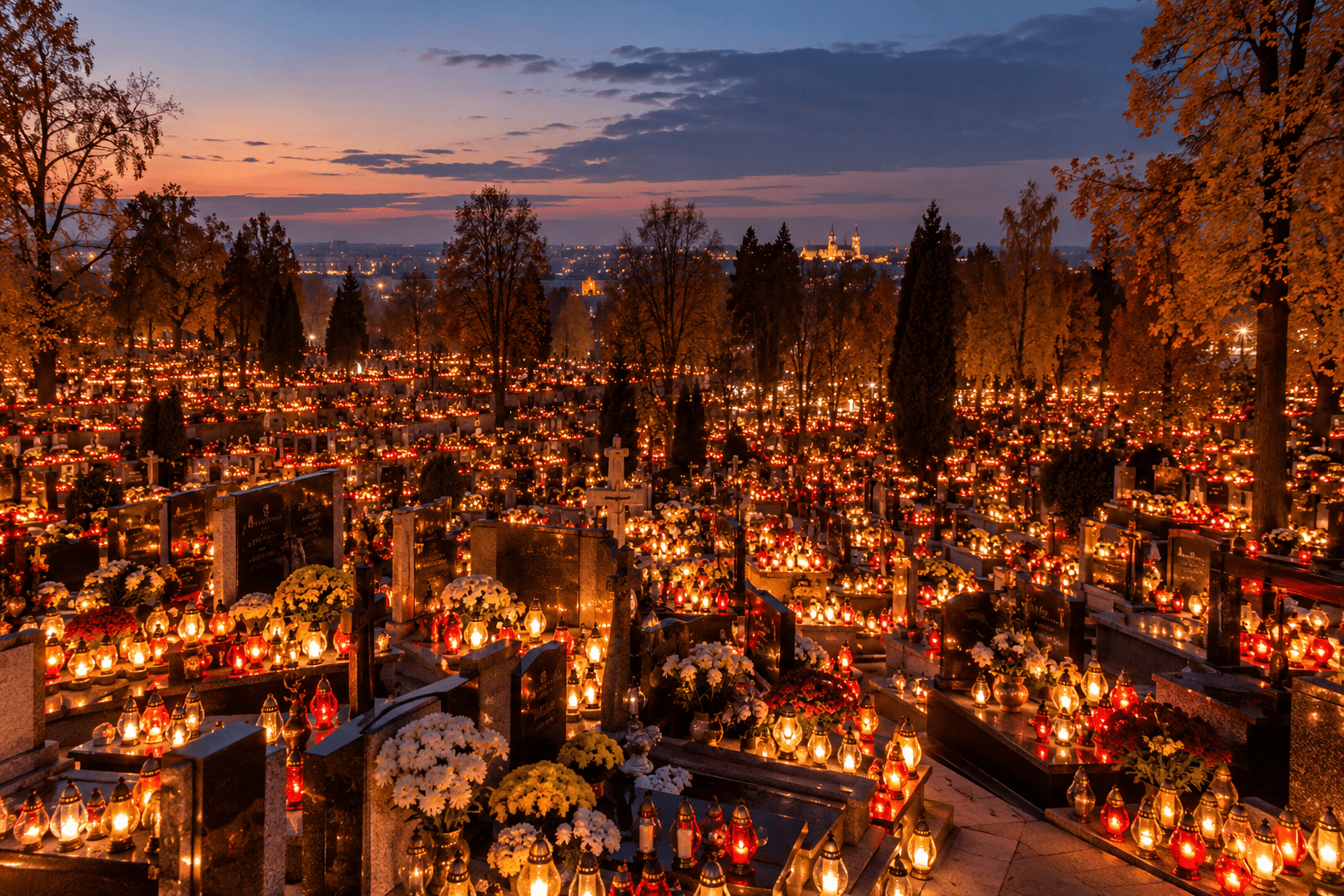
One candle becomes dozens. Dozens become hundreds. Across rows of graves, the small flames of red, white and amber znicze gradually join into broad fields of light, surrounded by chrysanthemums and late-autumn leaves.
For many families, the scene is inseparable from All Saints’ Day — Wszystkich Świętych — one of the most important dates in Poland’s annual calendar of remembrance.
- Find more news from Poland on our Homepage .
It is a Catholic feast and a statutory public holiday in Poland, but the custom of visiting cemeteries extends beyond regular churchgoers. Families travel to the places where parents, grandparents and earlier generations are buried, often combining prayer with a broader act of remembrance and family continuity.
The result, particularly after sunset, is one of the most visually striking traditions of the Polish autumn.
A family journey repeated each year
Preparations often begin before 1 November itself.
Graves are cleaned, leaves removed and decorations replaced. Temporary stalls appear outside cemeteries selling flowers and znicze — the characteristic memorial candles or lanterns placed on graves.
Chrysanthemums have become especially closely associated with the occasion. By the end of October they appear in large numbers outside cemetery gates, alongside candles in almost every imaginable size.
On the day itself, families may travel considerable distances to reach ancestral graves. The scale of the movement is large enough that cities routinely introduce additional public transport to major cemeteries and police prepare for unusually heavy road traffic.
Yet the central ritual is remarkably simple.
People gather at a grave, arrange flowers, light candles and remember somebody who is no longer there.
The candle is more than decoration. Its light has become one of the most recognisable symbols of remembrance in Poland — so recognisable that the Polish word znicz is closely associated with cemeteries and commemorative occasions.
The custom does not always stop with relatives.
Candles are also placed on neglected graves, unmarked graves and memorials to people whose families may no longer be able to visit them. Białystok University of Technology’s cultural guide describes lighting candles on forgotten graves as an established part of the tradition.
At historic cemeteries, the holiday can also become an occasion to protect the memory contained in the cemetery itself. Annual collections at places including Warsaw’s Stare Powązki raise money for the conservation of old tombs and monuments.
All Saints’ Day and Zaduszki are not the same day
The Polish customs of early November sometimes blur two separate observances.
All Saints’ Day falls on 1 November. In the Catholic calendar it celebrates all saints, known and unknown.
All Souls’ Day follows on 2 November. In Poland it is commonly known as Zaduszki and is specifically associated with prayer and remembrance for the dead.
The distinction matters, even though Polish family customs connect the two closely.
In practice, 1 November became the principal day for cemetery visits in part because it is the statutory holiday, while Zaduszki is not. Many families continue remembrance across both days.

Zaduszki also carries layers of older cultural history. Polish traditions surrounding the dead developed over centuries alongside Christian practice, while older Slavic and Baltic customs of remembering ancestors survived in folklore and literature.
Adam Mickiewicz famously drew on traditions surrounding Dziady — rites connected with the dead — in his dramatic cycle Forefathers’ Eve.
Modern cemetery visits, however, are not simply survivals of an ancient ritual. They are a living family custom shaped by Catholic observance, national history and personal memory.
When thousands of individual lights become one landscape
The scale is perhaps easiest to understand visually.
During All Saints’ Day in 2025, Associated Press photographs showed families gathering at cemeteries as graves filled with candles and chrysanthemums. Similar scenes appear from Warsaw to small villages: paths crowded during the afternoon, then cemeteries transformed by light after sunset.
The effect comes not from one organised display but from thousands of individual decisions.
One candle for a parent. Another for a grandparent. One for a friend. Sometimes another for a person whose grave might otherwise remain dark.
That is what makes the sight different from a festival illumination.
There is no central switch that lights a Polish cemetery on 1 November. The landscape appears gradually, grave by grave and family by family.
And when darkness finally settles over the cemetery, all those private acts of remembrance become visible together.