


Poland’s Border Guard says it has prevented every recorded attempt to cross illegally from Belarus in 2026, reporting a 100% success rate in its September figures. Prime Minister Donald Tusk has described the country’s eastern frontier as the best-protected border in the European Union, crediting upgraded defences, surveillance technology and the work of Polish security forces.
The figures mark a substantial change for a border that has faced years of migration pressure linked to Belarus and Russia.
In an official report published on 8 September, the Border Guard’s Podlaskie division, based in Podlaskie, the north-eastern region bordering Belarus, said it had recorded more than 410 attempted illegal crossings since the beginning of the year. Every recorded attempt had been prevented, it said, maintaining a 100% success rate.
- Find more news from Poland on our Homepage .
By 14 September, the number of recorded attempts had exceeded 440. Officers reported seven further attempts over the preceding weekend, with migrants retreating towards Belarus after encountering Polish patrols.
The results have reinforced the government’s argument that Poland has transformed one of the EU’s most challenging external frontiers into an exceptionally well-protected border.
Tusk declares Poland’s border the EU’s best protected
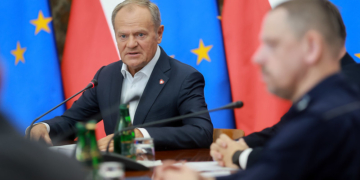
Prime Minister Donald Tusk made the claim during a meeting with Border Guard commanders in Otwock, near Warsaw, on 15 May.
He highlighted the contrast between 2023, when approximately 12,000 people were reported to have crossed illegally from Belarus, and the first three months of 2026, when authorities recorded no successful illegal crossings.
Speaking about the result, Tusk said:
“In the first quarter of 2026, not a single person managed to cross the Polish-Belarusian border illegally.”
He attributed the improvement to the combined work of the Border Guard, Polish military and police, supported by extensive infrastructure investment and changes to border-security legislation.
In the government’s official account of his remarks, Tusk described the country’s eastern frontier as the EU’s best-guarded border.
His description is a Polish government assessment rather than a position established by an independent EU-wide ranking. Nevertheless, the Border Guard’s reported prevention figures provide evidence of a substantial improvement in control over attempted crossings from Belarus.
From thousands of crossings to a reported 100% prevention rate
Poland’s border with Belarus became a major security challenge in 2021, when Belarusian authorities were accused of facilitating the movement of migrants towards Poland, Lithuania and Latvia.
The European Commission has also identified Russia and Belarus as using migration to exert political pressure on the EU’s eastern member states.
In its assessment of threats to the EU’s external borders, the Commission described the instrumentalisation of migrants, meaning the use of migrants as a political weapon, as a deliberate attempt to destabilise European societies.
By 2023, the Polish government says, approximately 12,000 people had crossed illegally from Belarus.
That figure refers to people who entered Poland, rather than the total number of attempted crossings. It therefore measures something different from the Border Guard’s more recent figures on detected attempts.
The number of attempted crossings has also fallen dramatically.
According to the Podlaskie Border Guard, approximately 360 attempts were recorded between January and 12 August 2026, compared with more than 19,300 during the equivalent period in 2025.
That represents a reduction of approximately 98%.
In its August operational report, the force said every attempt recorded during 2026 had been prevented.


The figures relate to detected attempts in the Podlaskie Border Guard’s area of responsibility. They do not independently prove that no undetected crossing occurred anywhere along the frontier.
Poland invests billions in border security
The government attributes the improvement to a combination of physical barriers, electronic surveillance and the permanent presence of trained personnel.
Poland began constructing its border fence under the previous government led by Law and Justice (PiS), the nationalist-conservative opposition party, completing the main physical barrier in 2022. The current government has continued upgrading the system.
The border is now protected by a combination of fencing, cameras, sensors, observation towers and electronic detection systems, supported by Border Guard patrols, police and military personnel.
Interior Minister Marcin Kierwiński said in May that almost PLN 3 billion (roughly €700 million) had been invested in strengthening border security.
Poland has also introduced an anti-drone system and expanded electronic monitoring along sections where rivers form the international boundary.
The measures are designed not only to detect people attempting to cross but also to identify breaches quickly enough for patrols to intervene.
During a June visit by Irish Minister for Justice, Home Affairs and Migration Jim O’Callaghan, Polish authorities presented the border as an example of effective protection against organised migration pressure.
The Interior Ministry reported that no successful illegal crossings had been recorded up to 31 May, despite approximately 215 attempts during the year.
Border Guard continues to target smuggling networks
Although recorded crossing attempts have fallen, Polish authorities continue to investigate suspected migrant-smuggling operations.
On 8 October, the Border Guard announced the detention of three foreign nationals suspected of organising illegal crossings from Belarus into Poland.
The suspects, citizens of Uzbekistan, Moldova and Georgia, were accused of helping migrants cross the frontier unlawfully.
The arrests demonstrate that enforcement operations continue even as the number of attempted crossings has declined.
Poland also maintains a restricted buffer zone along parts of the Belarusian border and temporary restrictions on applications for international protection, subject to specified exceptions.
Those measures have attracted criticism from human rights organisations.
The Commissioner for Human Rights of the Council of Europe, a human-rights body separate from the EU, has raised concerns about Poland’s asylum and removal procedures, particularly whether individuals receive adequate assessments of their protection needs.
Polish authorities maintain that enhanced border controls are necessary to counter the deliberate use of migration by Belarus and Russia.
A transformed border, but security measures remain
For Poland, the reported prevention rate represents a striking improvement from the years when thousands of migrants crossed or attempted to cross the Belarusian frontier.
The Border Guard’s September reports indicate that every detected attempt in its Podlaskie sector during 2026 had been thwarted, while recorded attempts were running at a fraction of the previous year’s levels.
Tusk has gone further, presenting Poland’s eastern frontier as the EU’s best protected.
Although that ranking has not been independently established, the government’s account is supported by official figures showing far fewer attempts and a reported 100% prevention rate during the period covered.
Poland’s security services remain deployed along the border, with the government maintaining that continued investment and vigilance are essential to preserving those results.