

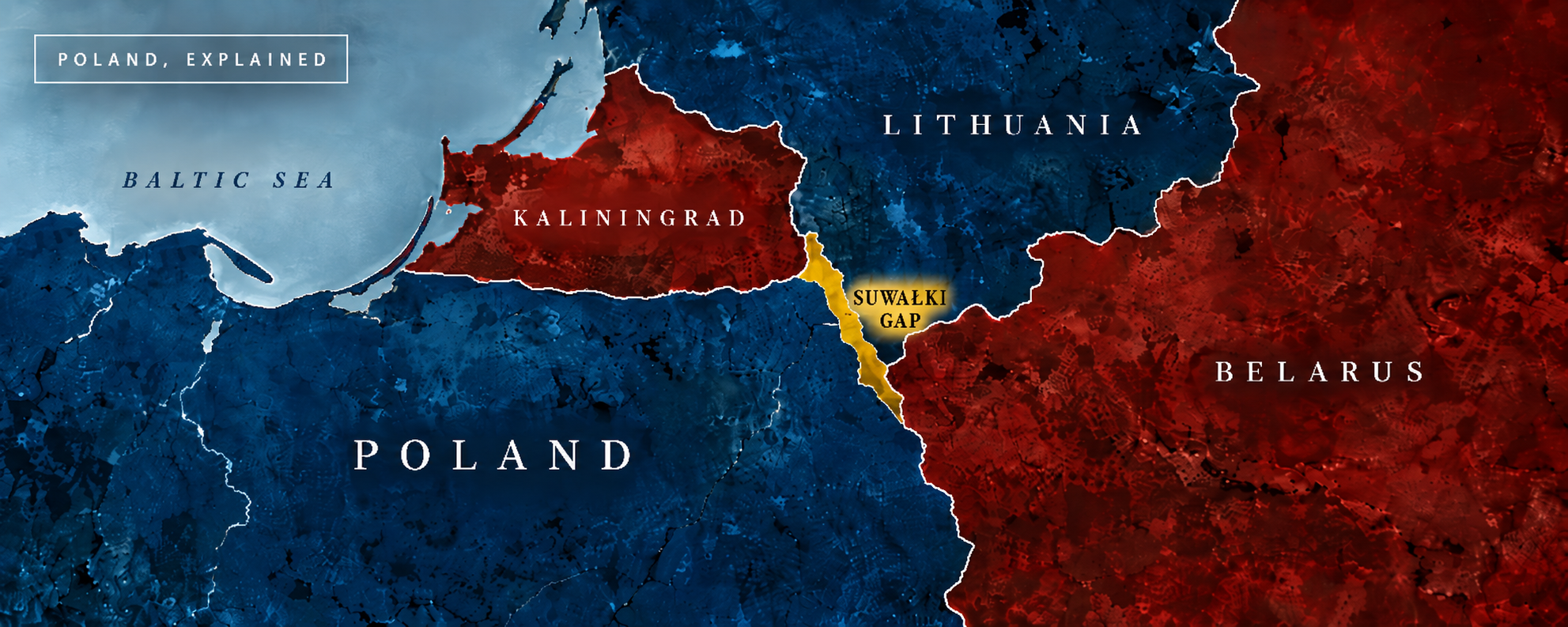
Look at a map of north-eastern Poland and the strategic problem becomes immediately apparent.
Poland meets Lithuania along a relatively narrow frontier. To the west is Kaliningrad, a heavily militarised Russian exclave on the Baltic Sea. To the east is Belarus, Russia’s closest military ally in the region.
Between them lies the territory commonly known in security discussions as the Suwałki Gap or Suwałki Corridor.
- Find more news from Poland on our Homepage .
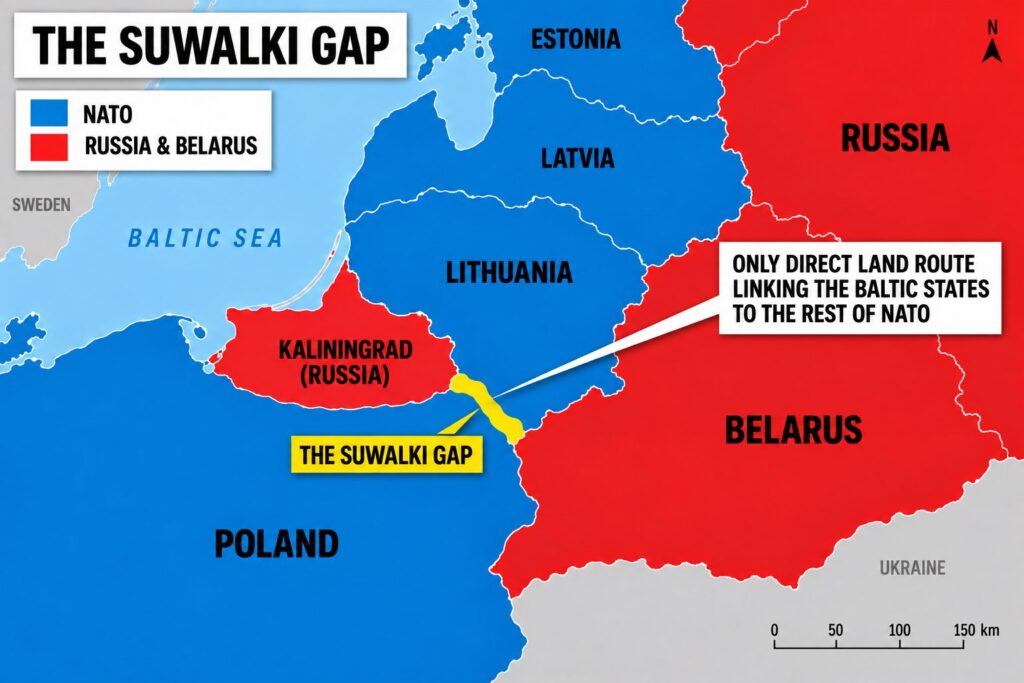
There is no official administrative region with that name, and there is no single universally agreed measurement of it. Military sources have defined the relevant corridor somewhat differently — from around 80 kilometres to roughly 60 miles, depending on what terrain is being considered. What matters strategically is not the precise number but the geography: this is the land route connecting Poland with Lithuania and, beyond it, Latvia and Estonia.
That makes it important to both NATO reinforcement and the defence of the Baltic states.
Why is it strategically important?
Estonia, Latvia and Lithuania are all NATO and EU members.
But if military equipment, personnel or supplies are moving overland from Poland into the Baltic states, they must pass through this general area.
A NATO Defense College publication described the corridor as the Baltic states’ only land connection with NATO members farther west and south. If that connection were unavailable during a conflict, reinforcement would have to rely much more heavily on air and maritime routes.
This is why the Suwałki Gap appears so frequently in NATO exercises, military planning and discussions about deterrence.
It is less useful, however, to imagine the Gap as a single motorway or narrow strip that could simply be “closed”.
It is a wider military problem involving roads, railways, terrain, air defence, logistics, communications and the ability to move forces quickly across Polish and Lithuanian territory.
US Army exercises in the region have, for example, tested the movement of armoured forces through Poland and Lithuania using both road and rail infrastructure — illustrating that reinforcement is as much a logistical challenge as a question of geography.
Why Kaliningrad matters
Kaliningrad is Russian territory separated geographically from the main body of Russia.
It lies on the Baltic coast between Poland and Lithuania.
Its location means that Russian territory sits immediately to the west of the Suwałki region, while Belarus lies to the east.
That configuration is the reason military planners have historically paid so much attention to the corridor: in a hypothetical NATO-Russia conflict, forces operating from Kaliningrad and Belarus would be positioned on opposite sides of the Polish-Lithuanian connection.
That does not mean such an operation is expected or inevitable. NATO’s strategy is built around deterring precisely that kind of attack.
The Alliance has repeatedly stated that its eastern-flank deployments are defensive and that an attack on one member would engage NATO’s collective-defence commitments.
NATO forces are already positioned nearby
The Suwałki Gap is not undefended territory.
NATO has maintained a multinational battlegroup in north-eastern Poland since 2017, created as part of the Alliance’s reinforced eastern presence following Russia’s annexation of Crimea in 2014.
Today the force in Poland is US-led, with contributions from Croatia, Romania and the United Kingdom. NATO also maintains multinational forces farther north, including in Lithuania, Latvia and Estonia.
The Polish battlegroup operates from the Bemowo Piskie Training Area, close to the Suwałki region.
In a January 2026 presentation on NATO’s presence in Poland, the Alliance explicitly described these forces as standing guard over the Suwałki Gap. It said the battlegroup trains to enable rapid reinforcement and can expand with thousands of additional troops towards brigade strength if required.
That distinction is important.
The troops already present are part of a wider system designed not simply to fight alone, but to ensure that any attack would immediately involve forces from multiple NATO members and trigger much larger reinforcement plans.
Poland is fortifying its eastern approaches
The Suwałki region also sits within a much larger transformation of Poland’s eastern defences.
In 2024, the Polish government launched Tarcza Wschód — East Shield, a programme intended to strengthen roughly 700 kilometres of Poland’s eastern and north-eastern frontier with Belarus and Russia.
The programme was initially allocated around PLN 10 billion and covers far more than conventional fortifications. Government plans include detection and warning systems, logistics hubs, protected positions, infrastructure for anti-drone systems and preparations intended to make terrain more difficult for an attacking force to cross.
Poland is also directing part of its large allocation from the EU’s SAFE defence financing instrument towards East Shield and other military infrastructure.
Lithuania is strengthening its side of the region as well. In January 2026, the Lithuanian and Polish defence ministers discussed cooperation over Lithuania’s planned Kapčiamiestis training area, which the Lithuanian defence ministry explicitly described as being located in the Suwałki Gap and important to the defence of both countries and NATO.
Finland and Sweden changed the map
This is the part that older explanations of the Suwałki Gap can miss.
When much of the modern discussion about the corridor developed after Russia’s annexation of Crimea, Finland and Sweden were not NATO members.
Finland joined the Alliance in April 2023. Sweden followed in March 2024.
That did not make the Suwałki Gap irrelevant.
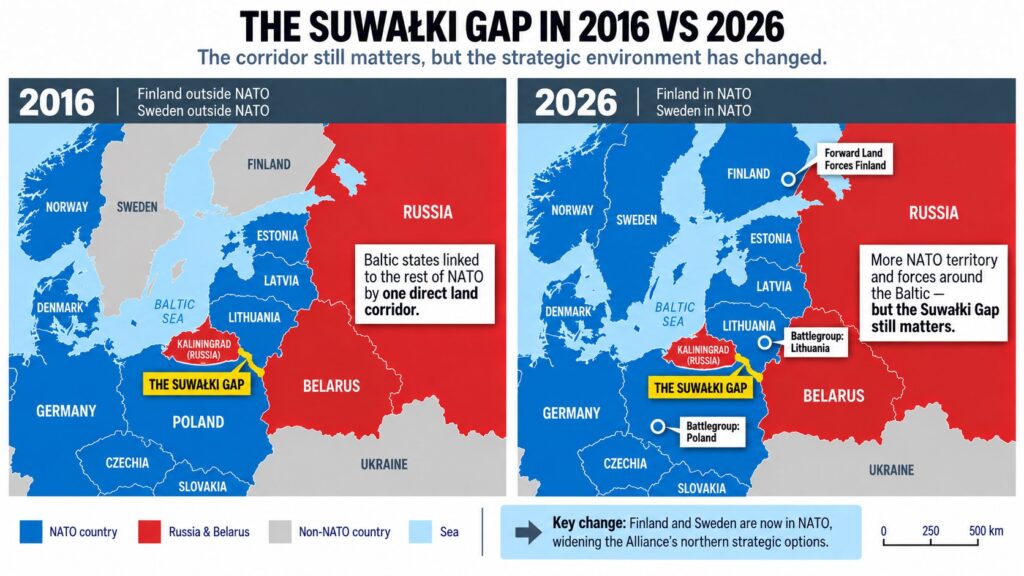
It did, however, make NATO’s northern geography considerably more favourable.
Sweden gives NATO territory and military access along the western side of the Baltic Sea, including the strategically important island of Gotland. Finland brought a long land border with Russia and considerable military capabilities into the Alliance.
NATO has itself said that the two countries’ accession changes the geography of Baltic defence and improves the Alliance’s ability to reinforce and protect the region.
That process has continued. In June 2026 NATO established a new multinational Forward Land Forces presence in Finland, led by Sweden, giving the Alliance nine multinational battlegroups along its eastern and northern flank.
So the modern strategic picture is more complicated than the familiar description of the Suwałki Gap as NATO’s single “Achilles heel”.
The land corridor remains extremely important — particularly for rapid ground reinforcement — but it now sits within a much wider network of Allied territory, Baltic maritime access, air power and northern reinforcement routes.
What is often misunderstood
The Suwałki Gap is not a physical gap in the landscape.
It is a strategic term used to describe the Polish-Lithuanian connection between Kaliningrad and Belarus.
It is not a single road.
Defending and reinforcing the region involves multiple roads, rail links, military positions, airspace and logistics networks.
The Baltic states would not automatically be isolated if the land route were disrupted.
NATO could also operate by sea and air, and Finland and Sweden’s accession has expanded the Alliance’s options considerably. But losing reliable ground access would still create a major military and logistical problem.
Its importance does not mean war there is considered inevitable.
Much of NATO’s activity around the corridor exists precisely to deter an adversary from believing it could exploit the geography successfully.
Why this matters
The Suwałki Gap demonstrates something fundamental about Poland’s role in European security.
Poland is not simply another country on NATO’s eastern flank.
Its territory is the land bridge between the core of the Alliance and the Baltic states.
That geography helps explain why Poland places such emphasis on military mobility, infrastructure, air defence, border fortification and maintaining substantial armed forces in the country’s east.
It also explains why apparently local developments in places such as Suwałki, Orzysz or the Polish-Lithuanian border can carry implications far beyond Poland.
NATO’s eastern flank has changed substantially since the term “Suwałki Gap” first entered mainstream security debate. Finland and Sweden are now Allies. NATO’s multinational deployments have expanded. Poland and Lithuania are investing heavily in their own defences.
But geography has not disappeared.
As long as Poland remains the principal direct land connection between the Baltic states and the rest of NATO to their south, the Suwałki Gap will remain one of the pieces of European geography military planners keep watching.
POLAND, EXPLAINED is published one week earlier on our X profile. Follow Poland-24 on X to read each new edition first.
🇵🇱 POLAND, EXPLAINED: Poland already hosts US troops. So what would a permanent “Fort Trump” actually change?
— Poland 24 🇵🇱 (@poland24com) September 27, 2026
We explain the difference between rotational and permanent forces — and why it matters. https://t.co/OmsCS5VJax