

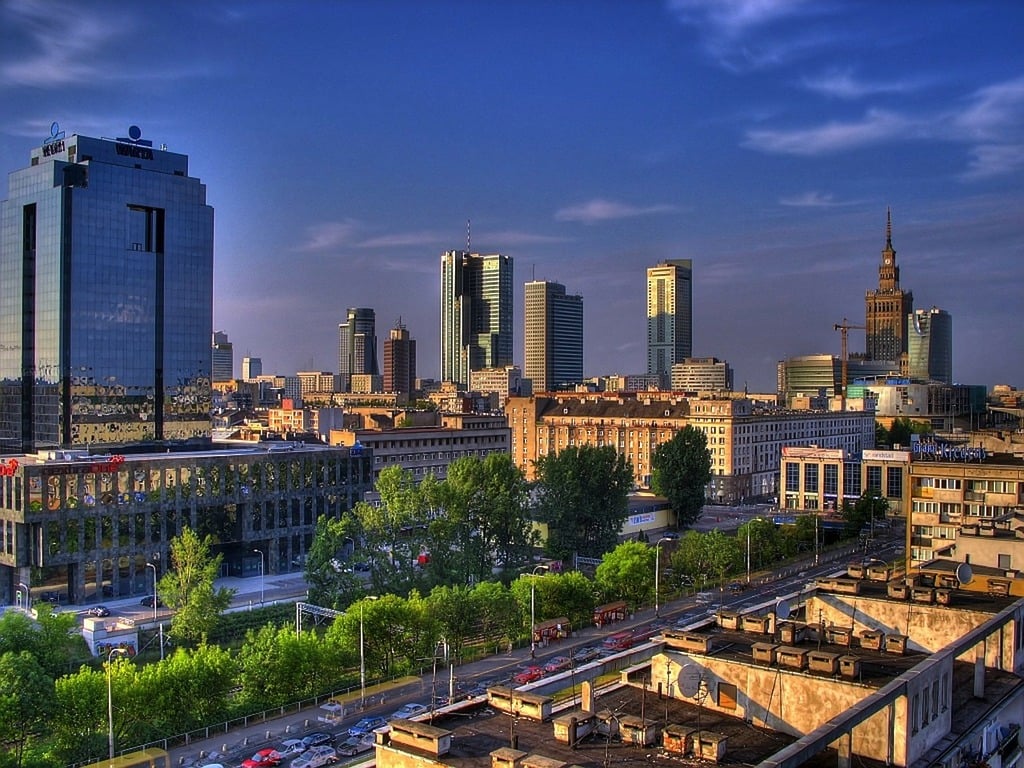
From a country burdened with billions of dollars in debt to one of Europe’s fastest‑growing economies, Poland’s transformation is being held up as a model by the head of the International Monetary Fund, who describes it as nothing less than a “Polish miracle.”
Speaking at a reception at the Polish Embassy in Washington marking the 40th anniversary of Poland’s return to the IMF and World Bank, IMF Managing Director Kristalina Georgieva said Poland has earned its place among the world’s leading economies and should use its new status in the Group of 20 to play a larger leadership role. She noted that Poland, now the 20th‑largest economy in the world by nominal gross domestic product, has come a long way since rejoining the Fund in 1986, when it carried $31 billion in debt.
Georgieva said Poland’s path since the mid‑1980s has become a reference point inside the IMF when persuading other countries to undertake painful reforms. According to her, Poland’s income per capita has risen from about 40 percent to 80 percent of the European Union average, while income inequality has declined even as the economy expanded. That combination of robust growth and falling inequality is rare and one reason, she said, the IMF frequently invokes “the Polish experience” in talks with other governments.
- Find more news from Poland on our Homepage .
The IMF chief said she recently cited Poland’s record in a conversation with Argentinian President Javier Milei, arguing that so‑called shock therapy can succeed if there is enough political will to see it through. She framed Poland’s transition as evidence that deep structural reforms, though socially and politically difficult, can deliver long‑term gains when they are sustained and paired with broader economic opening.
Georgieva also pushed back on the notion that Poland’s reliance on coal has made it an obstacle to international climate policy. She said data show that as Poland’s economy has grown, its carbon dioxide emissions per unit of GDP have fallen sharply, challenging the narrative that Warsaw is sabotaging emissions‑reduction efforts because of its traditional dependence on coal. According to her, Poland’s trajectory suggests that economic growth and decarbonization can proceed together.
In her remarks, Georgieva highlighted the significance of Poland’s arrival at the G20 table, saying the country has “earned” its place in the group and should treat it as another opportunity to lead. Finance Minister and Economy Minister Andrzej Domański and central bank governor Adam Glapiński are expected to participate Thursday in a formal G20 meeting of finance ministers and central bank heads in Washington, held alongside the spring meetings of the IMF and World Bank. It will be the first such gathering at that level under the U.S. presidency of the G20.
Georgieva opened her speech with a personal anecdote from her first visit to Poland in 1980, when she arrived as a young academic from Bulgaria. She recalled that her Polish hosts, faced with empty store shelves, solved the problem of how to entertain foreign guests in a uniquely Polish way: they offered her a driving lesson. It was in Poland, she said, behind the wheel of a small Polski Fiat, that she first learned how to drive.
That memory, contrasted with Poland’s current position as a mid‑sized European power with global economic clout, framed Georgieva’s broader message: in four decades, the country has moved from scarcity and debt to prosperity and influence. As Polish officials prepare to sit alongside the world’s largest economies in the G20, the IMF chief suggested that Poland’s story is no longer just about post‑communist transition. It is increasingly about how a once‑indebted state in Central Europe turned itself into a case study in successful reform – and a voice in the room where global economic decisions are made.