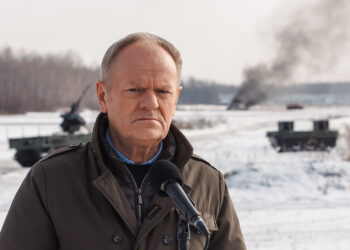

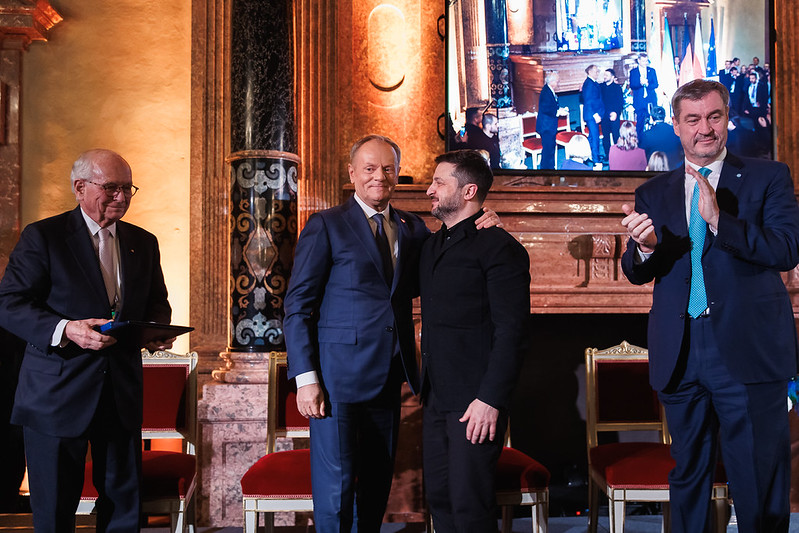
Polish Prime Minister Donald Tusk used a keynote appearance at the Munich Security Conference to deliver an emotional tribute to Ukrainian President Volodymyr Zelensky and the people of Ukraine, telling them “we are grateful to you” for holding the line against Russia’s war.
Tusk spoke in Munich on Feb. 14 as he presented the Ewald von Kleist Award to Zelensky on behalf of the influential security conference, framing Ukraine’s struggle as a fight not only for its own survival but for the security and moral order of the entire democratic world. He said Ukrainians are “paying the highest price” for their resistance against an aggressor who threatens Europe as a whole and insisted that their sacrifice demands sustained support from allies.
Calling the Ukrainian people a nation that “deserves the highest respect of the free world,” Tusk praised what he described as their extraordinary courage and resilience in the face of “inhuman suffering,” including the abduction of thousands of Ukrainian children by Russia. He said Ukraine’s determination confounded early predictions that it could not withstand a larger and better-armed enemy, arguing that moral clarity and resolve had offset Moscow’s advantages in manpower and hardware.
The Ewald von Kleist Award, named after the founder of the Munich Security Conference, is given to individuals and institutions seen as defending peace and international security; this year’s decision to honor Zelensky was meant to underscore Ukraine’s central role in the European security architecture since Russia’s full-scale invasion began in 2022. By asking a Polish prime minister to deliver the laudation, organizers also highlighted Poland’s position as one of Kyiv’s closest frontline backers, providing military aid, political support and refuge to millions of Ukrainian civilians.
Tusk used that platform to anchor Ukraine’s battle in a broader narrative about the defense of democratic values, saying the war is a test of whether concepts such as dignity, decency and a rules-based order still carry real meaning in global politics. Those principles, he argued, are not “historical artifacts” but living commitments that require concrete action, from supplying weapons and air defenses to sustaining political unity in the face of fatigue and domestic pressures in Western capitals.
The Polish leader cast the conflict as a moral and strategic dividing line between those who can distinguish truth from lies and those willing to accept a world shaped by brute force. He warned that allowing Russia to prevail would embolden other authoritarian actors, undermine international justice mechanisms and erode the security guarantees smaller states rely on to deter aggression. In that context, he suggested, Ukraine’s trenches, cities and air defense crews have become the front line for Europe’s own freedom.
Although the laudation focused on Ukraine, it also served as an implicit message to European Union and NATO partners, some of whom have struggled to maintain consensus over long-term financing and weapons deliveries. Tusk’s remarks echoed fears voiced across the conference that delays in supplying ammunition and air defense systems could tip the battlefield in Russia’s favor, and that wavering political will in the West may prove as dangerous as any shortage of hardware.
By thanking Ukraine “in the name of the free world,” Tusk sought to invert narratives that portray Kyiv as a supplicant and instead depict it as a security provider whose resistance buys time for Europe to rearm and adapt. He stressed that Poland, with its own history of uprisings, occupations and struggles for sovereignty, sees Ukraine’s fight as part of a shared Central and Eastern European experience of resisting imperial domination from Moscow.
The speech also landed against a charged domestic backdrop in Poland, where debates over aid to Kyiv, relations with the European Union and the legacy of the previous nationalist government have sharpened political divides. Admirers online hailed Tusk as a “master of words and emotion” and welcomed the fact that a senior Polish leader had clearly articulated public gratitude to Ukraine, especially after earlier controversies over demands for Ukrainian “thankfulness” from some Polish officials.
Tusk’s remarks, which some commentators described as concise and free of empty rhetoric, framed Ukraine’s defense as a daily reminder of what is at stake for Europe’s own security and democratic norms. He closed by reinforcing that message of shared destiny, affirming support for a free and independent Ukraine and linking it explicitly to the vision of a strong, united Europe capable of defending itself and its values.