


Polish Prime Minister Donald Tusk issued an urgent appeal Thursday calling on all Polish citizens to leave Iran immediately and to abandon any planned trips there, citing a “very, very real” risk of a U.S. military strike and the outbreak of war that could make evacuation impossible.
Speaking at a news conference on a military training ground in Zielonka, near Warsaw, Tusk framed the warning as a matter of utmost seriousness, saying that once potential hostilities begin, the government may no longer be able to help citizens trapped in the region. The appeal came as U.S. forces continue a rapid build-up across the Middle East amid mounting speculation that Washington is preparing a large-scale operation against Iran.
“I would like to make all Polish women and men who are still in Iran aware, or God forbid are planning to travel to that country, and I say this also on behalf of Foreign Minister Sikorski,” Tusk said, noting he had spoken with the foreign minister before arriving at the range. “Please leave Iran immediately — all those who are still in Iran — and under no circumstances travel to that country.”
- Find more news from Poland on our Homepage .
The prime minister stressed he did not wish to sow panic, but said the public needed to understand the gravity of the situation. “I do not want to scare anyone with some possible turn of events, but we all know what I mean,” he said. “The possibility of a hot conflict is very, very real and in a few, a dozen or several dozen hours, the eventuality of evacuation will not be an option.”
Tusk urged Poles to treat his message with the utmost seriousness, citing past crises in which some citizens ignored official travel warnings. “We have bad experiences from the past,” he said. “Some people take these appeals and information lightly, therefore I want to underline once again — please immediately leave Iran or refrain from traveling to that country, because nobody will be able to guarantee evacuation capabilities in the event of a hot conflict.”
Poland’s Ministry of Foreign Affairs has also updated its own guidance, strongly advising against travel to Iran and warning those already in the country to exercise extreme caution. The ministry is urging people to avoid gatherings and protest sites, to register their stay in the Odyseusz consular system and to follow official updates from the ministry and Polish diplomatic missions.
The heightened Polish warnings mirror growing alarm among Western governments as military and political signals point to a possible clash between the United States and Iran. CBS had earlier reported that Washington was pulling some U.S. personnel out of the region, part of wider preparations that officials and analysts say could precede airstrikes on Iranian targets and potential retaliation against U.S. bases.
Military analysts cited by Italian-based monitoring portal ItaMilRadar say the concentration of American and Israeli forces around Iran now appears sufficient to sustain a full-scale operation lasting many weeks. The build-up includes advanced air assets and a significant naval presence, underscoring the scale of any potential campaign.
According to those assessments, the core of U.S. air power being deployed to the region consists of several types of cutting-edge aircraft. They include a detachment of air superiority fighters F-22 Raptor, around 36 multirole F-16 Fighting Falcon jets and 18 stealth F-35A Lightning II fighters that took off from Lakenheath air base in Britain and headed to Jordan.
At sea, U.S. naval activity in the Persian Gulf has also sharply increased. Defense-focused outlet TheWarZone, citing navy sources, reports that at least 12 surface vessels are currently in the area, forming the backbone of an expanded maritime presence close to Iran’s shores.
The main element of that presence is the Abraham Lincoln Carrier Strike Group, which is supported by seven Arleigh Burke–class destroyers and three Littoral Combat Ships. En route to the region is the newer aircraft carrier USS Gerald R. Ford with its own escort, adding another powerful platform to American forces massing near Iran.
Completing the picture are several nuclear-powered submarines whose precise locations and numbers remain classified, in line with standard U.S. Navy procedures. Their deployment would give Washington additional strike and intelligence capabilities while increasing pressure on Tehran.
The military moves have unfolded against an increasingly confrontational political backdrop. In recent weeks, U.S. President Donald Trump has repeatedly threatened Iran with military action, while Iranian officials have vowed to target American bases across the Middle East if an attack occurs. In comments to reporters last Friday, Trump said that “the best solution” would be a change of regime in Tehran, a remark that Tehran has condemned as open interference in its internal affairs.
Against that background, Tusk’s plea to Polish citizens fits into broader efforts by European governments to reduce the number of their nationals exposed to potential conflict zones before fighting starts. For Warsaw, the immediate concern is to ensure there are as few Poles as possible in Iran should the crisis tip into open warfare.
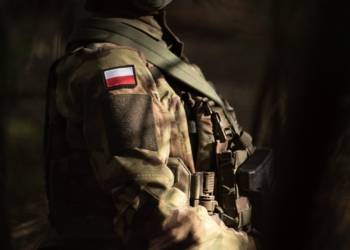
By delivering his message from a snowy training ground, with combat vehicles visible behind him, Tusk underscored the security-focused nature of his appeal and the military context of the warning. The prime minister made clear that while Poland is not a party to the confrontation, its citizens could be directly at risk if the situation escalates and borders close or airspace is shut down.
Officials in Warsaw say their ability to mount emergency evacuations from a war zone would be constrained by both security conditions and coordination with allies. That is why, they argue, the safest option is for Polish nationals to leave Iran now, before any potential U.S. strike or Iranian response.
As tensions remain high, Polish authorities continue to monitor developments in the United States and the wider region, while reiterating their calls for de-escalation and diplomatic solutions. For those still in Iran, however, the government’s message Thursday was unambiguous: go home while there is still time.