

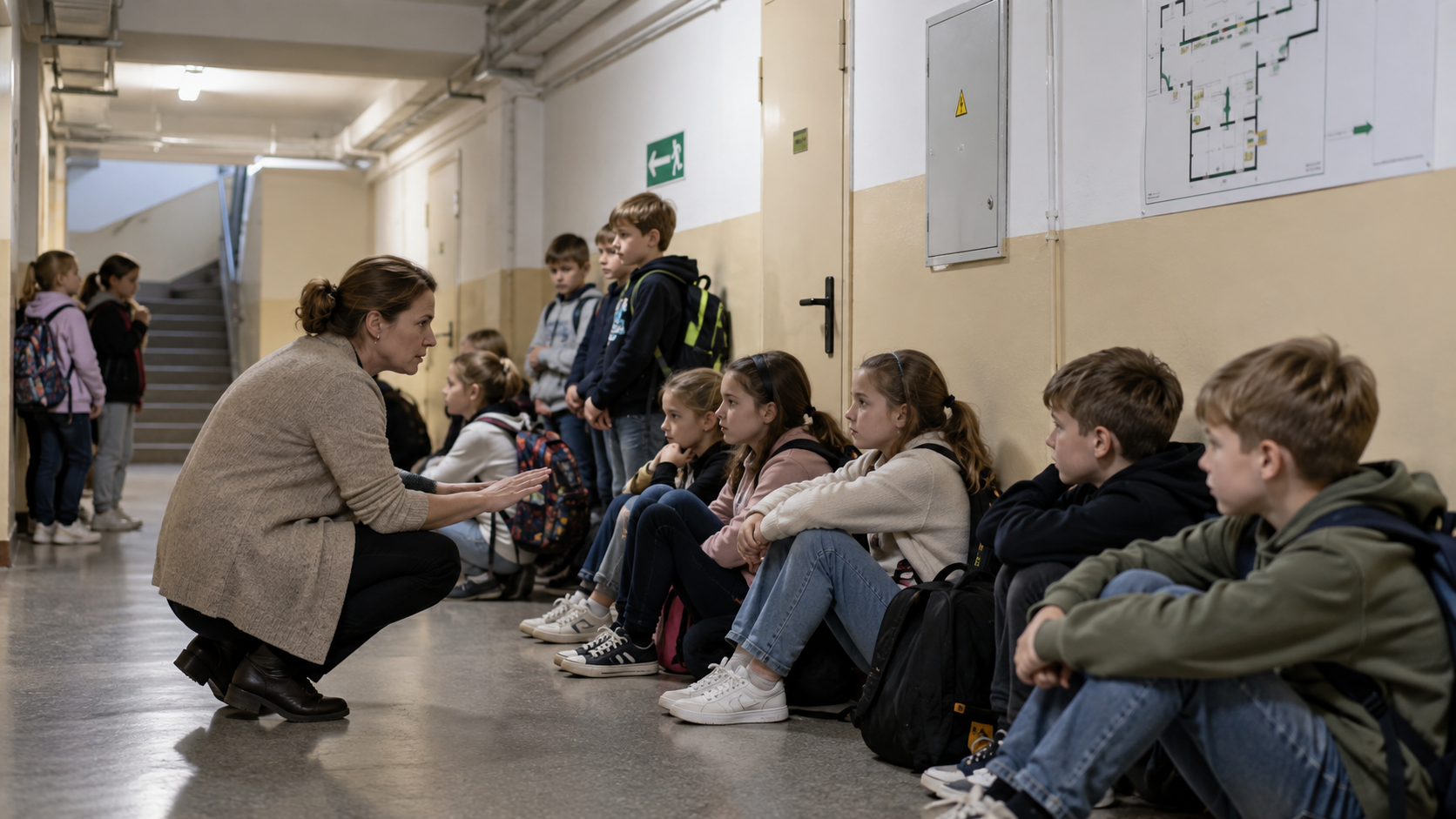
Poland has completed new emergency guidance for schools on how to respond to air-attack warnings and other security threats, after recent alerts near the Ukrainian border exposed weaknesses in evacuation procedures at some institutions.
Deputy Interior Minister Magdalena Roguska said the document had been prepared by experts from the State Fire Service together with specialists working in education and would shortly be distributed to schools across the country.
The guidance is intended to help headteachers and staff prepare buildings, procedures and drills for situations in which pupils and employees may need to move rapidly to safer areas.
- Find more news from Poland on our Homepage .
It follows an air-threat alert issued on 17 September to residents of the Lubelskie and Podkarpackie regions, when the Government Security Centre instructed people to find a safe place and follow the directions of emergency services.
During that alert, schools adopted different responses.
Many moved pupils to basements, lower floors, cloakrooms or internal corridors away from windows. But officials later acknowledged that procedures at some schools had not worked correctly, including cases in which pupils were taken outside during an air-threat warning.
Government says schools need practised routines
Interior Minister Marcin Kierwiński said earlier this week that authorities had reviewed how schools responded to the September alert and concluded that clearer common guidance was needed.
“In crisis situations, when they happen, there is no time to think,” Kierwiński said, arguing that correct responses needed to become practised habits.
He said around 90% of schools in Lubelskie had responded correctly, while acknowledging shortcomings at some institutions.
Schools also differ considerably in their physical layout and their pupils’ needs.
Some have basements or suitable internal areas, while others do not. Some must also plan for children with limited mobility or other additional needs.
Kierwiński said the new document was therefore intended to create a common framework while still allowing individual schools to adapt their plans to their buildings and pupils.
New guidance already completed
By Thursday, officials said the school guidance itself had been completed.
Roguska said it would be passed through Poland’s voivodes to local governments, which run most state schools, as well as being provided to the Ministry of National Education.
She said the material was designed to guide school directors and staff through both preparing facilities and establishing procedures for emergencies.
Schools are also expected to practise those procedures rather than rely only on written instructions.
Roguska said the guidance incorporates some of the same principles contained in Poland’s wider civil-defence advice, including moving towards lower floors, away from external walls and windows, while also containing additional provisions specific to educational institutions.
The ministry has not yet publicly released the complete school-specific document in the sources reviewed by Poland-24, so the full list of procedures has not yet been independently examined.
Shelter may be safer than going outside
The broader air-attack guidance already being distributed by the Interior Ministry provides a clearer indication of the principles schools are likely to apply.
The official guidance says that if a person cannot safely reach a designated shelter during an alarm, they should remain inside a structurally sound building and move to a central room without windows, away from external walls.

In public buildings, including schools, people should favour rooms close to the centre of the structure, preferably on lower floors and with little or no glazing.
The guidance also warns against trying to reach a distant shelter if doing so would require spending a long time outside during an active alert.
That distinction is significant because an evacuation during a fire normally means leaving a building, while an air-attack warning may instead require pupils to shelter inside the building in a more protected location.
The correct response therefore depends on the type of threat.
Russia’s attacks changing Polish civil-defence routines
The new school procedures come as Poland expands civil-defence preparations following repeated Russian missile and drone attacks on western Ukraine.
On 17 September, the Government Security Centre issued a direct air-threat warning to Lubelskie and Podkarpackie telling residents to find a safe place.
Polish authorities have also repeatedly issued precautionary alerts during large Russian attacks on Ukraine and deployed Polish military aircraft when there is a risk that missiles or drones could approach Polish airspace.
The Interior Ministry says the growing scale of Russian air attacks close to the Polish border has increased the risk of an unidentified or hostile object entering Polish airspace.
Authorities have responded with a wider programme of civil-defence education.
Training sessions in Lubelskie and Podkarpackie have taught residents how to respond to air-threat alerts, how to identify safe rooms and shelters and how to use the government’s shelter-location tools. Similar exercises are being extended to other regions.
Guidance, not a new law
The school document is an operational safety guide rather than a new piece of legislation.
That means there is no separate legal commencement date comparable with a statute or regulation.
Officials said the completed material would be passed immediately through voivodes and local governments to schools.
The practical next step will be for individual schools to incorporate the instructions into their emergency plans and conduct exercises with staff and pupils.
For Poland, the change illustrates how the war across the border is increasingly influencing everyday institutions far from the battlefield.
Air-defence alerts are no longer only a military issue: they are becoming something Polish schools are expected to prepare for as part of routine civil protection.