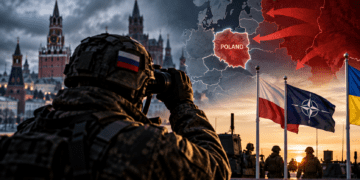


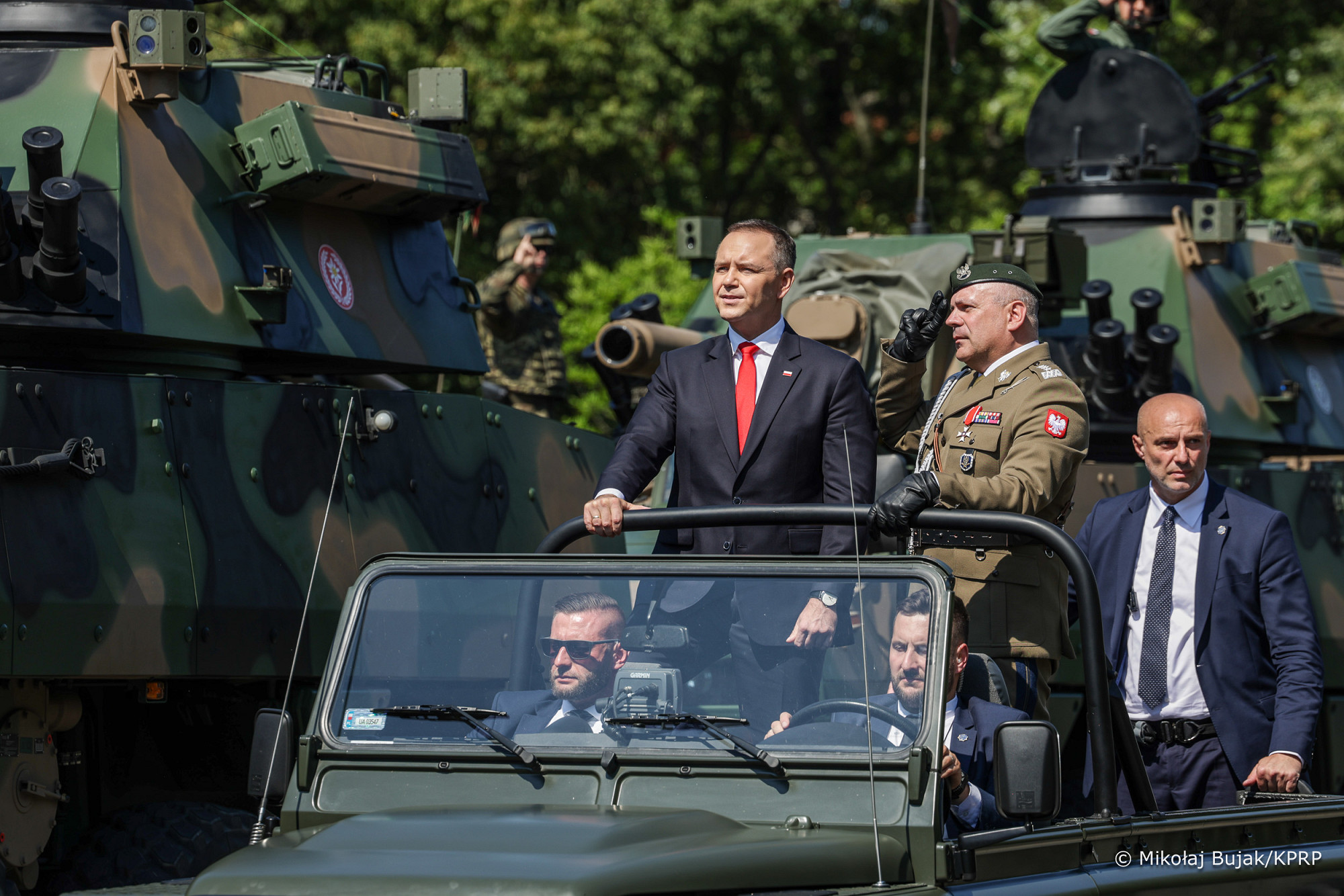
President Karol Nawrocki has called for Poland to seek a nuclear deterrent, arguing that the country must bolster its defenses in the face of what he described as an “aggressive, imperial Russia.”
In an interview broadcast Sunday by private television station Polsat News, Nawrocki said he is “a huge advocate of Poland joining a nuclear project,” framing such a step as a logical extension of efforts to strengthen national security along NATO’s eastern flank. He stopped short of specifying whether he favored participation in a NATO-style nuclear sharing arrangement or the development of a national program, but made clear he wants Warsaw to move decisively in that direction.
“The path to Polish nuclear potential, while respecting all international regulations, is the path we should take,” Nawrocki said, adding that Poland should “start acting in this direction so that we can begin work.” He noted that Poland borders Ukraine, where Russia’s full-scale invasion is entering its fifth year, and said Moscow’s stance toward Warsaw leaves little room for complacency.
- Find more news from Poland on our Homepage .
“We are a country right on the border of an armed conflict,” the president said. “It is clear what the aggressive, imperial Russia’s attitude toward Poland is.” He added that while Russia “can react aggressively to anything,” the priority for Polish authorities must be to ensure that Poles “feel safe.”
Nawrocki’s remarks came after German Chancellor Friedrich Merz disclosed at the Munich Security Conference that he had begun confidential talks with French President Emmanuel Macron on European nuclear deterrence. Asked whether Poland should seek protection under a broader European nuclear umbrella or pursue its own options, Nawrocki framed the issue in terms of building long-term strategic capabilities rather than choosing a single concrete model now.
The president’s comments mark the latest escalation in a debate that has simmered in Poland since Russia launched its full-scale invasion of Ukraine in 2022. That year, then-President Andrzej Duda said Poland was open to hosting nuclear weapons and had discussed the idea with the United States, signaling that Warsaw was ready to deepen its role in NATO’s deterrence posture.
Duda later reiterated that Poland “declared our readiness” to host nuclear weapons from NATO allies, remarks that prompted Moscow to say it was analyzing the situation and would take “all necessary steps” to ensure its own security. In 2025, he welcomed Macron’s proposal to extend France’s “nuclear umbrella” over European allies, seeing it as a way to strengthen Europe’s capacity to deter Russia and reduce strategic dependence on the United States.
Prime Minister Donald Tusk, however, has suggested going further. While backing close cooperation with allies, he has floated the idea that it might be better for Poland to develop “our own nuclear arsenal” rather than rely exclusively on the capabilities of other countries. His comments underscored an emerging consensus across much of Poland’s political spectrum that nuclear deterrence must at least be discussed, even as parties differ over the best path forward.
Nawrocki, who often clashes with the government led by Tusk and is aligned with the opposition, positioned his proposal as part of a broader effort to present a united front on national security. Despite political tensions on domestic issues, both the president and the prime minister have portrayed defense and deterrence as areas where partisan divisions should be set aside.
The broader security backdrop to Nawrocki’s remarks is one of steadily worsening relations between Warsaw and Moscow. Polish authorities say operatives working on behalf of Russia have carried out a campaign of so-called hybrid actions in and against Poland, including sabotage, cyberattacks and disinformation operations aimed at undermining public trust and destabilizing the country.
At the same time, the Kremlin has frequently accused Poland of harboring a hostile, “Russophobic” stance, and Russian officials have warned their citizens against traveling to the country. Recent polling in Russia has shown that a large majority of respondents now view Poland as an “enemy,” placing it among the states seen in Moscow as most hostile to Russian interests.
For now, Nawrocki’s intervention appears designed to inject urgency into discussions rather than to announce a concrete policy shift. The government has not yet commented on his latest remarks, and any move toward a Polish nuclear capability — whether through sharing, hosting or a national program — would require complex legal, political and technical decisions, as well as agreement with key NATO partners.
Still, the president’s call reflects a growing conviction in Warsaw that the strategic environment created by Russia’s war against Ukraine and its hostile posture toward NATO neighbors demands a rethink of Europe’s nuclear architecture. Whether that ultimately leads to deeper integration into allied nuclear planning, a European framework involving France or steps toward a more autonomous Polish role, Nawrocki signaled that, in his view, the debate can no longer be postponed.