

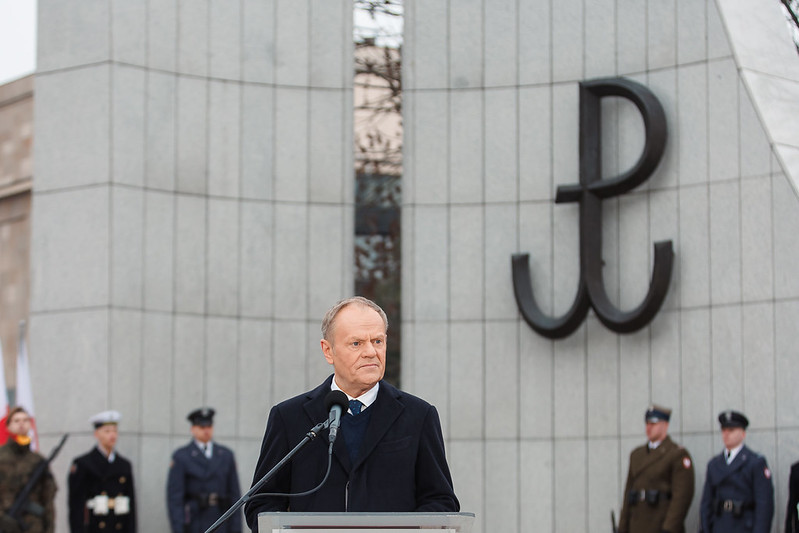
Prime Minister Donald Tusk on Saturday paid tribute to Home Army veterans in central Warsaw, saying their underground struggle during World War II carried a “deep and universal” meaning that still resonates in today’s battles for freedom and national sovereignty.
Speaking at an official remembrance ceremony marking the National Day of Remembrance of Home Army Soldiers, Tusk said that members of the wartime underground stood up for the “freedom and dignity of Poland” in some of the country’s darkest hours. The commemoration came as crowds marched through the capital in a “Defilada Szacunku,” or Parade of Respect, honoring the biggest resistance formation in occupied Europe and its fighters.
The march wound its way along Warsaw’s Royal Route before ending at the Monuments to the Polish Underground State and the Home Army, where state leaders, veterans and young people gathered for an evening roll call of remembrance and wreath-laying ceremony. It was the second time Poland has marked the newly established national holiday dedicated specifically to the Home Army, known by its Polish initials AK.
- Find more news from Poland on our Homepage .
In his speech, Tusk recalled that at its peak the Home Army counted nearly 380,000 soldiers and operated as one of the largest and best-organized underground armies in Nazi-occupied Europe. Despite chronic shortages of weapons and supplies, its officers and rank-and-file carried out sabotage, intelligence gathering and open combat operations in a bid to restore an independent Polish state, he said.
Quoting the underground’s first commander, Gen. Stefan “Grot” Rowecki, Tusk said the Home Army “did not fight for ideals detached from life” but rather “for the human being, for his right to freedom, to dignity, to truth and to his own homeland.” “These words sound extraordinarily current today,” the prime minister said, adding that they capture the moral core of the Home Army’s legacy and its relevance for contemporary security debates.
Tusk told the assembled veterans and dignitaries that he planned to repeat Rowecki’s words later Saturday before global leaders at the Munich Security Conference, underscoring that “the fight for dignity, for freedom, for one’s own homeland never ends.” He framed the Home Army’s experience as a warning and a lesson for today’s Europe amid ongoing threats to democracy and sovereignty.
The prime minister also paid homage to the enormous human cost borne by the underground movement, noting that around 100,000 Home Army soldiers were killed during the war. Yet, he stressed, the “spirit” of the formation outlived the conflict, as many veterans went on to join postwar independence organizations that resisted the imposition of Soviet-backed communist rule in Poland.
“The veterans we have the opportunity to meet are a living testimony of heroism and sacrifice,” Tusk said, calling their courage a model for future generations. Elderly former fighters, some decorated with wartime medals and supported by family members, were among those present at the roll call in front of the monument.
The ceremony drew the country’s top parliamentary officials and representatives of the president and defense ministry, underscoring the cross-party significance of the new day of remembrance. Among those attending were Sejm Speaker Włodzimierz Czarzasty, Senate Speaker Małgorzata Kidawa-Błońska, presidential representative Jan Józef Kasprzak and Deputy Defense Minister Cezary Tomczyk.
In a separate message posted on X, President Karol Nawrocki said Home Army soldiers “fought out of love for Poland” for the country’s independence and sovereignty. He reminded readers that on Feb. 14, 1942, the Union of Armed Struggle, the main resistance structure loyal to the Polish government-in-exile, was transformed by order of Gen. Władysław Sikorski into the Home Army, “the armed arm of the Polish Underground State and a symbol of fidelity to the Republic and an unbroken struggle for its freedom.”
Nawrocki noted that this year’s anniversary coincided with a ceremonial change of the national flag over the Presidential Palace in Warsaw, which he described as a “clear sign of state continuity and an expression of homage to the Home Army.” The symbolic gesture was meant to link today’s democratic institutions with the clandestine structures that operated under occupation more than eight decades ago.
Saturday’s commemorations were organized by the Office for War Veterans and Victims of Oppression in cooperation with the World Association of Home Army Soldiers, the city of Warsaw and the Jan Karski Institute of War Losses. Officials said the aim was not only to honor surviving veterans but also to educate the wider public about the scale and character of the underground state that functioned alongside the Home Army during the war.
The National Day of Remembrance of Home Army Soldiers was created by Poland’s parliament in 2025, following a proposal coordinated with veterans’ organizations and the veterans’ office. Lawmakers backed the measure by acclamation, signaling broad political support for singling out the Home Army within the country’s dense calendar of historical anniversaries.
In the preamble to the law, the Home Army is described as the “largest conspiratorial army in Europe conquered by Germany and Russia,” which, as the armed arm of the Polish Underground State, “conducted a heroic struggle to restore the sovereignty and independence of the Republic of Poland.” The text also notes that after World War II, many of its soldiers were persecuted by communist authorities subordinate to the Soviet Union.
The holiday is observed each year on Feb. 14, on the anniversary of Sikorski’s 1942 order formally establishing the Home Army as the successor to earlier underground structures known as the Service for Poland’s Victory and the Union of Armed Struggle. The Home Army operated as an integral part of the Polish Armed Forces, subordinate to the commander-in-chief and the Polish government-in-exile.
For Tusk and other leaders gathered in Warsaw, the day served as both a commemoration of sacrifice and a reminder that the values the Home Army fought for — national independence, human dignity and political truth — remain central to Poland’s security and identity today.